

India’s solar energy capacity has expanded nearly 62-fold over the past decade, rising from 2.82 GW in 2014 to approximately 175 GW as of October 31, 2026, as large-scale solar projects, rooftop installations and domestic manufacturing accelerate the country’s clean energy transition, according to a government report released by the Press Information Bureau (PIB).
India added 37 GW of solar capacity in 2025, surpassing the United States in annual additions and emerging as the world’s second-largest solar growth market. The expansion has been supported by policy initiatives, infrastructure development, competitive bidding and increasing participation from households and farmers.
The growth was highlighted during the Bharat Renewable Energy Summit & Expo (BRESE) 2026, held at Bharat Mandapam, New Delhi, from November 2–5 under the theme ‘Invest. Innovate. Inspire.’ The event brought together stakeholders from more than 130 countries and featured over 400 organisations, alongside discussions on renewable energy investment, technology and international cooperation.
Solar Capacity Additions Accelerate
India recorded its highest-ever annual solar capacity addition of 44.61 GW in FY2025-26, nearly doubling the 23.83 GW added in FY2024-25. During FY2026-27, the country had already added 24.29 GW of solar capacity, according to the report.
Solar module manufacturing capacity has also expanded significantly, increasing from 2.3 GW in 2014 to approximately 172 GW by March 2026 and reaching 192 GW by June 2026. India’s total non-fossil fuel installed capacity stood at 308.03 GW as of September 30, 2026, including 299.25 GW of renewable energy and 8.78 GW of nuclear power.
Renewable sources also met 51.5% of India’s electricity demand on July 29, 2025, marking the highest monthly share recorded to date.
Government Policies Support Solar Deployment
Several government initiatives have contributed to India’s solar expansion, including the National Solar Mission, Solar Parks Scheme, Green Energy Corridor Programme and competitive bidding mechanisms.
India’s renewable energy targets under the Panchamrit commitments include achieving 500 GW of non-fossil fuel capacity by 2030 and net-zero emissions by 2070. Renewable Purchase Obligations (RPOs) are also driving demand by requiring obligated entities to source a defined share of electricity from renewable energy. The RPO target for FY2026-27 has been set at 35.95%.
Schemes such as PM Surya Ghar: Muft Bijli Yojana and PM-KUSUM are extending solar adoption to residential consumers and farmers through rooftop installations, solar pumps and agricultural feeder solarisation.
The report also highlighted the role of competitive bidding in reducing solar tariffs. Solar power tariffs have declined from around ₹18 per unit in 2010 to a record-low ₹1.99 per unit discovered by Gujarat Urja Vikas Nigam Ltd. (GUVNL) in 2020. Utility-scale solar photovoltaic electricity in India had a levelised cost of electricity (LCOE) of approximately $35 per MWh in 2025, compared with the global average of $44 per MWh.
Solar Parks and Transmission Infrastructure Expand
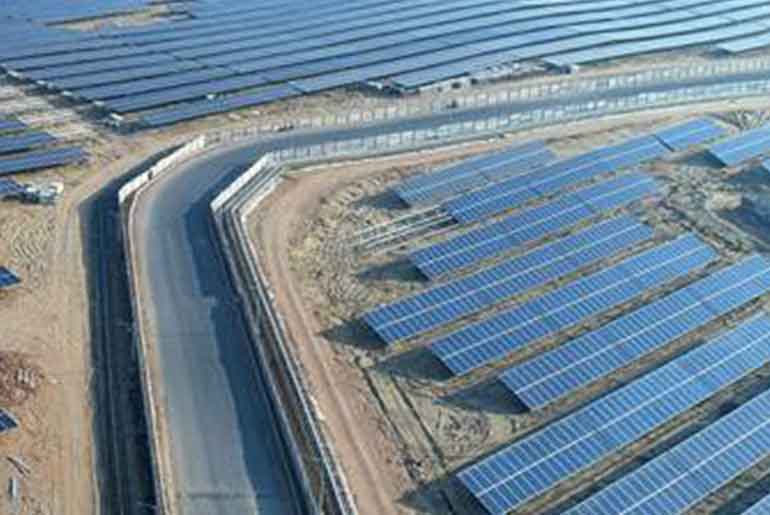
The Solar Parks Scheme has supported the development of large-scale solar projects by providing land and shared infrastructure. Initially launched with a 20 GW target, the scheme was expanded to 40 GW in 2017. By October 2026, 56 solar parks with a combined sanctioned capacity of 39,461 MW had been approved across India.
Major solar parks include Bhadla Solar Park in Rajasthan, Pavagada Solar Park in Karnataka, Ananthapuramu and Kurnool solar parks in Andhra Pradesh, and Rewa Ultra Mega Solar Park in Madhya Pradesh.
The Green Energy Corridor programme is strengthening transmission infrastructure to evacuate renewable power from resource-rich regions to demand centres. As of February 2026, the programme had enabled the evacuation of 24,567.8 MW of renewable energy, while transmission projects across 10 states are planned to support approximately 44 GW of renewable energy capacity.
Floating Solar and Storage Gain Policy Support
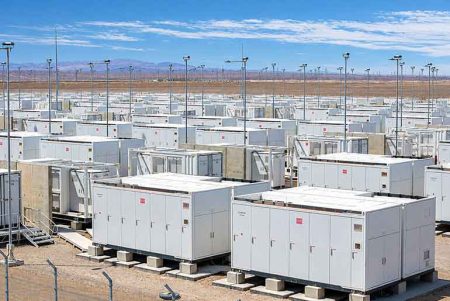
The government has also approved the Pradhan Mantri Surya Sarovar Yojana (PM-SSY), targeting 5,000 MW of floating solar photovoltaic projects with co-located energy storage systems. The scheme includes a minimum two-hour storage requirement, equivalent to 10,000 MWh, and carries an outlay of ₹5,070 crore for FY2026-27 to FY2030-31.
The initiative aims to utilise reservoirs and industrial water bodies for solar generation while reducing land requirements and improving grid reliability through energy storage. India’s estimated floating solar potential stands at 102.18 GWp, according to an assessment by the National Institute of Solar Energy (NISE).
The scheme is expected to reduce approximately 10 million tonnes of carbon dioxide emissions annually and generate 16,000–17,000 jobs. It will also support domestic manufacturing of floating structures, solar cells, modules and energy storage systems.
Rooftop Solar and Agricultural Adoption Rise
Distributed solar is becoming a major contributor to India’s capacity additions. During FY2025-26, rooftop solar and PM-KUSUM installations together added 16.3 GW, accounting for 36% of the year’s total solar capacity addition.
Under PM Surya Ghar: Muft Bijli Yojana, around 65 lakh households had installed rooftop solar systems as of November 2026, while more than 21 lakh households were reportedly receiving zero electricity bills. The scheme supports residential solar adoption through subsidies and financing assistance.
PM-KUSUM is supporting farmers through standalone solar pumps, decentralised solar plants and solarisation of grid-connected agricultural pumps. As of September 30, 2026, nearly 11.91 lakh off-grid solar pumps had been installed, while more than 17.18 lakh agricultural pumps had been covered through feeder-level solarisation. The scheme has also enabled the commissioning of around 2,426 MW of decentralised solar capacity on farmers’ land.
India Strengthens Global Solar Cooperation
India is expanding its international renewable energy engagement through platforms such as the International Solar Alliance (ISA) and the One Sun One World One Grid (OSOWOG) initiative.
The ISA, co-founded by India and France in 2015, promotes solar deployment, technology exchange and cooperation among member countries. Meanwhile, OSOWOG aims to develop interconnected electricity networks to facilitate cross-border renewable energy trade and strengthen energy security.
As solar manufacturing, deployment, transmission infrastructure and distributed energy programmes continue to expand, solar power is expected to remain a central pillar of India’s renewable energy growth and its long-term climate commitments.
 Electrify your feed! Click here to join our Whatsapp group and to get the latest updates, expert insights, and innovations driving India’s energy storage revolution.