

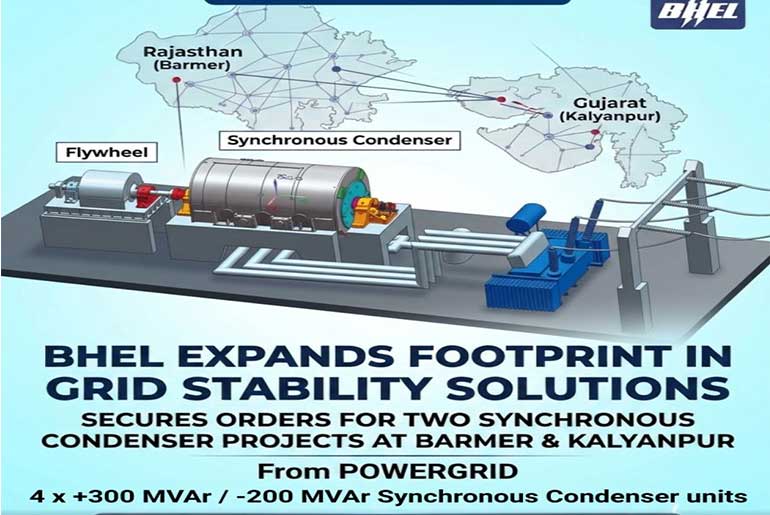
Bharat Heavy Electricals Limited (BHEL) has strengthened its presence in India’s grid stability solutions market after securing two orders from Power Grid Corporation of India Limited (POWERGRID) for the installation of four synchronous condensers across Rajasthan and Gujarat. The orders cover two units each at the Barmer-II HVDC Terminal Station in Rajasthan and Kalyanpur in Gujarat, marking an important step in BHEL’s expansion into the synchronous condenser segment.
The orders were received through separate Notifications of Award (NOAs) issued by POWERGRID on behalf of its project special purpose vehicles. BHEL disclosed the Barmer order on 7 November 2026, followed by the Kalyanpur order on 11 November 2026. Each project involves two synchronous condenser units rated at +300/-200 MVAr. The individual order values are estimated at ₹600 crore to ₹900 crore, excluding GST, according to the company’s stock-exchange disclosures.
Orders Cover Renewable Energy Transmission Infrastructure
The Kalyanpur project is associated with the transmission system for integrating electricity from renewable energy projects in Gujarat’s Jam Khambhaliya Renewable Energy Zone (REZ). BHEL will execute the project over 35 months.
The Barmer project involves installing two synchronous condensers at the Barmer-II HVDC Terminal Station, with an execution period of 44 months. The equipment is intended to provide reactive power support and strengthen grid stability at the HVDC transmission facility.
BHEL’s scope across both projects includes complete design, engineering, manufacturing, supply, erection, testing and commissioning of the synchronous condenser systems.
BHEL Advances Indigenous Synchronous Condenser Technology
According to BHEL, the orders mark an important step towards the development and deployment of its first indigenously designed synchronous condenser solution. The development reflects the company’s strategy to expand into emerging grid-support technologies while strengthening domestic design, engineering and manufacturing capabilities.
For these projects, BHEL will supply synchronous machines and auxiliaries, transformers and medium-voltage (MV) switchgear from its Bhopal plant. Control systems will be supplied by the company’s Electronics Division plant in Bengaluru.
Supporting Grid Stability Amid Renewable Expansion
Synchronous condensers are large rotating electrical machines that help maintain the stability and reliability of electricity networks. Unlike conventional power generators, they do not generate electricity for commercial supply. Instead, they provide or absorb reactive power to regulate grid voltage and support the transmission system.
These machines also contribute to short-circuit strength and physical inertia, helping the grid withstand disturbances and maintain stable operation. Their role is becoming increasingly important as solar and wind power account for a growing share of electricity generation.
Unlike conventional synchronous generators, inverter-based renewable energy systems do not inherently provide the same physical rotational inertia. Consequently, additional grid-support equipment is required to maintain voltage stability, system strength and reliability.
BHEL’s latest orders highlight the growing importance of specialised electrical equipment in India’s renewable energy transition. As new renewable energy zones are connected to the national transmission network, technologies such as synchronous condensers will play an increasingly important role in supporting reliable power evacuation and strengthening grid infrastructure.
 Electrify your feed! Click here to join our Whatsapp group and to get the latest updates, expert insights, and innovations driving India’s energy storage revolution.