
Close Menu
The Battery MagazineThe Battery Magazine
  • Just In
  • Batteries
    • Battery Manufacturing (BESS)
    • Battery Materials & Chemistries
    • Battery Recycling
    • C&I Storage
  • Solar
  • Renewable energy
    • Wind Energy
    • Hydropower
    • Green Hydrogen
    • Bioenergy
  • Tenders
    • Energy Storage
    • Solar Energy
    • Wind Energy
  • Policy
    • Storage
    • Solar
    • Wind
    • EV
    • Transmission
  • EV
    • EV Batteries
    • EV Charging Infrastructure
    • Electric Mobility Trends
  • Grid
    • Transmission & Distribution
    • Grid Infrastructure
    • Power Generation
    • Power Equipments
  • Exclusive
    • Cover Story
    • Watt Matters
    • Perspective
    • Articles
  • More
    • E-Mag
    • Events
    • Contact Us
Facebook LinkedIn WhatsApp
The Battery MagazineThe Battery Magazine
  • Just In
  • Batteries
    • Battery Manufacturing (BESS)
    • Battery Materials & Chemistries
    • Battery Recycling
    • C&I Storage
  • Solar
  • Renewable energy
    • Wind Energy
    • Hydropower
    • Green Hydrogen
    • Bioenergy
  • Tenders
    • Energy Storage
    • Solar Energy
    • Wind Energy
  • Policy
    • Storage
    • Solar
    • Wind
    • EV
    • Transmission
  • EV
    • EV Batteries
    • EV Charging Infrastructure
    • Electric Mobility Trends
  • Grid
    • Transmission & Distribution
    • Grid Infrastructure
    • Power Generation
    • Power Equipments
  • Exclusive
    • Cover Story
    • Watt Matters
    • Perspective
    • Articles
  • More
    • E-Mag
    • Events
    • Contact Us
LinkedIn Facebook WhatsApp YouTube
The Battery MagazineThe Battery Magazine
Home » Batteries » Chungnam Researchers Boost Zinc-Ion Battery Stability with New Coating
Batteries

Chungnam Researchers Boost Zinc-Ion Battery Stability with New Coating

PrakashBy PrakashAugust 14, 20253 Mins Read
Facebook Twitter LinkedIn WhatsApp
Chungnam National University researchers have developed a zinc-bonded polyacrylic acid layer that stabilizes zinc-ion battery anodes, enhancing safety, performance, and affordability.

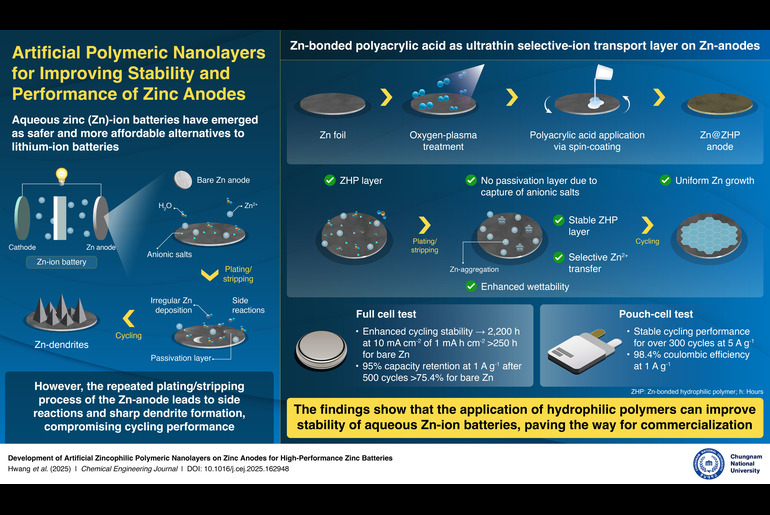
Chungnam National University Researchers have developed a new zinc-bonded polyacrylic acid (ZHP) layer that effectively prevents dendritic growth and stabilizes the anode in zinc-ion batteries. This innovation enhances cycling performance and stability, paving the way for safer and more affordable next-generation zinc-ion batteries.

Aqueous zinc-ion batteries (ZIBs) are gaining attention as a safer and more affordable alternative to lithium-ion batteries. Unfortunately, zinc anodes in ZIBs suffer from undesirable side reactions and sharp dendrite formation during charging and discharging, which impacts their cycling performance and stability. Previous attempts to use protective coatings were often too thick or difficult to manufacture, limiting their real-world use.

In a breakthrough, a research team led by Associate Professor Woo-Jin Song from the Department of Organic Materials Engineering at Chungnam National University, South Korea, designed a new ultra-thin selective-ion transport layers (SITL) that is both effective and easy to produce.

“In this study, we developed a nanoscale zinc-bonded polyacrylic acid (Zn–PAA) protective layer for zinc anodes via oxygen plasma treatment,” explains Dr. Song. “Unlike conventional thick and complex coatings, our approach offers a simpler fabrication process and is scalable for large-area applications.”

Their study was made available online on May 8, 2025, and published in Volume 515 of the Chemical Engineering Journal on July 1, 2025.

This new SITL is based on polyacrylic acid (PAA), which can prevent direct contact between the zinc anode and water-based electrolyte, inhibiting corrosion. This significantly reduces dendritic growth, stabilizing the anode interface. Thanks to its hydrophilicity, it also improves ion transfer between the electrolytes and the anode, promoting uniform distribution of zinc-ions and enhancing battery performance.

However, bare PAA tends to dissolve in water-based electrolytes, reducing cycling performance. To prevent this, the researchers applied oxygen plasma treatment to zinc-anode, which enhanced adhesion between PAA the layer and the anode surface. The PAA was deposited on the treated zinc-anode using the cost-effective and scalable spin-coating technique, resulting in a nanoscale PAA coating. The PAA-coated anode was then heated on a hot plate, forming the zinc-bonded PAA (ZHP) layer.

The ZHP coated zinc anode demonstrated remarkable performance. In full cells, it retained 95% of its capacity after 500 cycles. In pouch cells, the anode demonstrated stable cycling for over 300 cycles.

“The enhanced stability of water-based electrolytes makes ZHP based ZIBs ideal for safety-critical industries such as grid-scale energy-storage systems and detection sensors.” remarks Dr. Song. “And due to their low cost and toxicity, these batteries are also well-suited for portable electronics and wearables.”

whatsapp icon Electrify your feed! Click here to join our Whatsapp group and to get the latest updates, expert insights, and innovations driving India’s energy storage revolution.
lithium-ion batteries Zinc-Ion Battery
Prakash
  • Website
  • LinkedIn

I am a Junior Journalist with experience in researching, reporting, and creating engaging content across diverse topics and platforms. My work has strengthened my skills in communication, relationship building, and understanding people, while also honing my organisational and problem-solving abilities.

Keep Reading

NavPrakriti and IIT Kharagpur

NavPrakriti and IIT Kharagpur Partner to Advance Battery Recycling and Critical Mineral Recovery

Advait Energy Secures 150 MW/300 MWh BESS Project from GUVNL

Advait Energy Secures 150 MW/300 MWh BESS Project from GUVNL

SJVN Flags

SJVN Flags Renewable Power Demand Gap Amid Rising Capacity Additions

Comments are closed.

Renewable energy
PIP Partners with Fourier to Deploy Hydrogen-Powered Energy Storage System in Gujarat

PIP Partners with Fourier to Deploy Hydrogen-Powered Energy Storage System in Gujarat

June 4, 2026
IIT Guwahati

IIT Guwahati Develops Perovskite Technology Achieving 25.73% Solar Cell Efficiency

June 4, 2026
India’s Clean Energy Sector

India’s Clean Energy Workforce Grows by 6.6 Lakh, Rooftop Solar Leads Job Creation

June 4, 2026
SJVN Flags

SJVN Flags Renewable Power Demand Gap Amid Rising Capacity Additions

June 4, 2026
Batteries
NavPrakriti and IIT Kharagpur

NavPrakriti and IIT Kharagpur Partner to Advance Battery Recycling and Critical Mineral Recovery

June 4, 2026
Advait Energy Secures 150 MW/300 MWh BESS Project from GUVNL

Advait Energy Secures 150 MW/300 MWh BESS Project from GUVNL

June 4, 2026
cylib and Vianode

cylib and Vianode Partner to Advance Recycled Graphite for EV Batteries

June 4, 2026
Trina Storage

Trina Storage Wins 160 MWh Ultra-High Voltage Battery Project in Japan’s Kyushu Region

June 3, 2026

Subscribe for Updates

Get the latest news about energy storage in your inbox.

    © 2026 Thebatterymagazine.com.
    • Home
    • About Us
    • Contact Us
    • Privacy Policy
    • Terms of Service

    Type above and press Enter to search. Press Esc to cancel.