

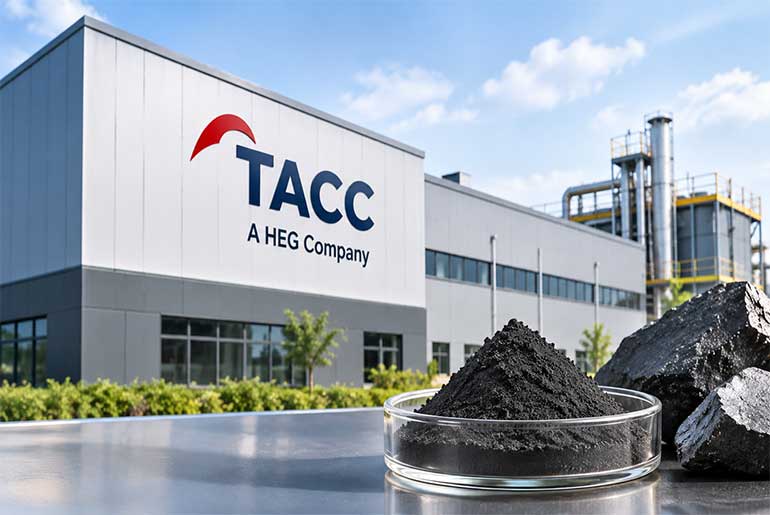
HEG Advanced Materials Limited’s wholly owned subsidiary, TACC Limited, has received approval for a ₹609.50 crore incentive under the Government of India’s Electronics Component Manufacturing Scheme (ECMS) for its synthetic graphite anode material manufacturing project in Dewas, Madhya Pradesh. The approval, granted by the Ministry of Electronics and Information Technology (MeitY), is expected to support the development of domestic manufacturing capabilities for a key material used in lithium-ion battery cells.
The incentive is linked to TACC’s project at the Sirsoda Industrial Area in Dewas and remains subject to the scheme’s guidelines and prescribed conditions. The facility, spread across more than 100 acres, is planned to achieve a committed scaled capacity of over 30,000 metric tonnes per annum (MTPA) by FY2028-29. Its first phase, with an annual manufacturing capacity of 20,000 MTPA, is targeted for commissioning by June 2027.
Strengthening India’s Battery Anode Manufacturing Ecosystem
Synthetic graphite is a key material used in the anode of lithium-ion battery cells. Anodes play an important role in battery performance, energy storage and charging characteristics. Establishing domestic manufacturing capacity for this material could help strengthen India’s battery supply chain and reduce dependence on imported anode materials.
The ECMS incentive approval represents a significant policy-backed development for TACC as it advances its plans to manufacture synthetic graphite anode materials for domestic and international cell manufacturers.
Riju Jhunjhunwala, Chairman, Managing Director and CEO of HEG Advanced Materials Limited, said, “We are grateful to the Government of India and the Ministry of Electronics and Information Technology for this support, and for their vision of building a strong electronics component manufacturing base in the country. The approval under ECMS is a strong endorsement of TACC’s technology and of our belief that India can build a globally competitive battery materials value chain at home. Anode material sits at the heart of every battery cell, and producing it at scale in India is central to a secure and resilient energy storage supply chain.”
Dewas Facility Targets First-Phase Commissioning by June 2027
The first phase of the Dewas facility is designed to produce 20,000 tonnes of anode active material annually. The company is targeting commissioning by June 2027, with plans to scale the facility’s committed capacity to more than 30,000 MTPA by FY2028-29.
Commenting on the development, Ankur Khaitan, Managing Director and CEO of TACC Limited, said, “The support under ECMS strengthens our ability to execute at scale. Our Dewas facility is designed to deliver high-performance synthetic graphite anode material that meets the standards of global cell manufacturers. Our focus now is on timely execution, consistent quality and close collaboration with customers to ensure supply reliability. We thank the Ministry of Electronics and Information Technology for its support.”
Expanding Advanced Materials Capabilities
TACC, part of the LNJ Bhilwara Group, is developing a portfolio of advanced carbon and graphite materials for energy storage and industrial applications. Alongside its anode active material manufacturing plans, the company is also advancing commercial graphene production, targeting a capacity of 500 tonnes per annum.
The incentive approval comes as India seeks to strengthen its domestic battery manufacturing ecosystem, covering not only cell production but also the materials and components required across the value chain. The development of local anode material manufacturing capacity could support battery producers, electric vehicle manufacturers and energy storage applications.
With its Dewas project, TACC is seeking to establish a larger presence in the battery materials segment, while the ECMS approval provides policy support for its manufacturing expansion. The project’s next milestone will be the execution and commissioning of its first 20,000 MTPA phase.
 Electrify your feed! Click here to join our Whatsapp group and to get the latest updates, expert insights, and innovations driving India’s energy storage revolution.