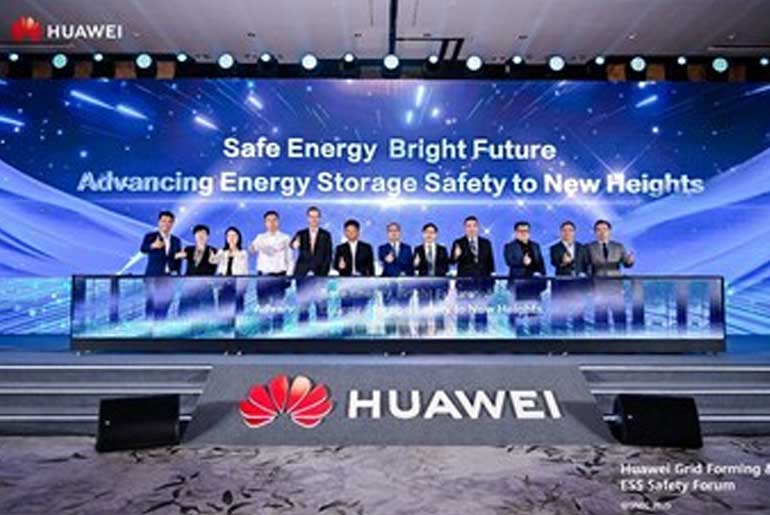
Huawei Digital Power hosted the Grid Forming & Energy Storage System (ESS) Safety Forum in Shanghai on June 12, 2025, inviting clients, associates, insurance providers, and certification bodies from the PV and ESS sectors to talk and exchange ideas about business procedures, ESS safety ecosystem development, and the advancements and uses of grid-forming technology. To take ESS safety to the next level, Huawei Digital Power, along with clients, partners, insurance providers, and certifying bodies, introduced the ESS Safety Initiative at the forum.
The introductory remarks were given by Huawei Digital Power’s President of the Smart PV & ESS Product Line, Steven Zhou. According to him, as the global energy transformation progresses, the ESS is providing both previously unheard-of possibilities and problems by facilitating the widespread integration of renewable energy sources into the grid and guaranteeing reliable grid operations. A grid-forming ESS has emerged as a cutting-edge and well-liked technology due to its exceptional grid-supporting capabilities. Furthermore, the industry’s continuous growth places ESS safety as its top priority. The latest FusionSolar 9.0 Smart PV+ESS solution from Huawei Digital Power promotes grid-forming technology from ESS to PV+ESS and across all scenarios, reaching complete applicability.
Maintaining grid stability requires strict adherence to safety regulations. Four safety requirements are put out by Huawei Digital Power: non-flammable, non-explosive, non-spreading, and non-harmful. The system’s dependability is increased by the cell-to-grid safety architecture. In order to encourage the adoption of safety standards and spur business model innovation, Huawei will keep coming up with new ideas and working with clients, partners, and trade associations. This will guarantee that everyone in the industry chain can take advantage of technological breakthroughs and secure a sustainable future.
Grid-Forming Business Strategies: Promoting Active Safety and Accelerating the Construction of New Power Systems
Robert Liew, APAC Research Director at Wood Mackenzie, and Patrick Zank, Business Development Manager at VDE, shared insights about how grid-forming technology can support renewable energy investments and ideas about how unified standards and market trust are essential to promoting its large-scale applications.
Billy Qiu, Technical Manager of Smart Energy at TÜV SÜD, and Vannsith Ith, Director of the Power Management Division at SchneiTec, discussed the first utility-scale ESS project in Cambodia. In compliance with PPP 58232, TÜV SÜD empirically tested Huawei’s grid-forming PV+ESS system’s capacity to construct a grid in Cambodia. The test findings show the growth of grid-forming initiatives in Southeast Asia and offer a strong basis for creating a robust and dependable smart grid.
According to Chen Danqing, CTO of Huawei Digital Power’s Grid-Forming ESS Business, the widespread commercial application of grid-forming technology faces four main technical obstacles: robust overload support, wideband oscillation damping, device safety and reliability, and multi-device parallel operation stability.
With extensive experience in the PV and ESS fields, particularly in grid-friendly and grid-forming technologies, Huawei Digital Power proposes the Smart String Grid-Forming ESS technology system. The technology system encompasses grid-forming capabilities across the entire power generation, transmission, distribution, and consumption process, redefining the core standards of grid-forming capabilities. Specifically, grid-forming ESS should possess grid-forming capabilities for all performance levels, under all grid conditions, and throughout the full lifecycle. It can provide deterministic and stable support for power systems, meeting the requirements of various business models in the future. Huawei’s Smart String Grid-Forming ESS has undergone rigorous empirical tests in projects in Qinghai and Xizang, and has been successfully applied in GW-level projects.
ESS Safety Ecosystem: Strengthening Safety to Sustain Industry Growth
Chen Weipeng, Regional Business President (Non-Life Insurance) of Munich Re Group, shared his insights on the theme of safeguarding ESS projects. Chen Xiong, General Manager of Electric Power and Electronic Products Service, TÜV Rheinland China pointed out that true system safety should encompass the entire lifecycle of the ESS.
Steve Zheng, President of Grid-Forming ESS Business, Huawei Digital Power, pointed out that ESSs have three typical characteristics: high density, high voltage, and high current. During the lifecycle, the electrochemical inconsistency, grid uncertainty, and insufficient digital management capabilities of ESSs may cause great safety risks.
To address these issues, Huawei Digital Power launches an innovative safety system that integrates the “Panshi” battery pack, two-stage string architecture, and smart health diagnosis to ensure the ESS’s safety throughout its lifecycle.
- The battery pack is designed as the minimum safety unit. Based on the mechanism of battery thermal runaway, it employs three-level insulation to prevent arcs, thermal propagation, and fire.
- This architecture effectively blocks current backfeed, maintains stable active power during high- and low-voltage ride-through, and enables rapid power grid recovery.
- The advanced digital management platform enhances visibility and control of safety. With smart cell-to-grid safety protection, it delivers fault warnings up to seven days in advance, identifies over 30 fault types, and provides uninterrupted real-time status monitoring.
Together with the international authoritative organization DNV, Huawei Digital Power successfully conducted an extreme ignition test on the Smart String Grid-Forming ESS, fully verifying its safety protection capability in extreme ignition scenarios. Additionally, during the forum, the nail penetration, water immersion, and thermal runaway tests were demonstrated at the Huawei Dongguan Grid-Forming ESS Comprehensive Lab. The test results effectively verified the safety performance of the system under the four safety standards of non-flammable, non-explosive, non-spreading, and non-harmful, as well as the three basic safety standards of grid-friendly, load-friendly, and environment-friendly. Huawei Digital Power will continue to provide PV+ESS solutions and work with the industry chain to achieve a sustainable and green future.
Huawei Digital Power, along with customers, partners, and organizations, launched the ESS Safety Initiative. The initiative aims to improve the ESS-dedicated fire suppression specifications, promote the global promotion and continuous iteration of ESS safety levels, establish ESS safety capabilities that can be visualized and managed throughout the lifecycle, and establish an ESS project risk assessment system throughout the process, thereby safeguarding the future of energy, building a safety foundation, and advancing ESS safety to new heights together.
 Electrify your feed! Click here to join our Whatsapp group and to get the latest updates, expert insights, and innovations driving India’s energy storage revolution.