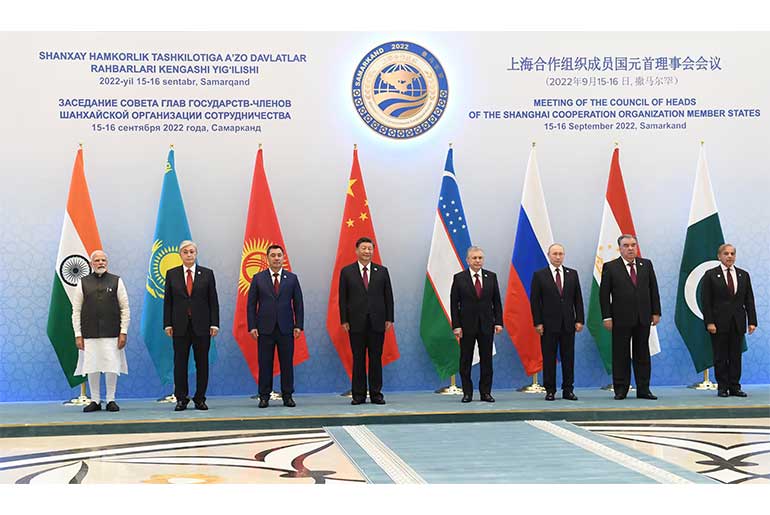
India became one of the other member states of the Shanghai Cooperation Organisation to enhance collaboration in the artificial intelligence field, citing the strategic role of the new technology in revolutionizing societies and economies. The commitments among the member states regarding artificial intelligence, among others, are outlined in the Tianjin Declaration of the SCO Council of Heads of States that was signed and adopted at the Shanghai Cooperation Organisation Summit today. The SCO grouping consists of 10 member states, two observer states, and 14 dialogue partners.
Prime Minister Narendra Modi, in his address to the plenary session of the SCO Summit on Monday, flagged emerging threats, including cyber-terrorism, stressing that regional security strategies must evolve to meet new challenges. “It is a matter of great satisfaction that the SCO is evolving with time. Four new centers are being established to address contemporary challenges, such as organized crime, drug trafficking, and cybersecurity. We welcome this reform-oriented approach,” Modi said.
In his opening speech at the AI Action summit in Paris, which he co-chaired earlier this year, PM Modi made an optimistic note about the potential of AI and warned about its biases. By indicating that AI already is redefining polity, economy, security, and even society, Prime Minister Modi emphasized the necessity of global collaboration in defining governance and standards that reflect communal values, deal with risks, and instill trust.
India is also quickly establishing itself as a strong AI computing and semiconductor platform to serve its growing online economy. In 2024, the government gave a go-ahead to the IndiaAI Mission and allocated Rs 10,300 crore to boost AI capabilities in five years.
As a follow-up to the UN General Assembly Resolution on Strengthening International Cooperation in the Field of Artificial Intelligence Capacity Building, the Tianjin Declaration focused on the idea that all countries have equal rights to create and utilize artificial intelligence.
The SCO member countries (including India) said they are ready to collaborate to eliminate risks to ensure the ongoing enhancement of the security, accountability, reliability, transparency, inclusiveness, trustworthiness, and fairness of artificial intelligence technologies to the benefit of all humankind. In this respect, they supported the adoption of the Roadmap on the Implementation of the cooperation program of SCO Member States on the development of Artificial Intelligence (Chengdu, 12 June 2025).
SCO member states received well the July 25, 2025, UN General Assembly Resolution, “The role of artificial intelligence in creating new opportunities for sustainable development in Central Asia,” which mentions the initiative to create a Regional Artificial Intelligence Centre in Dushanbe. SCO member countries observed the suggestions to implement cooperation in the area of artificial intelligence and on the advanced and breakthrough technologies of the SCO.
In his keynote speech at the Tianjin summit
Chinese President Xi Jinping had also suggested that SCO member states should increase collaboration in a broad spectrum of spheres, such as energy, infrastructure, digital economy, science and tech innovation, and artificial intelligence.
It is worth noting that a humanoid AI robot, Xiao He, was released to help media workers and participants of the summit do different assignments at the Tianjin Summit. Xiao He caused a lot of attention at the SCO Summit, and the humanoid body of the robot and the sophisticated features aroused interest and respect.
At the same time, before PM Modi visited China, he took part in the 15th India-Japan Annual Summit in Tokyo, where one of the main results was the debut of the Japan-India Artificial Intelligence Initiative to enhance bilateral collaboration in the domain of AI technologies. The project will facilitate cross-border cooperation on large language models, data centers, and AI governance and is expected to spur innovation and research between the two countries.
“Cooperation in the area of high technology is a priority for both of us. In this context, Digital Partnership 2.0 and AI cooperation initiatives are being undertaken,” PM Modi said in Tokyo.
In October
PM Modi also invited the Japanese Prime Minister, Shigeru Ishiba, to the AI Impact Summit that will be held in India in February 2026. We are living in a world of artificial intelligence, and these two leaders understood that AI is an extremely radical technology that will eventually change our society and economies. The project will intensify India and Japan’s cooperation in AI, Foreign Secretary Misri announced in a press statement concerning the prime minister’s visit to Japan.
On 15 January 2019
PM Modi also invited Japanese PM Shigeru Ishiba to the AI Impact Summit in India, which is due in February 2026. Evidence: we have entered the era of artificial intelligence, and both the leaders understood that AI is a disruptive technology that will change our society and the economy. Through the initiative, cooperation between India and Japan will be enhanced in the field of AI, Foreign Secretary Misri remarked in a media briefing about the visit of the PM to Japan.
Last month, during the BRICS outreach summit in Brazil, PM Modi called for ensuring responsible governance of artificial intelligence. “In the 21st century, the progress and well-being of people largely depend on technology, especially artificial intelligence. On one hand, AI can greatly improve everyday life, while on the other hand, it also raises concerns about risks, ethics, and bias,” PM Modi had said. “India’s approach and policy on this topic are clear, and it sees AI as a medium to enhance human values and potential. “Working on the mantra of ‘AI for All,’ today we’re widely and actively using AI in sectors like agriculture, health, education, and governance in India.”
 Electrify your feed! Click here to join our Whatsapp group and to get the latest updates, expert insights, and innovations driving India’s energy storage revolution.