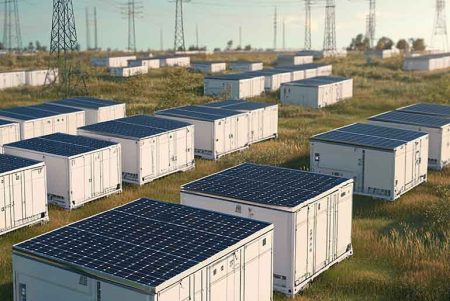
Kerala is preparing for a major expansion of its energy storage capacity, with five battery energy storage system (BESS) projects planned by the Kerala State Electricity Board (KSEB) expected to begin commercial operations by October 2026.
The projects are designed to improve grid stability, reduce dependence on expensive peak-hour electricity purchases, and support the efficient use of the state’s increasing solar power generation.
Five BESS Projects Target October 2026 Operation
As per an update submitted by KSEB to the Kerala State Electricity Regulatory Commission (KSERC), all five planned battery storage projects are expected to achieve commercial operation by October 2026.
Two of these projects are located in Kasaragod district. The largest facility will be a 125 MW/500 MWh battery energy storage system at Mylatti, while another 15 MW/60 MWh project is planned at Mulleria.
Other proposed storage facilities include a 40 MW/160 MWh BESS at Sreekantapuram, a 30 MW/120 MWh system at Areecode, and a 40 MW/160 MWh project at Pothencode.
KSERC, in its June 12 order, confirmed that KSEB has committed to the October 2026 commissioning timeline for all five projects.
Supporting Kerala’s Growing Solar Capacity
The upcoming storage projects are expected to address one of Kerala’s key power sector challenges — managing surplus solar generation during daytime hours and meeting higher electricity demand in the evening.
With solar capacity increasing across the state, Kerala often has excess renewable power available during periods of low demand. However, limited storage capacity has made it difficult to store this energy for later use.
As a result, KSEB has had to depend on costly power purchases during peak demand hours and surrender some contracted power supplies to accommodate solar power entering the grid.
Battery storage systems will allow excess renewable electricity to be stored during low-demand periods and supplied when demand rises, improving grid flexibility and reducing power procurement costs.
Storage Could Have Helped During Power Shortages
The need for large-scale battery storage became more visible during electricity shortages faced by Kerala earlier this year.
The regulatory commission noted that if the proposed BESS projects had been operational earlier, KSEB could have better managed supply-demand gaps and reduced the need to surrender contracted power.
The projects are expected to strengthen Kerala’s energy security while enabling greater renewable energy adoption.
Sixth BESS Project Approved at Brahmapuram
In addition to the five upcoming projects, Kerala’s energy storage plans have expanded with the approval of another major BESS facility at Brahmapuram in Ernakulam district.
KSERC has approved KSEB’s proposal for a 250 MW/500 MWh grid-connected battery storage project at the 220 kV substation premises in Brahmapuram.
The project will receive support through the Central government’s Power System Development Fund (PSDF) under the Viability Gap Funding (VGF) mechanism. The commission has also approved the Battery Energy Storage Sale Agreement between KSEB and Shreyas LFP Energy for project development.
Kerala Moves Towards a Flexible Power System
With six battery storage projects now moving forward, Kerala is taking significant steps toward building a more reliable and renewable-focused electricity system.
The combined storage capacity is expected to help integrate more solar power, reduce dependence on high-cost peak electricity purchases, and improve overall grid management.
Once operational, these projects will represent one of the largest battery energy storage deployments by a state utility in India and mark an important milestone in Kerala’s clean energy transition.
 Electrify your feed! Click here to join our Whatsapp group and to get the latest updates, expert insights, and innovations driving India’s energy storage revolution.