

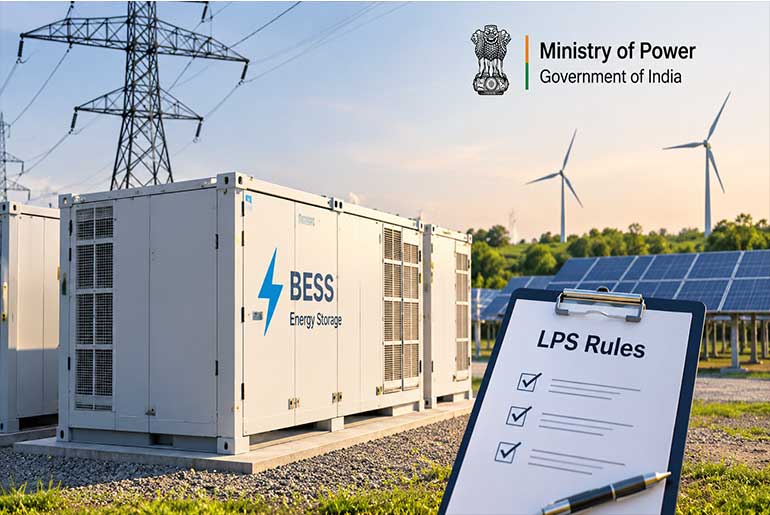
The Ministry of Power (MoP) has proposed extending the Electricity (Late Payment Surcharge and Related Matters) Rules, 2022, to independent energy storage service providers, a move aimed at strengthening payment security for standalone Energy Storage Systems (ESS) and encouraging investment in the sector. The proposed amendment seeks to bring independent storage developers under the same statutory payment protection framework currently available to power generation companies, transmission licensees and electricity trading licensees.
The ministry has invited stakeholder comments on the draft amendment, titled the Electricity (Late Payment Surcharge and Related Matters) (Amendment) Rules, 2026. The proposal addresses a gap in the existing regulatory framework, under which standalone storage operators do not receive the same statutory safeguards against delayed payments by electricity distribution companies (DISCOMs).
Addressing the Payment Security Gap
Under Rule 18 of the Electricity Rules, 2005, energy storage systems can be owned by generating companies, transmission companies, distribution companies, consumers or independent storage companies. Storage assets owned by power generators already fall under the LPS framework because they assume the legal status of the generator.
However, independent energy storage service providers operating standalone projects are currently outside this protection. If a DISCOM delays payments to these companies, they must rely primarily on contractual arrangements rather than the statutory payment safeguards available to other electricity sector participants.
The proposed amendment seeks to introduce a new category of ‘energy storage service provider’ under the LPS Rules. It defines such an entity as an organisation providing energy storage as a service or supplying electricity using an energy storage system that is not owned by a generating company, transmission licensee, distribution licensee or consumer.
The draft also proposes extending the applicability of the rules to outstanding dues of energy storage service providers, alongside generating companies, transmission licensees and electricity trading licensees. Corresponding changes are proposed across provisions dealing with payment timelines, delayed payment surcharge and payment security.
What the Existing LPS Framework Provides
Under the existing rules, payments must be made by the date specified in the power purchase agreement (PPA). Where the agreement does not specify a payment date, the amount is payable within 45 days of the presentation of the bill.
The framework also provides for a late payment surcharge on overdue amounts. The interest rate starts at the State Bank of India’s one-year lending rate plus five percentage points and increases by 0.5 percentage points for every month of delay, subject to the prescribed ceiling. DISCOMs are also required to maintain a Letter of Credit (LC) with a bank as payment security.
Further, if a bill remains unpaid two-and-a-half months after presentation, the defaulting DISCOM can be restricted from purchasing electricity through the short-term market and power exchanges. The framework also provides for progressive curtailment of long-term power supply in cases of continued default.
Storage Expansion and Investment Requirements
The ministry’s proposal comes as India prepares for a substantial expansion in energy storage capacity. According to the explanatory note accompanying the draft, Battery Energy Storage System (BESS) capacity is projected to increase from approximately 15 GWh in October 2026 to 321 GWh by 2035-36. Pumped Storage Plant (PSP) capacity is expected to rise from 44 GWh in September 2026 to 630 GWh over the same period.
The ministry highlighted the importance of payment certainty in attracting financing for these capital-intensive projects.
“ESS projects need large investment upfront, which is recovered through payments over many years. Investors and banks will invest into such projects only if they are confident that these payments will be made on time,” the ministry said.
Extending payment protections to independent storage operators could improve lenders’ confidence, attract private investment and reduce financing costs. Over time, this may also help lower the overall cost of energy storage.
As renewable energy penetration increases, storage is becoming increasingly important for shifting surplus solar and wind generation to periods of higher demand and supporting reliable round-the-clock electricity supply.
The proposal is not yet a final amendment. Following stakeholder consultation, the ministry will consider the feedback before finalising and notifying the changes. If implemented, the amendment could provide an important regulatory safeguard for India’s expanding standalone energy storage market.
 Electrify your feed! Click here to join our Whatsapp group and to get the latest updates, expert insights, and innovations driving India’s energy storage revolution.