Close Menu
The Battery MagazineThe Battery Magazine
  • Just In
  • Batteries
    • Battery Manufacturing (BESS)
    • Battery Materials & Chemistries
    • Battery Recycling
    • C&I Storage
  • Solar
  • Renewable energy
    • Wind Energy
    • Hydropower
    • Green Hydrogen
    • Bioenergy
  • Tenders
    • Energy Storage
    • Solar Energy
    • Wind Energy
  • Policy
    • Storage
    • Solar
    • Wind
    • EV
    • Transmission
  • EV
    • EV Batteries
    • EV Charging Infrastructure
    • Electric Mobility Trends
  • Grid
    • Transmission & Distribution
    • Grid Infrastructure
    • Power Generation
    • Power Equipments
  • Exclusive
    • Cover Story
    • Watt Matters
    • Perspective
    • Articles
  • More
    • E-Mag
    • Events
    • Contact Us
Facebook LinkedIn WhatsApp
The Battery MagazineThe Battery Magazine
  • Just In
  • Batteries
    • Battery Manufacturing (BESS)
    • Battery Materials & Chemistries
    • Battery Recycling
    • C&I Storage
  • Solar
  • Renewable energy
    • Wind Energy
    • Hydropower
    • Green Hydrogen
    • Bioenergy
  • Tenders
    • Energy Storage
    • Solar Energy
    • Wind Energy
  • Policy
    • Storage
    • Solar
    • Wind
    • EV
    • Transmission
  • EV
    • EV Batteries
    • EV Charging Infrastructure
    • Electric Mobility Trends
  • Grid
    • Transmission & Distribution
    • Grid Infrastructure
    • Power Generation
    • Power Equipments
  • Exclusive
    • Cover Story
    • Watt Matters
    • Perspective
    • Articles
  • More
    • E-Mag
    • Events
    • Contact Us
LinkedIn Facebook WhatsApp YouTube
The Battery MagazineThe Battery Magazine
Home » Batteries » Rystad Energy: India Posts Record Biannual Renewable Energy Capacity Additions in First Half of 2025
Batteries

Rystad Energy: India Posts Record Biannual Renewable Energy Capacity Additions in First Half of 2025

PrakashBy PrakashJuly 21, 20254 Mins Read
Facebook Twitter LinkedIn WhatsApp
Rystad Energy: India’s record 22 GW renewable boost in H1 2025 highlights progress, but coal reliance threatens net-zero goals.

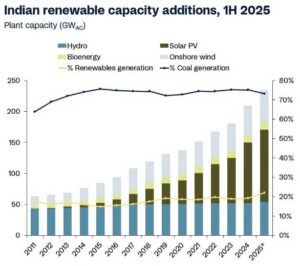
India added a record 22 gigawatts (GW) of renewable energy capacity in the first half of 2025 – a 57% jump from the 14.2 GW installed during the same period last year. The new capacity includes 18.4 GW of solar, 3.5 GW of wind, and 250 megawatts (MW) of bioenergy, which is generated from plant and animal waste. This marks the country’s highest-ever addition in any six-month period. The surge was largely driven by developers moving quickly to take advantage of the government’s Interstate Transmission System (ISTS) charge waiver, which begins at 25% and increases annually until full implementation by June 2028, significantly lowering project costs and incentivizing developers to act now.

India is now inching closer to its goal of sourcing 50% of its installed power capacity from clean energy sources, with a total of 234 GW in place, including large hydropower projects. While this growth is positive from a strict emissions reduction perspective, fossil fuels continue to dominate actual energy consumption in the country, accounting for around 75% of electricity generated in the first half of the year from coal, oil and gas-fired plants.

Additionally, nuclear power is beginning to play a larger role, with the commissioning of Unit 7 of the Rajasthan Atomic Power Project—a 700-MW unit connected to the northern grid—and government approval for the country’s first small modular reactor (SMR) planned in the northern state of Bihar. However, reliance on coal remains a significant challenge and the role of nuclear energy continues to be debated due to concerns over costs, safety and waste management.

“India installed 22 GW of renewable energy capacity in the first half of 2025, a new record. However, the country is still banking heavily on coal to meet growing power demand, with plans to install an additional 80 GW of new thermal projects. India is not yet undergoing a true energy transition; instead, it is focusing on building up installed capacity from both conventional and renewable energy sources to ensure energy security. Without urgent action to improve affordability and sustainability, particularly through grid upgrades and energy storage, coal will remain central to electrification efforts, jeopardizing progress toward India’s net-zero goals.”

– Sushma Jaganath, Vice President, Renewables & Power Research, Rystad Energy
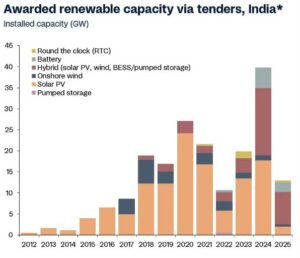
While India’s renewable energy capacity more than doubled in the first half of the year, battery energy storage systems (BESS) also saw a significant uptick, with 5.4 GW of collocated solar-BESS and 2.2 GW of standalone BESS awarded to developers, marking the country’s highest BESS allocation to date. The strong participation across auctions reflects a growing emphasis on grid stability and renewable integration, with Rystad Energy projecting accelerated growth in the sector over the coming years. Average quoted tariffs stood at around INR 4,000 ($48.02) per megawatt-hour (MWh) for standalone BESS and INR 3,208 ($38.50) per MWh for collocated solar-BESS projects—a downward trend in pricing that could encourage more developers to pursue integrated installations over standalone solar.

Among the top developers, Jindal Group secured 990 MW of collocated solar and BESS capacity, while NTPC and ReNew each won 900 MW in the same category. In the standalone BESS segment, JSW Energy was allocated 625 MW and Reliance Power won 525 MW of collocated capacity. Adani Green also participated, securing a 510 MW collocated solar and BESS project, indicating a shift from its previous focus on standalone solar and wind.
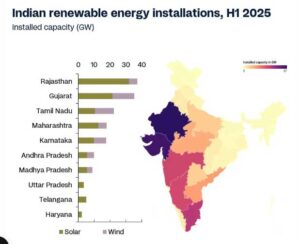
India’s western states remain at the forefront of the country’s renewable energy rollout. Rajasthan leads with 37.4 GW of installed capacity, driven by 32 GW of solar and 5.2 GW of onshore wind, supported by high solar irradiance and vast desert terrain. Gujarat follows with 35.5 GW, including 21.5 GW of solar and 13.8 GW of wind. Tamil Nadu ranks third, with 11.8 GW of wind and 10.6 GW of solar, and is also a top performer in bioenergy, contributing 1 GW of the national total of 11.6 GW. Onshore wind also features prominently in several other states, including Karnataka (7.7 GW), Maharashtra (5.3 GW), Andhra Pradesh (4.4 GW), and Madhya Pradesh (3.2 GW).
whatsapp icon Electrify your feed! Click here to join our Whatsapp group and to get the latest updates, expert insights, and innovations driving India’s energy storage revolution.

BESS clean energy renewable energy Rystad Energy
Prakash
  • Website
  • LinkedIn

Journalist with experience in researching, reporting, and creating engaging content across diverse topics and platforms. My work has strengthened my skills in communication, relationship building, and understanding people, while also honing my organisational and problem-solving abilities.

Keep Reading

Berde Renewables Partners With Sungrow to Deploy 500 MWh Battery Storage Across Southeast Asia

Berde Renewables Partners With Sungrow to Deploy 500 MWh Battery Storage Across Southeast Asia

Assam Unveils ₹77,353 Crore Power Infrastructure Expansion Plan

Assam Unveils ₹77,353 Crore Power Infrastructure Expansion Plan

Attero Secures ISO-Verified Life Cycle Assessment for Recycled Metals

Attero Secures ISO-Verified Life Cycle Assessment for Recycled Metals

Comments are closed.

Renewable energy
Berde Renewables Partners With Sungrow to Deploy 500 MWh Battery Storage Across Southeast Asia

Berde Renewables Partners With Sungrow to Deploy 500 MWh Battery Storage Across Southeast Asia

July 20, 2026
Tongwei Unveils 770W Solar Module With Industry-Leading 93.07% Bifaciality

Tongwei Unveils 770W Solar Module With Industry-Leading 93.07% Bifaciality

July 20, 2026
Assam Unveils ₹77,353 Crore Power Infrastructure Expansion Plan

Assam Unveils ₹77,353 Crore Power Infrastructure Expansion Plan

July 20, 2026
Attero Secures ISO-Verified Life Cycle Assessment for Recycled Metals

Attero Secures ISO-Verified Life Cycle Assessment for Recycled Metals

July 20, 2026
Batteries
POWERGRID Secures Fatehgarh-II Synchronous Condenser Project to Strengthen Grid Stability and Renewable Energy Integration

POWERGRID Secures Fatehgarh-II Synchronous Condenser Project to Strengthen Grid Stability and Renewable Energy Integration

July 20, 2026
Kerala Includes ISTS Benefits for RE and BESS in New Power Procurement Rules

Kerala Includes ISTS Benefits for RE and BESS in New Power Procurement Rules

July 20, 2026
Waaree Energies opens a 5.15 GWh BESS container production plant

Waaree Energies opens a 5.15 GWh BESS container production plant

July 17, 2026
Researchers Have Developed a Unique Porous Organic Anode Material For More Efficient Lithium-Ion Batteries

Researchers Have Developed a Unique Porous Organic Anode Material For More Efficient Lithium-Ion Batteries

July 17, 2026

Subscribe for Updates

Get the latest news about energy storage in your inbox.

    © 2026 Thebatterymagazine.com.
    • Home
    • About Us
    • Contact Us
    • Privacy Policy
    • Terms of Service

    Type above and press Enter to search. Press Esc to cancel.