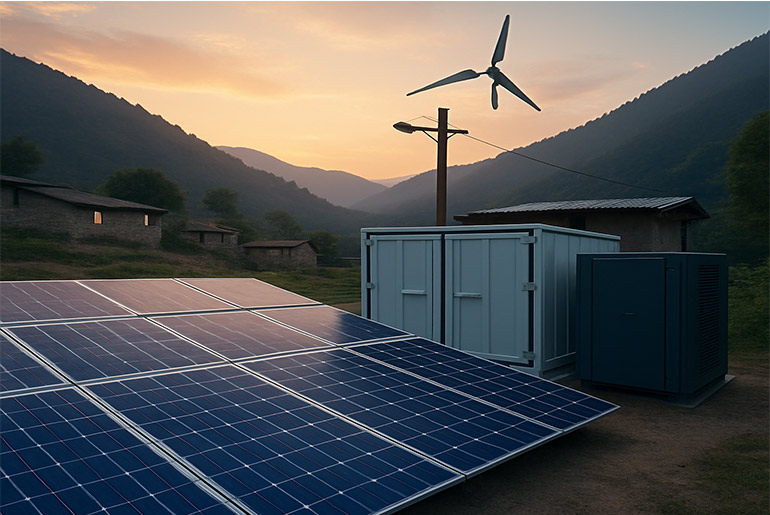
In a remote Himalayan village, where power outages were once routine and children studied under flickering kerosene lamps, the hum of a steady power supply now marks a quiet revolution. This transformation isn’t powered by towering transmission lines but by a microgrid—a self-contained energy system harnessing the sun and storing its power in intelligent batteries. As the world pushes towards energy equity and sustainability, energy storage for microgrids is emerging as a lifeline for rural and underserved regions, bridging the energy access divide and igniting opportunity where darkness once prevailed.
The Energy Access Gap Persists in Remote Communities
Currently, approximately 759 million people are without electricity in the world with a large portion of these individuals further isolated either geographically or economically. Connecting conventional grids to these places is not only expensive but also complicated logistically. Remote areas either deep in forests, in mountainous areas, or dispersed island populations can only rely on expensive and polluting diesel generators that can fail to provide a consistent energy supply. This limited access to power means limited economic opportunities, prevention of a transition to more modern power, and inadequate access to essential services like healthcare, education, and communication.
Microgrids Are Not the Complete Solution
Micro grids based on renewable sources like solar or wind provide a way forward but they are, by their very nature, intermittent. Solar panels don’t work at night, and wind turbines don’t work without wind. Unless they’re paired with storage, there’s no reason to expect microgrids to act like a 24/7 power source, and therefore the value of microgrids is assumed to be add-on/complimentary resources and not replacements. This is where energy storage comes into play: the essential component needed to convert a micro grid from a temporally conscious resource to a primary source of energy is reliable energy storage.
Advantages of energy storage for microgrids
- Reliable Continuous Energy: Battery packs store excess power produced from energy production throughout the day and discharge to the load when production is low or has stopped, meaning power is available 24/7.
- Cost Savings: After the amortization of the energy storage system, they will save costs each day in operational costs and maintenance on diesel fuel, transportation, and more for a full ROI.
- Environmental Benefits: Emission-free operation means that storage-backed microgrids help improve the air quality of the immediate area and contribute to broader national goals of carbon emissions reductions.
- Energy Autonomy: Energy independence emancipates remote communities from unreliable or costly central grids.
- Disaster Resilience: In flood-prone or cyclone-hit regions, storage-enhanced microgrids keep vital systems—like water pumps, mobile networks, and clinics—running when the main grid collapses.
Highlighting Technology
Battery technology is a crucial element of these environments. The mass-market sector is developing mainly with lithium-ion batteries and for good reasons: energy density, cycle life, and cost. Flow batteries have energy density but are making strides because their long discharge duration is ideal in larger installations. In areas of extreme temperature swings or the least technological capacity, sealed lead-acid or sodium-ion batteries provide durability with less maintenance.
Battery Management Systems (BMS) will ‘fine-tune’ battery performance, avoid overcharging, control health and state, and assist with predictive maintenance. Smart inverters or digital controllers will also incorporate intelligent energy flow management, which optimizes every watt being stored.
Real-World Examples / Case Studies
India: Microgrids are providing year-round electricity
In Ladakh with lithium-ion batteries and solar panels, even in harsh winter conditions. In the Sundarbans delta, storage-enabled systems are providing light to homes, schools, and health centres that used diesel as fuel.
Africa: In Kaduna state, Nigeria, solar mini-grids with lithium storage now provide energy to more than 2000 households, reducing fuel costs and improving livelihoods. Tatu City, Kenya, is using smart micro grids to power 1000 acres of mixed industrial and residential areas sustainably.
Pacific Islands: The island of Ta‘ū in American Samoa runs almost entirely on solar power stored in Tesla batteries, eliminating the need for 100,000 gallons of diesel annually.
Assistance for Financing and Policy
There are now opportunities for rural electrification through government funding mechanisms, such as India’s National Energy Storage Mission and Saubhagya Scheme. Global initiatives for energy storage are also gaining momentum – USAID assistance for mini and micro grids across Africa and the World Bank Scaling Solar program are all examples
Energy storage systems are now more accessible through subsidies, accelerated depreciation and concessional financing. Startups and private companies are also starting to embrace the market and develop pay-as-you-go business models that are based in community micro grids.
Problems and the Next Steps
Cost is still a problem, especially for widespread use in low-income areas. Supply chain problems, especially with important minerals like lithium and cobalt, could slow down growth. Recycling and throwing away batteries are bad for the environment in the long run.
But innovation keeps moving forward. Sodium-ion and vanadium redox flow batteries are two new types of batteries that promise safer, longer-lasting, and cheaper solutions. To make scaling work, it will be important to build up local technical skills and set clear rules for micro grids with storage.
Conclusion: Making the Last Mile Bright
Energy storage for microgrids is more than just a technical fix; it’s a way to promote social justice, fight climate change, and build resilience. It opens up opportunities for education, economic growth, and dignity by giving remote communities clean, reliable, and self-sufficient power.
Micro grids with energy storage are examples of what can happen when innovation and inclusion come together in a world that wants to reach net-zero emissions and make energy available to everyone. Not only is the future of energy big, it’s also local, smart, and stored.
In a world striving for net-zero emissions and universal energy access, micro grids with energy storage stand as symbols of what’s possible when innovation meets inclusion. The future of energy isn’t just big—it’s local, smart, and stored.
 Electrify your feed! Click here to join our Whatsapp group and to get the latest updates, expert insights, and innovations driving India’s energy storage revolution.