India is at a historic crossroads. As the nation gathers for the AI Summit, the conversation is no longer just about code and algorithms; it is about volts and watts. India has made its intentions clear: it wants to be a global leader in artificial intelligence. However, the backbone of this ambition is not just human talent but a massive, uninterrupted supply of electricity.
The digital age has entered a high-density phase. Standard data centers were already in need of power, but the machines discussed at the AI Summit require exponentially more power. This raises an important question: Can India’s solar and battery sectors evolve fast enough to prevent a power bottleneck?
Why AI Needs So Much Power
To grasp the scale of the challenge, we need to see how AI compares to traditional computing. A regular Google search uses a small amount of energy, but a single prompt to a generative AI model can use ten times more. Worldwide, data centers make up nearly 2% of total electricity use. In India, this footprint is growing quickly. Experts at the AI Summit note that India’s data center capacity is expected to surpass 3.2 gigawatts (GW) by 2026. This growth is driven by the need for “training clusters” massive groups of GPUs that run 24/7 to teach AI models how to think. These facilities do not just need power; they need high-density, “always-on” power that cannot flicker for even a millisecond.
India’s Solar Leap: A Foundation, Not a Total Solution
India has made impressive strides in renewable energy. By late 2025, the country reached 250 GW of non-fossil fuel capacity, hitting its climate goals five years early. The government is now aiming for 500 GW by 2030.
At the latest AI Summit, policymakers highlighted that solar energy is the cheapest and fastest-to-deploy source available. However, solar has a fundamental flaw when it comes to AI: intermittency.
The Night-Time Gap: AI training does not stop when the sun goes down, but solar production does.
Seasonal Fluctuations: Monsoon clouds and winter haze can drop solar output significantly.
Grid Stability: Sudden drops in renewable generation can destabilize the grid, which is a nightmare for the sensitive hardware discussed at the AI Summit.
To bridge this gap, India is moving toward “Round-the-Clock” (RTC) renewable energy. This is where the battery industry enters the spotlight.
BESS: The Critical Bridge to a 24/7 AI Economy
Battery Energy Storage Systems (BESS) play a crucial role in the shift to sustainable energy. Without storage, extra solar power produced during the day goes to waste. BESS allows this energy to be saved and used during peak evening hours or at night.
The year 2026 is being called the “inflection point” for Indian battery storage. Installations are expected to surge tenfold—from a mere 500 megawatt-hours (MWh) in 2025 to around 5 gigawatt-hours (GWh) in 2026. This shift was a major talking point at the AI Summit, where infrastructure players noted that batteries are no longer an optional add-on; they are a structural necessity.
Key Projects Leading the Way:
Gujarat’s Khavda Park: Adani is starting a huge 3,530 MWh battery project, which is one of the largest in the world.
Rajasthan’s Solar-plus-BESS: New tenders require developers to include 4 to 6 hours of storage to keep the grid stable.
Hybrid Models: Companies like ENGIE are winning bids for projects that mix 200 MW of solar with 600 MWh of battery storage.
The Role of Policy and the AI Summit
For India to synchronize its digital and energy ambitions, the policy must be as agile as the technology. The AI Summit serves as a platform where these two worlds meet. Recent government initiatives have provided a much-needed push:
Viability Gap Funding (VGF): A ₹5,400 crore package to support standalone BESS projects.
Transmission Waivers: Extending waivers on inter-state transmission charges for solar-plus-storage projects until 2028.
Mandatory Storage: New rules requiring solar projects to include a minimum of 10% storage capacity.
During the AI Summit, it was noted that these policies are designed to lower the “levelized cost of storage,” making green AI power competitive with traditional coal-fired electricity.
Challenges on the Horizon
Despite the optimism at the AI Summit, the road ahead is not without obstacles.
| Challenge | Impact on AI Industry | Potential Solution |
| Supply Chain | Dependence on imported lithium cells from China. | PLI schemes for local cell manufacturing. |
| High Initial Cost | Higher capital expenditure for data center operators. | Long-term PPAs (Power Purchase Agreements). |
| Grid Congestion | Hubs like Mumbai and Chennai face local grid stress. | Dedicated “Green Power Corridors” for data centers. |
Speakers at the AI Summit emphasized that while lithium-ion is the current leader, India must also explore Long-Duration Energy Storage (LDES) like pumped hydro and flow batteries to support the multi-day storage needs of a true AI superpower.
Synchronization: The Only Way Forward
The convergence of AI and energy is a “structural transformation.” We are moving away from a world where energy was a utility to a world where energy is a strategic asset. At the AI Summit, industry leaders argued that the “winner” of the AI race won’t just be the country with the best data, but the country that can provide the most reliable green energy.
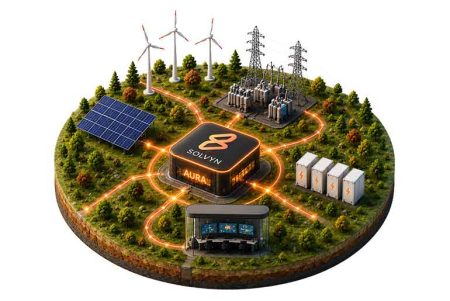
India is currently building “Sovereign AI” infrastructure. To make this work, the energy industry must deliver. We are seeing a move toward co-location, where data centers are built directly next to massive solar farms equipped with giant battery banks. This reduces transmission losses and ensures the AI models discussed at the AI Summit are powered by the cleanest electrons possible.
Conclusion: Built on Megawatts
The AI revolution will not be built solely on clever code. It will be built on stable grids, scalable batteries, and sustainable megawatts. As the delegates at the AI Summit wrap up their discussions, the mandate is clear: India’s energy transition is no longer just a climate goal—it is the fuel for our digital destiny.
The solar and battery ecosystem is showing signs of readiness. With a tenfold jump in storage capacity and a clear roadmap for 500 GW of renewables, India is positioning itself to handle the “compute-heavy” future. The AI Summit has highlighted the demand; now, the engineers and energy developers must ensure the lights stay on.
Is India’s energy ecosystem ready? The foundation is being laid. If 2025 was the year of planning, 2026 is the year of performance. As we look forward to the next AI Summit, the measure of success will not be the number of models released, but the number of GWh stored and ready to power them.
The real test for India is speed. Can we synchronize our AI Summit goals with our renewable energy timelines? If we can, India won’t just be using AI it will be powering the world’s AI. Every major AI Summit in the future will likely have a “power” track at its core, because in the world of artificial intelligence, energy is the ultimate currency.
 Electrify your feed!