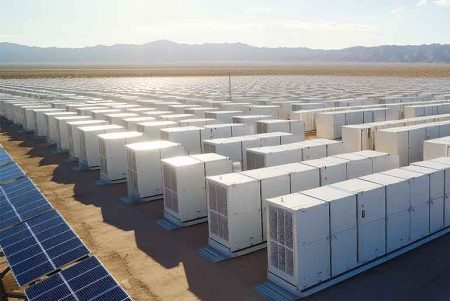
By noon on a clear summer day, India’s solar parks are generating electricity at full capacity. Across Rajasthan, Gujarat, Karnataka and other renewable energy hubs, millions of solar panels flood the grid with clean power. Yet this abundance presents an unexpected challenge—electricity demand is often lower than supply during these hours. By evening, however, the picture changes completely. As homes light up, industries continue production and air conditioners roar into life, demand surges just as solar generation disappears. This growing mismatch is exactly why the Energy Storage Obligation (ESO) in India has emerged as one of the country’s most significant clean energy policies.
The timing couldn’t be more vital. India is already one of the world’s fastest-growing renewable energy markets and is working towards an ambitious target of 500 GW of non-fossil fuel-based electricity capacity by 2030. But building up renewable capacity is only half the battle. Solar power is at its peak in the daytime . Wind generation varies with the weather . Demand for electricity rarely matches either of these . Without sufficient storage, excess renewable energy is curtailed, and conventional power plants continue to meet evening demand.
The Energy Storage Obligation (ESO) is a game changer in India’s energy transition. That’s not the next challenge for the country to produce clean electricity, but to make sure it’s there when the grid and consumers need it. This policy could become the Renewable Purchase Obligation (RPO) for solar and wind in several ways, the trigger that converts an emerging technology into a mainstream infrastructure for battery storage.
Renewable Targets to Reliable Power – The Journey to Energy Storage Obligation
For almost a decade, India’s energy transition was defined by a singular mission: build renewable energy at an unprecedented scale. Every new solar park, wind farm and renewable energy auction brought the country closer to its clean energy ambitions, while the Renewable Purchase Obligation (RPO) successfully pushed renewable adoption among DISCOMs, open access consumers and captive power producers.
But success revealed a new challenge.
As solar and wind capacity expanded, generating clean electricity was no longer enough—delivering it reliably became the real test. Solar power often exceeded demand during the day, only for conventional thermal plants to shoulder the evening peak once the sun had set. India’s renewable revolution had reached a turning point: the focus was shifting from generation to dispatchability.
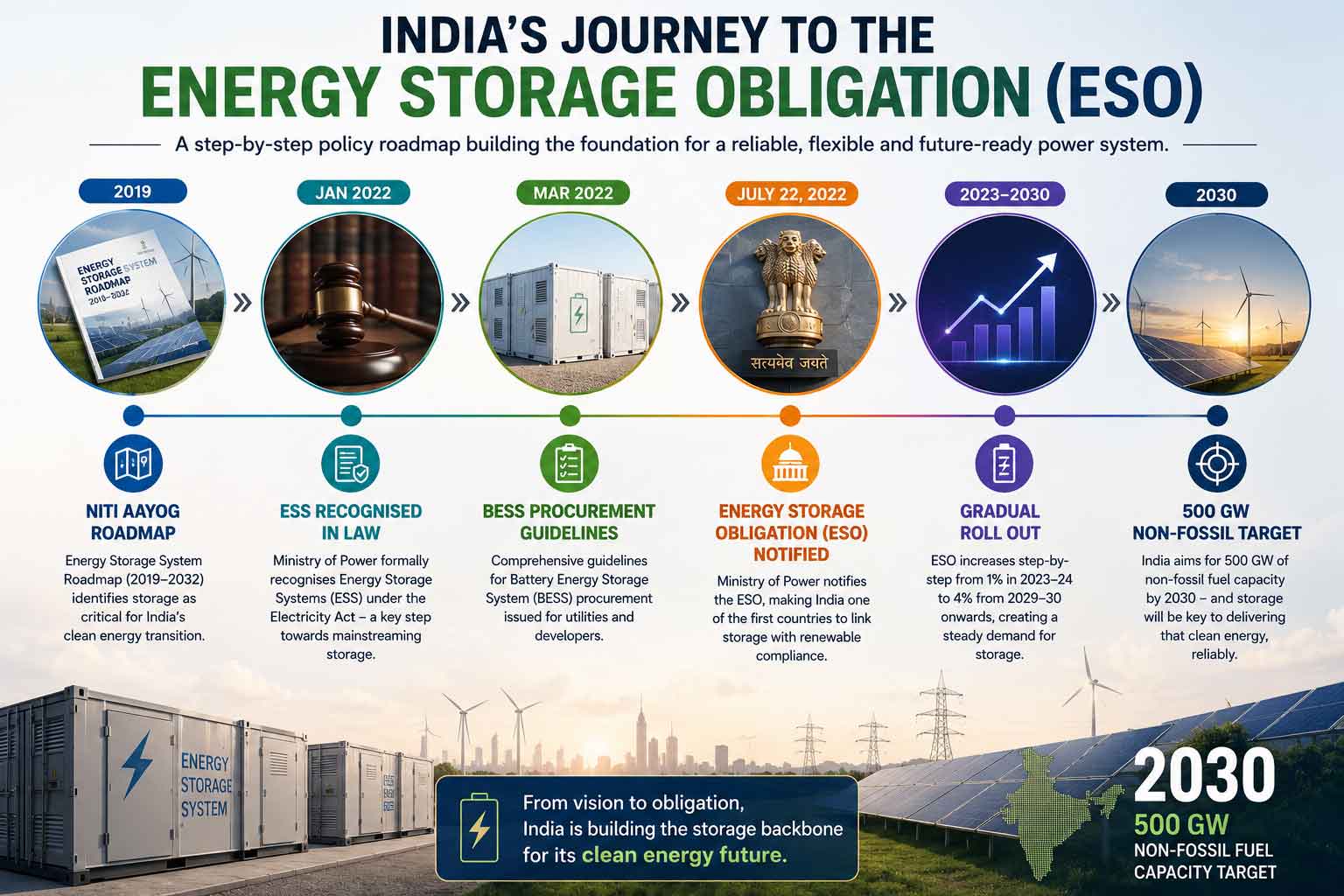
Recognising this, policymakers began laying the foundation for an energy storage ecosystem well before the Energy Storage Obligation (ESO) was introduced. In 2019, NITI Aayog’s Energy Storage System Roadmap (2019–2032) identified storage as critical for renewable integration, grid stability and domestic battery manufacturing. The momentum gained speed in 2022, when the Ministry of Power accorded legal recognition to Energy Storage Systems (ESS), followed by BESS procurement guidelines that standardised utility-scale battery deployment.
The defining moment came on 22 July 2022, when the Ministry of Power notified the Energy Storage Obligation (ESO). Much like the RPO transformed India’s solar and wind markets, the ESO aims to create long-term demand for battery energy storage, pumped storage and other flexible technologies—marking India’s shift from building renewable capacity to building a power system capable of delivering clean electricity whenever it is needed.
Decoding the Energy Storage Obligation – How the Policy Actually Works
Government policies often appear far more complicated than they actually are, and the Energy Storage Obligation (ESO) is no exception. Strip away the legal language, and the idea is remarkably simple: a growing share of renewable electricity must be backed by energy storage so that clean power remains available even when solar panels stop generating or the wind slows down.
This marks a fundamental shift in India’s energy policy. For years, success was measured by how much renewable electricity could be generated. The Energy Storage Obligation changes that equation by asking a different question: Can renewable electricity be delivered when consumers actually need it? Instead of promoting generation alone, the policy encourages renewable energy that can be stored and dispatched later, making the grid more reliable without slowing India’s clean energy transition.
Who Needs to Comply?
Rather than creating a new compliance mechanism, the Ministry of Power integrated the Energy Storage Obligation (ESO) into the existing Renewable Purchase Obligation (RPO) framework. The obligation therefore applies to:
- Electricity Distribution Companies (DISCOMs)
- Open Access Consumers
- Captive Power Plants and Captive Consumers
This alignment simplifies implementation while ensuring that storage becomes an integral part of renewable energy planning rather than a separate regulatory requirement.
How is Compliance Measured?
One of the most common misconceptions is that the Energy Storage Obligation is based on installing a certain amount of battery capacity.
It isn’t.
Compliance is expressed as a percentage of total electricity consumption, similar to the Renewable Purchase Obligation, rather than the number of batteries installed or their capacity in MW or MWh. The aim is simple: incentivise the discharge of stored renewable energy, rather than just the installation of storage assets.
A Gradual Roadmap, Not an Overnight Mandate
Recognising that India’s battery storage ecosystem is still evolving, policymakers introduced the obligation in phases.
| Financial Year | Energy Storage Obligation |
| 2023–24 | 1.0% |
| 2024–25 | 1.5% |
| 2025–26 | 2.0% |
| 2026–27 | 2.5% |
| 2027–28 | 3.0% |
| 2028–29 | 3.5% |
| 2029–30 onwards | 4.0% |
The 4% figure might seem small, but the fact that this percentage is being imposed in one of the fastest growing electricity markets means a tremendous demand for energy storage. That is why experts from the industry think that the Energy Storage Obligation is not just a compliance tool but also a signal of long-term demand in India’s battery storage market.
The Overlooked Clause: The 85% Renewable Charging Rule
One of the policy’s most important safeguards is also one of its least discussed.
To qualify under the Energy Storage Obligation, at least 85% of the annual energy used to charge an Energy Storage System (ESS) must come from renewable sources.
This prevents batteries from being charged mostly on coal electricity and then counted as “clean” storage. Connecting charging directly to renewable generation ensures that energy storage truly bolsters India’s transition to clean energy rather than just increasing battery deployment.
Ultimately, the Energy Storage Obligation is much more than another regulatory percentage. It changes the way renewable energy projects are planned. Developers now have to consider not only how much electricity a project can generate but also how that electricity will be stored, managed and dispatched at times of peak demand. It is this transition from generation to dispatchability that makes the Energy Storage Obligation one of the most important reforms in India’s evolving power sector.
Why a 4% Obligation Could Transform India’s Battery Storage Market
At first glance, the Energy Storage Obligation (ESO) appears surprisingly modest. By FY 2029–30, obligated entities will be required to meet a storage target of just 4%. On paper, that number hardly seems capable of transforming an industry as vast as India’s power sector.
But percentages rarely tell the whole story.
Applied to one of the world’s fastest-growing electricity markets, even a small storage obligation translates into an enormous demand for infrastructure. As India moves towards its ambitious 500 GW of non-fossil fuel-based electricity capacity by 2030, every additional unit of renewable electricity will also require the ability to be stored and dispatched when the grid needs it most.
This is why industry experts don’t see the Energy Storage Obligation as a compliance target—they see it as a market creation policy.
Unlike subsidy-driven schemes that depend on government budgets, the Energy Storage Obligation (ESO) creates long-term, predictable demand. As renewable electricity consumption grows, so does the requirement for energy storage, giving manufacturers, developers, utilities and investors greater confidence to plan for the future.
That confidence is already reflected in India’s projections.
According to the Central Electricity Authority’s National Electricity Plan (2023), India will require 82.37 GWh of energy storage by 2026–27, including 34.72 GWh of Battery Energy Storage Systems (BESS). By 2031–32, that requirement is projected to increase nearly fivefold to 411.4 GWh, with 236.22 GWh expected from battery storage alone. Looking further ahead, India’s long-term vision for 2047 estimates a staggering 2,380 GWh of energy storage capacity, including 1,840 GWh from batteries.
Those figures are not merely forecasts—they signal the emergence of an entirely new infrastructure industry.
Independent research confirms the validity of this conclusion. Studies conducted by the Berkeley India Energy & Climate Center confirm the assumption that India will need some 61 GW/ 218 GWh of storage by 2030, rising to 97 GW/ 362 GWh by 2032. A significant portion of total storage will consist of battery storage. The International Energy Agency (IEA) recognizes storage as one of the most vital flexibility options available to electricity systems with a large share of renewable energy sources. The India Energy Storage Alliance (IESA) foresees growth in India’s market for stationary battery storage and utility-scale projects being put into operation.
Despite using different methodologies, these organisations arrive at the same conclusion: India’s clean energy ambitions cannot be achieved without large-scale energy storage.
That shift is already visible across the market. Agencies including SECI, NTPC, NHPC and several state utilities are increasingly issuing tenders for standalone Battery Energy Storage Systems, Solar + Storage projects, Round-the-Clock (RTC) and Firm & Dispatchable Renewable Energy (FDRE) projects. Developers are no longer competing solely on the lowest tariff—they are competing on their ability to deliver reliable electricity whenever it is required.
This is why the Energy Storage Obligation matters far beyond regulation. It complements supply-side initiatives such as the ACC PLI Scheme, domestic manufacturing policies and the National Framework for Energy Storage Systems by creating something every emerging industry needs most: predictable demand.
Ultimately, the significance of the Energy Storage Obligation (ESO) is not that it mandates 4% storage. It is that it fundamentally changes the question facing India’s power sector—from “How much renewable energy can we generate?” to “How much renewable energy can we reliably deliver?” That shift may well define the next chapter of India’s energy transition.
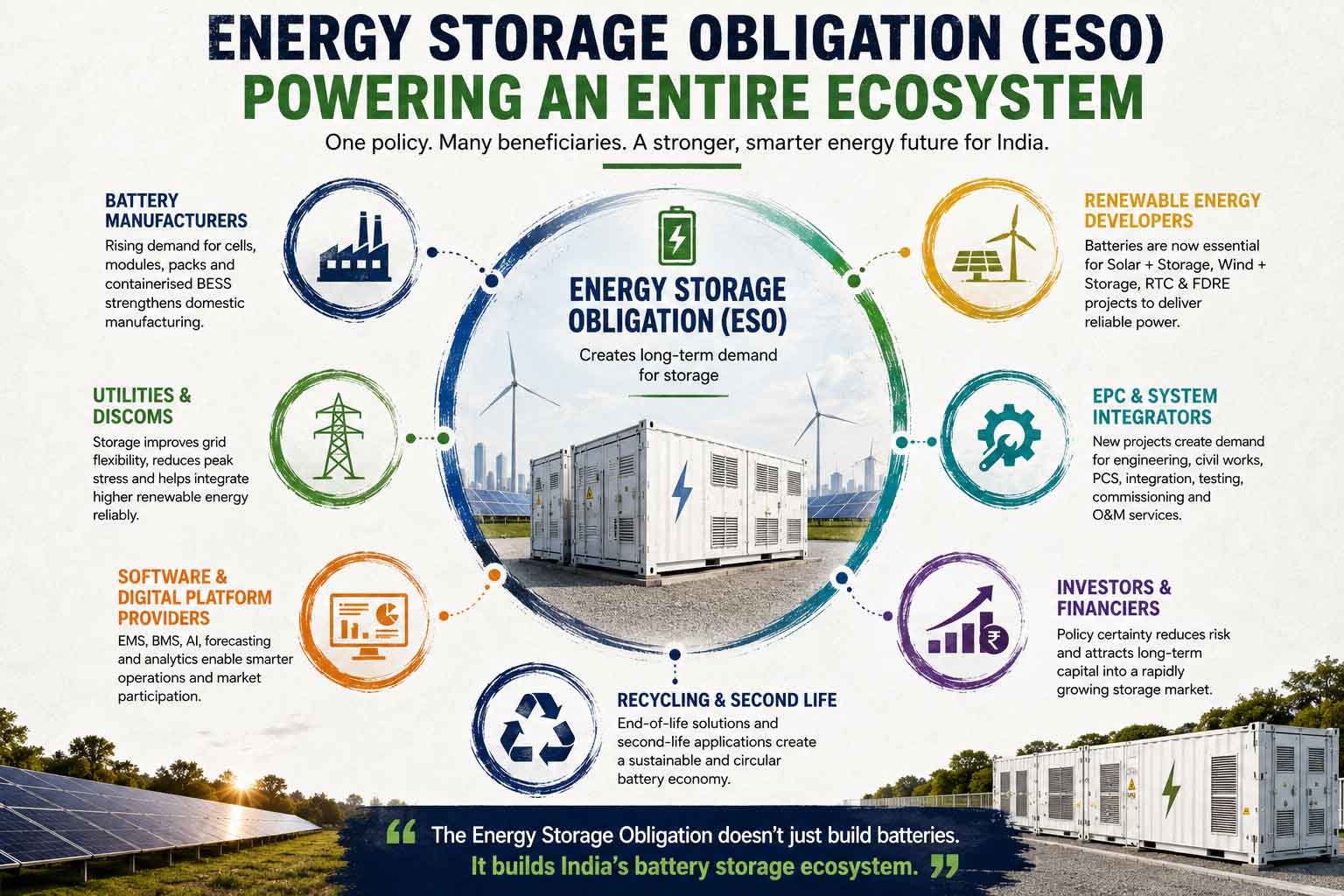
Who Wins in the Energy Storage Obligation Era?
Every transformative energy policy creates new industries.
When India introduced the Renewable Purchase Obligation (RPO), it did more than promote clean electricity. It gave investors the confidence to finance renewable projects, encouraged manufacturers to expand production and helped transform solar and wind into mainstream industries.
The Energy Storage Obligation (ESO) has the potential to do the same for energy storage—but its impact extends far beyond battery manufacturing.
Unlike conventional power projects, Battery Energy Storage Systems (BESS) sit at the intersection of generation, transmission, distribution and digital technologies. Every storage project commissioned under the ESO creates demand across an interconnected value chain, making the policy as much an industrial catalyst as an electricity reform.
Battery manufacturers are the most obvious beneficiaries. As storage deployment accelerates, demand for battery cells, modules, packs and containerised BESS is expected to rise. This also strengthens government initiatives such as the ACC Production Linked Incentive (PLI) Scheme, which aims to build domestic manufacturing capacity. Incentives can help factories open, but long-term demand is what allows them to scale. The ESO provides that demand certainty.
Renewable energy developers are also entering a new phase. Winning projects is no longer just about offering the lowest solar or wind tariff. Increasingly, utilities are procuring Solar + Storage, Wind + Storage, Round-the-Clock (RTC) and Firm & Dispatchable Renewable Energy (FDRE) projects, where reliable power delivery matters as much as generation itself. Batteries are becoming a competitive advantage rather than an optional project addition.
The opportunity extends well beyond developers and manufacturers. Every utility-scale storage project requires engineering, procurement and construction (EPC) services, power conversion systems, transformers, grid integration, software platforms, operations and maintenance, financing and, eventually, battery recycling. At the same time, utilities and DISCOMs gain a practical tool to store surplus renewable electricity, reduce dependence on thermal plants during peak demand and improve overall grid flexibility.
Perhaps the least visible—but potentially most valuable—beneficiaries are software companies. Modern battery systems rely on Battery Management Systems (BMS), Energy Management Systems (EMS), forecasting platforms, artificial intelligence and predictive analytics to determine when electricity should be stored, discharged or traded. As battery deployments increase, competitive advantage will depend not only on the batteries themselves, but also on the intelligence that operates them.
For investors, this ecosystem is underpinned by something even more valuable than technology: policy certainty. By establishing a phased compliance roadmap, the Energy Storage Obligation gives infrastructure funds, manufacturers, developers and financial institutions greater confidence that demand for energy storage will continue to grow.
Ultimately, the Energy Storage Obligation is not simply creating a market for batteries. It is creating demand for an entire energy storage ecosystem. The companies that recognise this shift early will be better positioned to lead one of the fastest-growing segments of India’s clean energy economy.
How Does India’s Energy Storage Obligation Compare Globally?
Every major economy pursuing renewable energy has reached the same conclusion: building renewable energy is only half the challenge. The real test is ensuring that clean electricity remains available when the sun isn’t shining or the wind isn’t blowing. That is why energy storage has become central to energy transition strategies worldwide.
What differs is how countries are creating that storage market.
India’s answer is the Energy Storage Obligation (ESO). Unlike many international approaches that rely primarily on financial incentives or government support, the ESO creates demand through regulation by making energy storage an integral part of renewable energy compliance.
The United States, for example, has accelerated battery deployment through generous tax incentives under the Inflation Reduction Act (IRA) and supportive state policies. The idea is simple: reduce project costs and private investment will follow. India has chosen a different path. Rather than subsidising every storage project, the ESO provides a predictable demand pipeline, giving developers confidence that storage requirements will grow alongside renewable energy consumption.
China has built the world’s largest battery ecosystem through industrial policy, large-scale manufacturing and provincial storage mandates. Today it controls much of the global lithium-ion battery supply chain. At the same time, India is trying to achieve two objectives of developing domestic battery manufacturing through initiatives such as the ACC Production Linked Incentive (PLI) Scheme and building a domestic market through the Energy Storage Obligation.
In Australia, grid-scale batteries have evolved from demonstration projects into critical infrastructure, supporting frequency regulation, peak demand management and renewable integration. The country’s experience shows that batteries are no longer just backup systems—they are active participants in modern electricity markets capable of delivering multiple grid services.
Electricity market reforms across Europe increasingly reward flexibility, through capacity markets, ancillary services and incentives for long-duration storage. European markets incentivise storage through market participation, while India’s approach is to embed storage within its renewable energy framework, and allow the market to develop from there.
This is what makes the Energy Storage Obligation distinctive. Instead of treating battery storage as a separate technology requiring independent support, it integrates storage into India’s broader renewable energy strategy. Much like the Renewable Purchase Obligation (RPO) accelerated the growth of solar and wind, the Energy Storage Obligation has the potential to make storage a standard component of every major renewable energy project.
Whether it can deliver on that promise will be down to execution. The policy has created long term demand, is in line with India’s ambition on renewable energy and supports domestic manufacturing. But its success will depend on the ability of utilities, developers, manufacturers, investors and policymakers to work together to translate regulatory intent into large-scale deployment.
The next chapter of India’s energy transition, therefore, will not be written by policy alone—it will be defined by how successfully India turns the Energy Storage Obligation into a functioning, competitive and resilient energy storage ecosystem.
Can the Energy Storage Obligation Deliver on Its Promise?
The Energy Storage Obligation (ESO) has all the ingredients of a transformative policy. It creates long-term demand, advances India’s renewable energy targets and promotes a domestic battery industry. But ambitious policies do not necessarily add up to successful outcomes. The proof is in the pudding.
The first challenge is production capacity. Even as initiatives such as the ACC Production Linked Incentive (PLI) Scheme are bolstering domestic battery production, India still relies heavily on global supply chains for lithium-ion cells and critical minerals. If the projections of the CEA (Central Electricity Authority) on the demand for storage are correct, then the manufacturers will have to ramp up production quickly and cut down on imports. The opportunity is huge but so is the challenge to build a globally competitive manufacturing eco-system.
Implementation is another important factor. But the successful implementation of the Energy Storage Obligation notified by the Ministry of Power will also depend on how SERCs adopt it in their regulatory frameworks. Some states are already taking the lead in procuring renewables and battery storage, while others are just beginning their storage journey. The pace at which states adopt and implement the policy will shape where future investments, manufacturing facilities and utility-scale storage projects are concentrated.
Financing presents a third challenge. Battery prices have fallen significantly over the past decade, but utility-scale Battery Energy Storage Systems (BESS) still require substantial upfront investment. Project viability depends not only on battery costs but also on financing, land, power conversion systems, grid interconnection, operations and maintenance, and long-term revenue certainty. This is why complementary measures such as Viability Gap Funding (VGF), competitive bidding and long-term procurement frameworks remain essential. The ESO creates demand; financial innovation will determine how quickly that demand becomes operational projects.
Finally, there is the grid itself. Deploying batteries at scale is only the beginning. Managing thousands of megawatt-hours of storage will require more sophisticated forecasting, advanced Energy Management Systems (EMS) and electricity markets that allow batteries to participate in ancillary services, frequency regulation and future capacity markets.
Ultimately, the success of the Energy Storage Obligation will not be measured by the number of policies announced or batteries installed. It will be measured by whether India can build an integrated ecosystem where manufacturing, regulation, finance and grid operations evolve together. If that happens, the ESO will be remembered not simply as a storage mandate, but as the policy that enabled India’s next phase of clean energy growth.
Beyond Compliance—The Policy That Could Define India’s Next Energy Decade
Here’s how we imagine it.
When historians look back at India’s energy transition, they are unlikely to remember every policy notification, tender or procurement guideline.
Instead, they will remember the moments when the country’s approach fundamentally changed.
The introduction of the Renewable Purchase Obligation (RPO) was one such moment. It transformed renewable energy from an alternative source of electricity into a central pillar of India’s power sector.
The Energy Storage Obligation (ESO) could prove to be another.
Its significance does not lie in the fact that it begins at 1% or rises to 4%. Those percentages will almost certainly evolve over time as India’s electricity system matures. Its real importance lies elsewhere. For the first time, India is formally acknowledging that renewable energy without storage is no longer enough. That recognition changes how power projects will be designed.
It changes how utilities plan their grids. It changes how investors evaluate opportunities. It changes how manufacturers decide where to build factories. And perhaps most importantly, it changes how India defines the success of its clean energy transition. The next decade will not simply be about installing more gigawatts of solar panels or wind turbines. It will be about ensuring that clean electricity is available after sunset, during peak demand, in every season, and whenever consumers need it most.
Achieving that vision will require more than batteries. It will require coordinated action between policymakers, regulators, utilities, developers, manufacturers, financiers and technology providers. The Energy Storage Obligation is not the destination. It is the framework that encourages all of them to move in the same direction.
Whether India ultimately becomes one of the world’s largest battery storage markets will depend on execution rather than ambition. The policy has already created the signal. The industry now has the opportunity—and the responsibility—to respond. One day, the success of India’s renewable energy transition may no longer be measured by how much clean electricity the country generates, but by how reliably that electricity reaches homes, businesses and industries whenever it is needed. If that happens, the Energy Storage Obligation (ESO) will be remembered not as another regulatory notification, but as the policy that helped transform India’s electricity system from renewable to truly reliable.
 Electrify your feed! Click here to join our Whatsapp group and to get the latest updates, expert insights, and innovations driving India’s energy storage revolution.