At London Climate Action Week, CATL and the Ellen MacArthur Foundation shared an ambition for accelerating the transition to a circular battery economy—that new battery production must be decoupled from the use of virgin raw materials. Doing so will enable a future where access, resilience, and sustainability go hand in hand—and where growth is no longer tied to extraction.
Since forming their strategic partnership earlier this year, CATL and the Ellen MacArthur Foundation have been working together to map out how circular economy principles can be applied across the battery value chain. The shared ambition offers a starting point—a North Star—for the collaboration and innovation that must follow. It is intended to guide not only CATL but also a broad community of global stakeholders seeking to redesign the system for long-term success.
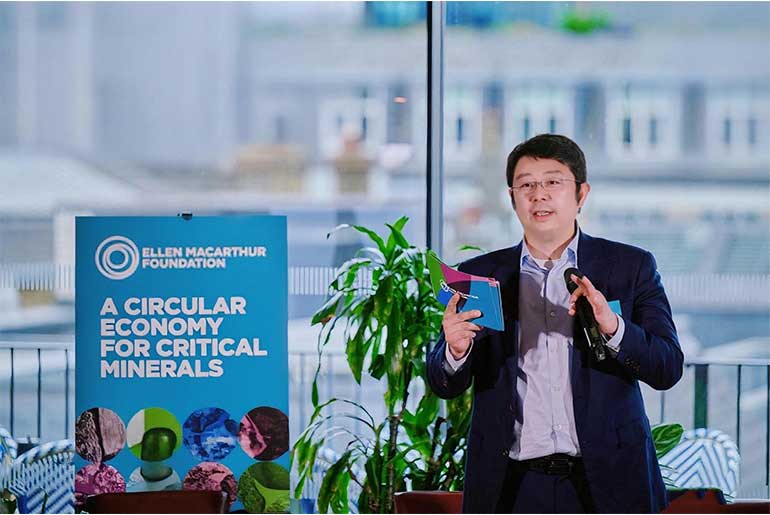
The ambition was introduced by Jiang Li, vice president and board secretary of CATL, at a high-level panel hosted by the Ellen MacArthur Foundation. The panel explored how stakeholders across research, industry, and government can work together to bring this ambition to life—and to identify what is needed to achieve it at scale.
To help bring this ambition into focus, CATL has introduced a directional goal: that within 20 years, 50% of new battery production could be decoupled from virgin raw materials. This is a long-term marker—one that will guide how we explore circular models, scale partnerships, and invest in innovation across the value chain.
Jiang Li highlighted that the circular economy will unlock new economic opportunities as well as environmental and social values. By 2040, the global battery recycling market is expected to exceed RMB 1.2 trillion (about 165 billion U.S. dollars), and the battery value chain could generate more than 10 million jobs—over half of which would be in developing countries.
Four principles to guide industry transformation
At the heart of this ambition are four practical principles, adapted from the Ellen MacArthur Foundation’s circular economy framework. These principles are designed to guide transformation across the battery value chain—from mining and manufacturing to mobility and energy systems. They offer a starting point to create further alignment with key stakeholders to design collaborative action to accelerate the shift toward a more circular battery economy.
Rethink Systems: A circular approach requires systemic change across the battery ecosystem. By embedding circularity into each stage of the value chain, it becomes possible to support low-carbon development, reduce waste, and enable the continuous flow of materials. This principle emphasizes optimizing the structure and interactions of the value chain to enable more efficient and resilient use of resources.
Redesign Products: Circularity begins at the design stage. Batteries must be built for longevity, disassembly, and second-life applications—using modular architecture and durable components. Designing with reuse and recycling in mind ensures that products can retain value for longer and be recovered more efficiently at the end of life.
Rethink Business Models: New business models are essential to decoupling resource use from economic growth. By shifting from traditional ownership to shared, service-based, or second-life models, batteries can deliver greater utility and become more accessible to users. This principle supports the creation of economically viable pathways for circularity to scale.
Recycle Materials: A high-performing recycling system is essential to circularity. Materials must be recovered efficiently and returned to high-value use, increasing the proportion of closed-loop recycling. This reduces dependence on virgin resources and helps establish a more sustainable, secure, and low-impact supply of critical raw materials.
Jiang Li also shared examples of CATL’s implementation of the four pillars.
- At the system level, CATL launched its Carbon Chain Management System to help decarbonize the battery value chain.
- In product design, CATL has extended battery lifespan significantly—its energy storage batteries now reach up to 18,000 cycles—reducing both materials demand and emissions.
- CATL also plans to deploy over 10,000 battery swap stations, improving battery efficiency and facilitating large-scale collection of retired batteries.
- In recycling, CATL operates the world’s largest battery take-back network, and in 2024 alone recycled around 130,000 tons of end-of-life batteries, recovering 17,000 tons of lithium salts.
Piloting change through GECC
To test and expand upon the shared ambition in real-world conditions, CATL is advancing the Global Energy Circularity Commitment (GECC)— Announced in March, GECC is an open, global platform where stakeholders from industry, cities, and academia come together to test circular economy solutions in practice. CATL looks to work with players across the value chain through this platform, exploring and sharing insights to help scale impact. This collective approach is key to building a resilient and sustainable battery system.
Looking ahead
This shared ambition is a starting point—a foundation for building new forms of collaboration, transparency, and systems innovation across the global battery landscape. CATL and the Ellen MacArthur Foundation will continue to engage with public- and private-sector partners to refine, expand, and operationalize the ideas set out here.
“The circular battery system won’t be built in a lab or a boardroom—it will be shaped through collaboration, testing, and shared effort. This ambition is a signal to help drive that work forward. Achieving it will require global collaboration, cross-sector learning, and open engagement across the value chain—all of which the Ellen MacArthur Foundation has long championed.”
– Jiang Li.
 Electrify your feed! Click here to join our Whatsapp group and to get the latest updates, expert insights, and innovations driving India’s energy storage revolution.