
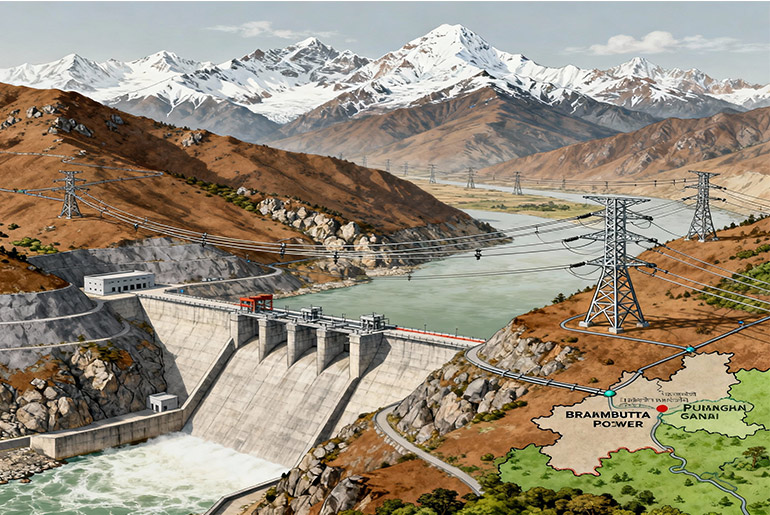
The central government has rolled out an ambitious ₹6.4 trillion master plan to evacuate 76 GW of hydropower potential from the Brahmaputra basin by 2047, aiming to unlock the Northeast’s hydro resources and strengthen India’s overall clean energy grid.
Prepared by the Central Electricity Authority (CEA) under the Ministry of Power, the blueprint envisions connecting 208 large hydro projects across 12 sub-basins. It includes ~65 GW of conventional hydro and ~11 GW of pumped storage to enable grid balancing and harness seasonal variabilities.
The plan will be implemented in two phases: the first (till 2035) with an estimated cost of ₹1.91 trillion, and the second (2036–2047) at ₹4.52 trillion. It envisages high-capacity transmission corridors, pooling substations, and redundant lines to enhance resilience, especially in high-risk Himalayan terrains.
Arunachal Pradesh stands out as a key state, offering over 52.2 GW of hydro potential. Other states involved include Assam, Meghalaya, Nagaland, Sikkim, Mizoram, Manipur, and West Bengal. The plan also recognizes the basin’s strategic importance — its transboundary nature (originating in Tibet as the Yarlung Zangbo) means hydropower development has geopolitical and hydrological sensitivities.
CEA emphasizes that this initiative will not only bolster India’s clean energy transition but also provide firm renewable power to complement variable solar and wind generation. With over 80 % of India’s untapped hydro potential lying in the Brahmaputra region, this plan is viewed as a cornerstone for the country’s grid reliability and decarbonization goals.
To make this vision real, coordination across central agencies, state governments, private developers, and financial institutions is vital. The government may explore funding via green bonds and PPP (public-private partnership) models. Development of this transmission backbone is one of India’s most ambitious infrastructure investments in the energy sector.
 Electrify your feed! Click here to join our Whatsapp group and to get the latest updates, expert insights, and innovations driving India’s energy storage revolution.