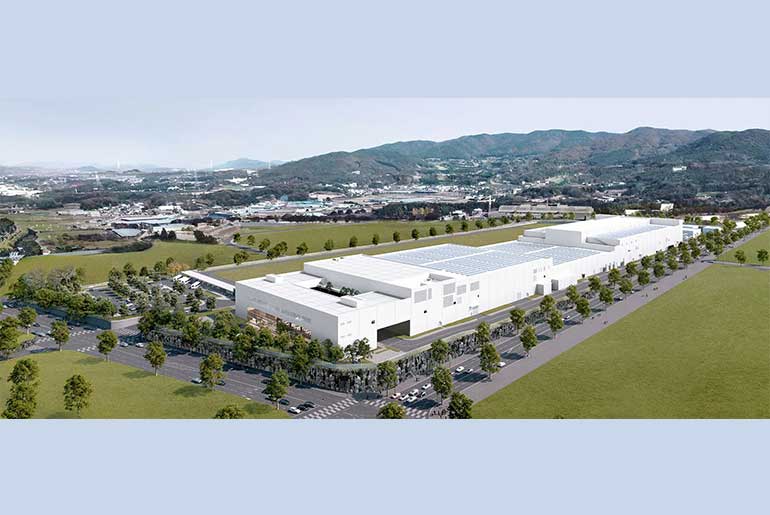
Hyundai Motor Group (the Group) held a topping-out ceremony for its Future Mobility Battery Campus in Anseong, Korea, marking a major milestone in the Group’s commitment to advancing battery technology and enhancing global electric vehicle (EV) competitiveness.
The event, held at Anseong’s Fifth General Industrial Complex, celebrated steady construction progress since breaking ground in January 2025 and reaffirmed the Group’s vision to lead future mobility through next-generation battery research and development infrastructure.
Representing a KRW 1.2 trillion investment, the campus spans approximately 197,000 m² (site area) with a total floor area of 111,000 m². Completion is targeted for the end of 2026.
“Through the Future Mobility Battery Campus, we aim to seamlessly connect the entire battery ecosystem to foster cross-industry collaboration and accelerate technological advancement. We are committed to strengthening Hyundai Motor Group’s EV battery competitiveness and advancing global electrification through strategic collaborations.”Heui Won Yang ,President and Head of the R&D Division at Hyundai Motor Group.
Why Is Hyundai’s Future Mobility Battery Campus Important?
Battery technology is a strategic pillar for EV performance and competitiveness. The Future Mobility Battery Campus will serve as the Group’s first comprehensive battery research and development hub, enabling Hyundai Motor Group to:
- Internalize core battery capabilities—including cell design, process engineering and integrated control systems linked to EV battery management
- Integrated battery technology R&D—across design, production and application to ensure the highest standards of quality and safety for seamless vehicle integration
- Validate breakthrough technologies—in high-precision, real-world conditions that accurately reflect diverse and detailed vehicle requirements
How Will Hyundai’s Future Mobility Battery Campus Help R&D?
Until now, Hyundai Motor Group has conducted advanced research on battery materials, cell design, and process technologies at facilities such as its Namyang R&D Center and Uiwang R&D Center, both located in Korea.
While existing research centers focus on initial cell and process design and validation at the unit level, the Future Mobility Battery Campus will take this further by performing continuous process validation.
This approach ensures consistent quality and reliability under conditions that consider real-world vehicle application, enabling comprehensive verification and advancement of battery technologies.
What Are the Key Focus Areas at Hyundai’s Future Mobility Battery Campus?
Key focus areas of the Group’s Future Mobility Battery Campus include:
1. High-Precision Validation
- Battery cell production process replication: Electrode, assembly, and activation steps under conditions similar to real production environments using advanced equipment
- Integrated testbed for iterative validation: Enables repeated testing of safety, quality, and scalability of key battery technologies
- Battery lifecycle testing: Verifies battery performance and safety across all stages, from cell to module, pack, and vehicle integration
2. Next-Generation Battery Development
- High-performance lithium-ion cells: Initially for EVs and Extended Range Electric Vehicles (EREVs), expanding to diverse formats and materials
- Adaptability for future mobility: Research scope designed to meet evolving market and technology trends
3. Digital and AI Integration
- Predictive modeling and automation: AI-based tools and automated testing to enhance accuracy and efficiency
- Big-data analytics: Improves reliability and optimizes performance through advanced data-driven insights
How Will Hyundai’s Future Mobility Battery Campus Enhance Industry Collaboration?
Hyundai Motor Group aims to build stronger partnerships with battery manufacturers and drive shared growth across the entire battery value chain. The Future Mobility Battery Campus will provide advanced infrastructure and data-driven insights that enable faster technology commercialization and more efficient validation processes.
This collaborative approach will help manufacturers and partners scale new technologies with confidence, reduce development risks, and unlock opportunities for collaborative innovation. Ultimately, the campus will serve as a catalyst for progress, accelerating next-generation battery solutions and strengthening the global electrification ecosystem.
What’s Next for Hyundai Motor Group’s Battery Technology?
Beyond EVs, the Future Mobility Battery Campus will enhance readiness for robotics, Advanced Air Mobility (AAM), and other future mobility sectors in the future.
In addition, during the topping-out ceremony, the Group signed an MOU with Gyeonggi Province, Anseong City, and Gyeonggi Housing and Urban Development Corporation to foster a battery industry ecosystem and attract related businesses. This partnership underscores the Group’s commitment to creating a robust industrial cluster that supports technological advancement and sustainable economic development.
 Electrify your feed! Click here to join our Whatsapp group and to get the latest updates, expert insights, and innovations driving India’s energy storage revolution.