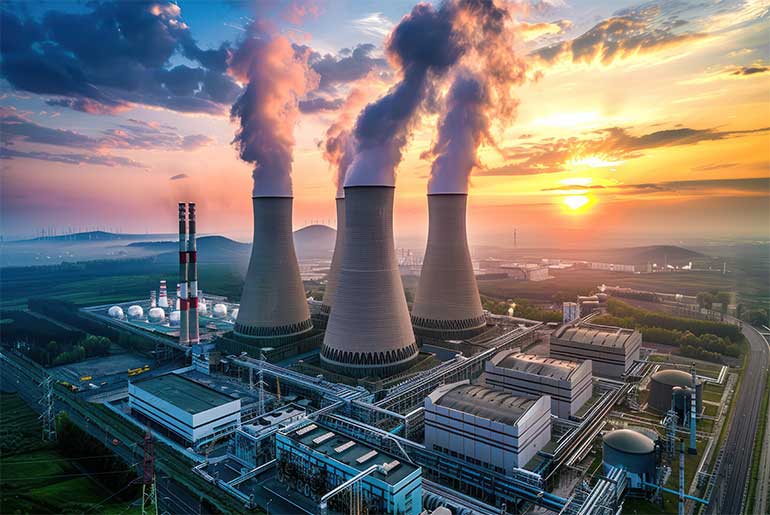
The Government of India has launched the Nuclear Energy Mission (NEM) under the Union Budget 2025–26, targeting 100 GWe of nuclear power generation capacity by 2047 as part of its Viksit Bharat vision and the goal of achieving net-zero carbon emissions by 2070. The mission also aims to develop and operationalise at least five indigenous Small Modular Reactors (SMRs) by 2033. In line with these objectives, the Bhabha Atomic Research Centre (BARC) is working on the design and development of the 220 MWe Bharat Small Modular Reactor (BSMR-200), 55 MWe Small Modular Reactor (SMR-55), and an up to 5 MWth High Temperature Gas Cooled Reactor (HTGCR) for hydrogen production.
The government has also enacted the SHANTI Act, 2025, to support the country’s nuclear energy ambitions and help achieve the target of 100 GW of nuclear capacity by 2047. A key provision of the legislation is the opening of India’s nuclear energy sector to private participation, which is expected to encourage greater investment and technological development. The move is aimed at strengthening India’s domestic nuclear capabilities while supporting the country’s long-term clean energy and decarbonisation goals.
Government has drawn up a roadmap for reaching the 100 GW nuclear power capacity by 2047 as announced in the Nuclear Energy Mission. As per the roadmap, the present nuclear power capacity of 8.78 GW is expected to reach about 22 GW by 2031-32 on progressive completion of projects presently at various stages of implementation. Another 32 GW of nuclear power capacity is envisaged to be set up beyond 2032 by NPCIL, comprising of indigenous Pressurised Heavy Water Reactors (PHWR) and Light Water Reactors (LWR) by 2047 taking the capacity to about 54 GW. As per the roadmap, the balance of 46 GW is expected to be set up by other Public Sector Enterprises (Central & State), State Governments, Private sector and Joint Ventures in different business models, comprising of reactors of different technologies.
(A) The BSMR-200 is an indigenous Pressurized Water Reactor (PWR) based power reactor. The current status of the BSMR-200 is mentioned below;
In-principle approval for engineering and construction of BSMR-200 has been received.
Proposal for Administrative & Financial sanction is cleared by Atomic Energy Commission (AEC) and the approval of Empowered Technology Group (ETG) has been obtained.
Atomic Energy Commission has approved Tarapur, Maharashtra as site for BSMR-200.
The SMR-55 is based on Pressurised Water Reactor design. The current status of the SMR-55 is mentioned below;
In-principle approval for engineering and construction of SMR-55 has been received.
Atomic Energy Commission has approved Tarapur, Maharashtra as site for SMR-55
Up to 5 MWth HTGCR is being designed and developed by BARC as nuclear heat source for suitable thermochemical cycle, such as copper-chlorine cycle, for hydrogen production. The current status of the HTGCR is mentioned below;
In-principle approval for engineering and construction of HTGCR has been received.
The proposed site for the reactor is BARC, Vizag. Siting consent has been received.
Terms of Reference (ToR) for obtaining environmental clearances has been received from the Ministry of Environment, Forest and Climate Change (MoEF&CC).
The SHANTI Act-2025 envisages participation of private entities in the field of nuclear energy including R&D in the field to promote indigenous nuclear technology. Also, BARC is engaging Indian industries through knowledge sharing and handholding for new technology developments for the SMRs, thus developing nuclear vendors for self-reliance in the field of nuclear technology encouraging R&D ecosystem in private sector.
To facilitate participation of private sector in nuclear power generation, the SHANTI Act establishes the regulatory body (Atomic Energy Regulatory Board) so as to give it a statutory status and to carry out its functions independently. Under the SHANTI Act, the regulatory body will be able to draft their own regulations and regulatory documents, carry out regulatory oversight, take enforcement action, and make recommendations to Central Government. In addition, the SHANTI Act will provide enhanced legislative and regulatory framework for continued excellence in nuclear safety keeping pace with large scale expansion of nuclear power program.
India has a robust system of implementation of Nuclear Safety and Security for all existing in India Nuclear Power Plants including Tarapur Atomic Power Station in Palghar District.
Highest priority is accorded to safety and security in all aspects of nuclear power viz. siting, design, construction, commissioning, and operation. Nuclear power plants are designed adopting safety principles of redundancy, diversity and provided with fail-safe design features following an overlapping defence-in-depth approach. This ensures that there are multiple barriers between the source of radioactivity and the environment. Nuclear power plants are constructed to highest quality standards and the operations are performed adopting well laid out procedures by highly qualified, trained and licensed personnel. There is also a robust internal and independent regulatory mechanism in place and periodic safety reviews are carried out both by Nuclear Power Corporation of India Ltd. (NPCIL) and the Atomic Energy Regulatory Board (AERB) to ensure safety of the plant.
The nuclear waste handling, treatment, storage and disposal are carried out as per the well laid down procedures and guidelines stipulated by the AERB in accordance with the Atomic Energy (Safe Disposal of Radioactive Wastes) Rules, 1987 and the requirements of AERB
Safety Code on ‘Management of Radioactive Waste (AERB/SC/RW)’. The adherence to these is verified through periodic inspection conducted by AERB. The handling and disposal area is kept under surveillance by the facility management. The environmental monitoring is carried out by Environmental Survey Laboratories (ESLs) of BARC.
Comprehensive safeguards and well-established procedures are implemented to ensure the safe storage, handling, and disposal of nuclear waste. Waste management practices are governed by stringent regulatory standards and are designed to protect operating personnel, the public, and the environment. Radioactive waste is segregated based on its activity level, treated using appropriate techniques such as chemical decontamination, absorption, ion exchange/membrane separations and volume reduction, and then conditioned into stable forms suitable for storage. Engineered storage systems with multiple containment barriers, radiation shielding, and leak detection mechanisms are employed to prevent any release of radioactivity. Waste handling operations are conducted using remote or shielded systems, wherever necessary, and under strict radiological surveillance. Regular monitoring, periodic safety reviews, and adherence to approved waste disposal protocols ensure continued safety throughout the lifecycle of waste management.
 Electrify your feed! Click here to join our Whatsapp group and to get the latest updates, expert insights, and innovations driving India’s energy storage revolution.