NITI Aayog has warned that India must urgently accelerate domestic production of electric vehicle (EV) batteries, battery-manufacturing equipment, and advanced EV technologies to avoid being confined to the lower end of the global EV value chain.
The caution comes from the Trade Watch Quarterly for Q1 FY26 (April–June 2025), released on Tuesday in New Delhi by NITI Aayog member Dr Arvind Virmani.
“India needs to enhance export competitiveness by rationalising incentives and correcting cost distortions, expanding export-linked financing for emerging markets, reducing inland and port logistics costs, and accelerating domestic production of critical inputs such as EV batteries,” the report stated.
Import Dependence Weakening Trade Competitiveness
According to the government think tank, India’s heavy reliance on imported high-value battery-making equipment and advanced technologies is undermining its trade competitiveness and long-term position in the global EV ecosystem.
Without strong domestic capabilities in high-precision machinery and next-generation battery technologies, India remains largely limited to exporting assembled EVs, while continuing to import high-value components such as battery cells, packs, and power electronics.
“This structural gap limits India’s ability to scale exports of high-value battery cells, packs, and power electronics, especially as global leaders consolidate their dominance through tight technology control and vertically integrated supply chains,” the report noted.
Global EV Trade Expanding Rapidly, India’s Share Remains Marginal
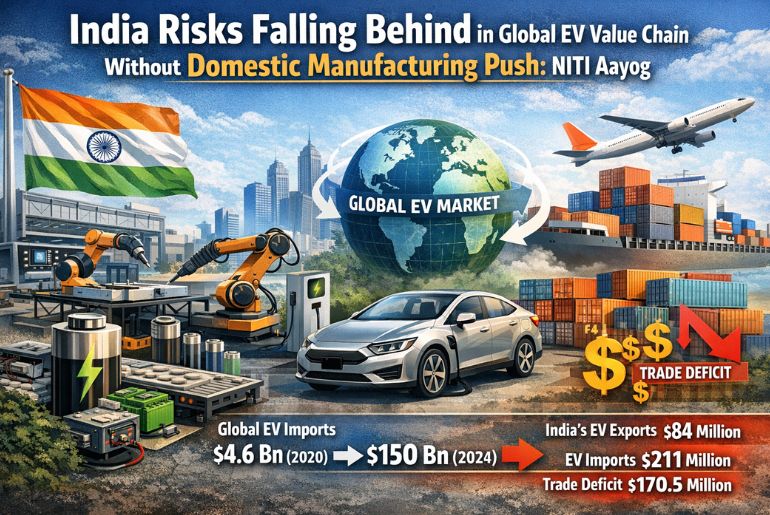
The report highlighted the sharp expansion of global EV trade over the past four years. Global EV imports surged nearly 30 times, rising from $4.6 billion in 2020 to almost $150 billion in 2024.
Despite this rapid growth, India’s share of global EV trade remains marginal, accounting for roughly around 0.1 per cent of global exports and imports.
India’s EV exports increased from $1.2 million in 2020 to $84 million in 2024, while imports climbed to $211 million in 2024, resulting in a trade deficit of $170.5 million, the report showed.
Exports Concentrated in Low-Cost Vehicles
India’s EV exports are currently dominated by small, affordable vehicles, limiting value realisation. Nepal accounted for 46.4 per cent of India’s EV exports in 2024, while emerging markets such as Indonesia and Japan have begun to feature, though shipment volumes remain modest.
Call for FDI, Technology Partnerships and Testing Infrastructure
NITI Aayog warned that as global markets shift towards advanced battery chemistries and stricter quality standards, India risks losing further ground unless it strengthens its domestic manufacturing ecosystem.
To address this, the report called for:
- Targeted foreign direct investment (FDI)
- Technology partnerships
- Dedicated equipment-testing and validation centres
- Greater focus on process innovation and manufacturing infrastructure
These measures, the think tank said, are essential to reduce import dependence and enable India to move up the EV value chain.
 Electrify your feed! Click here to join our Whatsapp group and to get the latest updates, expert insights, and innovations driving India’s energy storage revolution.