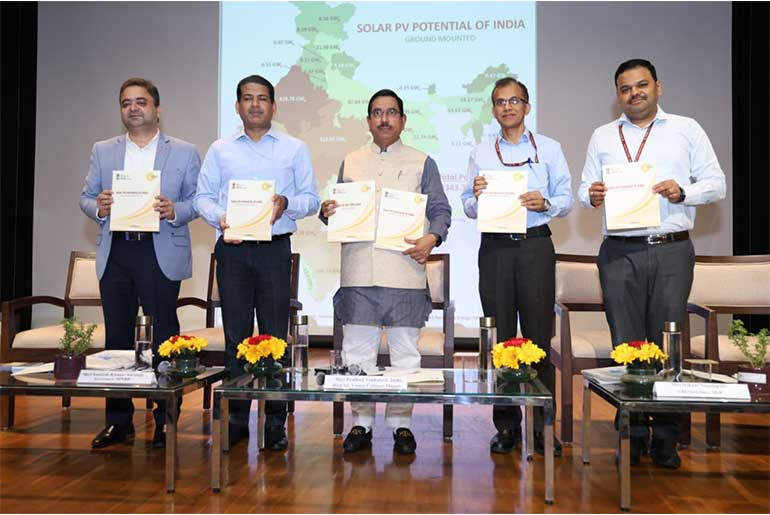
The Ministry of New & Renewable Energy announces a major milestone in India’s clean energy journey. Union Minister Shri Pralhad Joshi has officially launched the updated Solar PV Potential Assessment Report and inaugurated the first Training Programme on Solar Cell and Module Manufacturing at the National Institute of Solar Energy (NISE), Gurugram, under the aegis of Seva Parv.
These initiatives mark a significant step toward achieving India’s targets of 500 GW non-fossil fuel capacity by 2030, energy independence by 2047, and the net-zero commitment by 2070.
Stay tuned for more developments as India leads the way in sustainable, self-reliant, and inclusive energy growth.
He was addressing a gathering at MNRE headquarters where the report “Solar PV Potential Assessment of India (Ground-Mounted)” was released and the training programme was formally inaugurated. Shri Joshi underlined that these initiatives mark a decisive step towards achieving India’s target of 500 GW non-fossil fuel capacity by 2030, ensuring energy independence by 2047 and fulfilling the net-zero commitment by 2070.
The Minister highlighted that India has already crossed 250 GW of non-fossil installed electricity capacity and achieved the NDC target of 50% non-fossil share in installed capacity, five years ahead of the 2030 deadline. He noted that India has created a strong domestic manufacturing base with over 100 GW of solar PV module capacity and more than 20 GW of wind turbine manufacturing capacity annually, showcasing the vision of Atmanirbhar Bharat.
Release of Report: Solar PV Potential Assessment of India (Ground-Mounted)
India possesses one of the world’s richest solar resources, with average irradiance ranging from 3.5 to 5.5 kWh/m²/day across much of the country. Recognizing this opportunity, National Institute of Solar Energy (NISE) (an autonomous institute of Ministry of New and Renewable Energy (MNRE) has undertaken an updated, scientific, and spatially resolved assessment of India’s ground-mounted solar PV potential.
The new report builds on the earlier 2014 estimate of 749 GWp and incorporates cutting-edge methodologies, including high-resolution GIS, satellite-derived datasets, and refined land-use models.
Key methodological features:
- High-resolution geospatial analysis to identify feasible solar sites.
- Integration of infrastructure and technical design factors, such as inter-row spacing, shading, proximity to substations and road networks.
Major findings:
- Feasible ground-mounted solar potential: ~3,343 GWp, using approximately 6.69% of the total identified feasible wasteland
- The report shows that apart from well-known desert regions in Rajasthan and Gujarat a large number of states have very high potential for ground mounted solar PV.
- The potential is very well spread all over the country. Apart from the well-known regions of Rajasthan, Maharashtra, and Gujarat due to availability of vast wastelands, and high irradiance, a large number of other states also show significant capacity owing to favorable solar geometry and land-use efficiency.
This assessment provides a policy-linked, investment-ready framework to guide project siting, infrastructure development, and private sector participation. The results are directly aligned with India’s Panchamrit commitments announced at COP26 and support the nation’s long-term goals of energy independence by 2047 and net-zero emissions by 2070.
Inauguration of Training Program on Solar Cell and Module Manufacturing
The Hon’ble Minister also inaugurated the first Training Program on Solar Cell and Module Manufacturing at NISE. This initiative has been designed to build technical capacity and develop a skilled workforce in line with India’s growing solar manufacturing sector, which has already achieved 100+ GW of installed module manufacturing capacity and 15 + GW of solar cell manufacturing capacity.
The course will provide hands-on training in advanced manufacturing processes, quality control protocols, and global best practices, thereby contributing to the creation of a self-reliant and globally competitive solar manufacturing ecosystem.
Women Empowerment and International Cooperation
The Minister interacted with 28 women trainees from 15 nations participating in the International Training Programme on Solar Energy Technologies and Applications for Women. He emphasised that India’s clean energy transition is not only about technology, but also about people and empowerment.
Highlighting PM Modi’s vision of Solar Didi, he said Nari Shakti is at the forefront of the renewable energy journey. He also noted the significance of launching the initiatives during Seva Parv and Navratri, reflecting the spirit of collective service and the strength of divine feminine energy in driving India’s clean energy transition.
The Union Minister said that the dual initiatives of releasing the updated Solar PV Potential Assessment Report and launching the training programme on solar manufacturing mark a defining moment in India’s renewable energy journey. He underlined that these steps will provide the scientific roadmap, skilled manpower, and manufacturing strength required to realise the vision of Viksit Bharat. With sustained efforts, partnerships with global and domestic stakeholders, and the active participation of citizens, India is poised to emerge as a global leader in the clean energy transition while ensuring energy security, economic growth, and environmental sustainability.
 Electrify your feed! Click here to join our Whatsapp group and to get the latest updates, expert insights, and innovations driving India’s energy storage revolution.