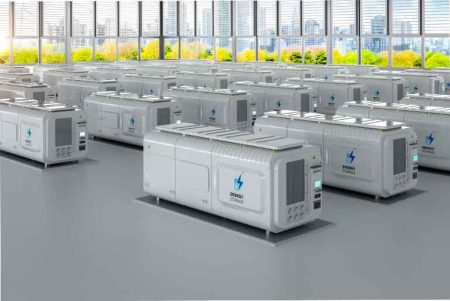
IESA has released a new report highlighting the enormous growth potential of energy storage systems (ESS) in India’s commercial and industrial (C&I) sector, with installations expected to surge more than 30-fold by 2032.
Developed by the India Energy Storage Alliance (IESA) in partnership with Customised Energy Solutions (CES), the report, titled “India Stationary Storage Market for C&I Applications: Insights Till 2032″, will be unveiled during the 12th India Energy Storage Week (IESW), scheduled to take place from July 8–10 at Yashobhoomi (IICC), New Delhi. According to the study, cumulative ESS installations across India’s C&I segment are projected to rise from less than 1 GWh in 2025 to between 23 and 31 GWh by 2032, reflecting a dramatic expansion of the market.
The report points to several factors driving this growth, including rising electricity tariffs, increasing demand for reliable and high-quality power, faster adoption of renewable energy, the need for cost optimisation, and India’s broader decarbonisation ambitions.
India Energy Storage Week (IESW) 2026, recognised as one of the leading platforms focused on clean energy transition, will bring together stakeholders from across the e-mobility, battery manufacturing, recycling, stationary storage, and green hydrogen ecosystems. As IESA’s flagship annual event, it is expected to host more than 200 exhibitors and over 10,000 industry professionals from 30+ countries, creating opportunities for networking, policy discussions, and technology exchange.
Commenting on the findings, Debmalya Sen, President of IESA, said, “India’s C&I energy storage market is at a pivotal moment. The sector is transitioning from backup and peak shaving to a strategic asset for energy optimisation, resilience, and decarbonisation. The insights from this report will help stakeholders shift from reactive power management to proactive energy leadership.”
The study outlines two possible growth trajectories for the sector. Under the Business-as-Usual (BAU) scenario, ESS deployments are expected to reach 22–23 GWh by 2032. Under the more optimistic Rapid Adoption (RA) scenario, favourable policy reforms and continued technological advancements could push installations up to 31 GWh. The BAU forecast assumes annual C&I load growth of 5–6% and a 15% CAGR in renewable energy adoption, while the RA scenario is based on an 18% renewable energy CAGR, supported by stronger policy measures and declining battery costs.
Vinayak Walimbe, Managing Director of CES, added, “With regulatory clarity, proven business models, and advanced storage technologies, C&I consumers can now make smarter, data-driven decisions that drive both cost savings and sustainability. Our study equips the industry with the actionable intelligence needed to capture this historic opportunity.”
The report provides a broad overview of the energy storage technology landscape, covering lead-acid, advanced lead-acid, lithium-ion, vanadium redox flow, sodium-ion, and pumped hydro storage systems. Its detailed technology assessment focuses on LFP, NMC, VRFB, and sodium-ion chemistries. While LFP batteries currently dominate the market, vanadium redox flow and sodium-ion technologies are gaining attention for long-duration storage applications.
Another key theme explored in the report is the ongoing shift from energy storage being used primarily as a backup solution to becoming a strategic tool tailored for specific applications. Businesses are increasingly deploying battery energy storage systems (BESS) for open-access renewable energy projects, diesel generator replacement, and rooftop solar integration.
To illustrate real-world applications, the report includes case studies such as DG Optimisation with BTM BESS for an industrial plant; solar & BESS at Scale Replacing Diesel in Leh; and the Om Shanti Retreat Centre project in Bhora Kalan, Gurugram (2021). These examples show that a one-hour-duration BESS designed to handle average outage loads and cycle more frequently can offer a better payback period than a larger system built to manage peak loads with lower utilisation. The case studies also demonstrate how solar-plus-storage systems can effectively replace diesel generation, even in remote, off-grid, and high-altitude locations. They further indicate that even a modest improvement in current PPA tariffs can significantly strengthen project economics.
Overall, the report concludes that battery energy storage systems are becoming increasingly viable in outage-prone and diesel-dependent environments, where hybrid solar-plus-storage solutions can improve reliability while delivering stronger economic returns. In addition to market forecasts, the study offers state-wise regulatory insights, technology benchmarking, and strategic recommendations for energy consumers, developers, investors, and policymakers.
 Electrify your feed! Click here to join our Whatsapp group and to get the latest updates, expert insights, and innovations driving India’s energy storage revolution.