JinkoSolar’s JKM650-670N-66QL6-BDV-F3 bifacial solar module and SunTera G3 6.25 MWh energy storage system are designed to address these complementary requirements.
The JKM650-670N-66QL6-BDV-F3 is built on JinkoSolar’s N-type TOPCon technology platform and is available in power ratings ranging from 650 W to 670 W. The bifacial module has an 85±5% bifaciality coefficient, allowing it to generate electricity from solar radiation received on both its front and rear surfaces.
An optimized cell and module layout is designed to improve solar energy capture, while the enhanced cell structure supports operation in low-light conditions. The module also incorporates metallization and encapsulation technologies intended to improve resistance to potential-induced degradation (PID), light-induced degradation (LID), light and elevated temperature-induced degradation (LeTID), and UV exposure.
The module is designed for utility-scale applications where mechanical strength is critical. It supports a maximum static load of 5,400 Pa on the front side and 2,400 Pa on the rear side.
Measuring 2,382 × 1,134 × 30 mm and weighing around 32.5 kg, the module features 2.0 mm anti-reflective coated front glass and 2.0 mm heat-strengthened rear glass. It also uses an anodized aluminium alloy frame and an IP68-rated junction box.
Module efficiency ranges from 24.06% at 650 W to 24.80% at 670 W. JinkoSolar specifies a 12-year product warranty and a 30-year linear power warranty, with an annual degradation rate of 0.35% after the first year.
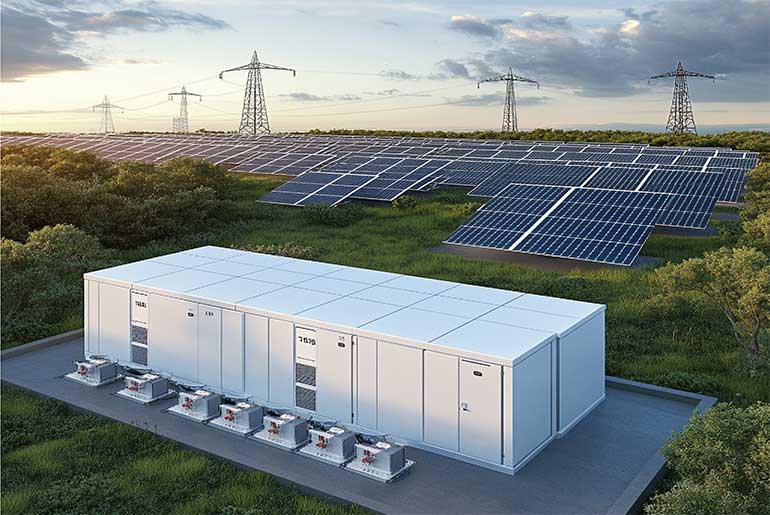
For energy storage applications, JinkoSolar’s SunTera G3 is a 6.25 MWh battery energy storage system designed for grid-scale deployments.
The system uses 588 Ah lithium iron phosphate (LFP) battery cells and a liquid-cooling architecture housed in a standardized 20-foot container. A rack-level energy management system is designed to improve round-trip efficiency by more than 1%, while active balancing technology can increase available charge and discharge capacity by up to 5%.
The container supports back-to-back and side-by-side installation configurations, giving project developers greater flexibility when designing storage sites.
Thermal management is a key feature of the SunTera G3. Its serpentine multi-parallel flow-channel design is designed to maintain a cell temperature difference of below 2.5°C. Multiple cooling-control modes are also intended to optimize thermal performance while reducing auxiliary power consumption.
Safety is addressed through a multi-level protection architecture covering the battery cell, rack and system levels. The system includes temperature and smoke detection, combustible gas detection, deflagration venting, aerosol protection and a water sprinkler system.
According to JinkoSolar’s specifications, the SunTera G3 has a rated capacity of 6.25 MWh and a rated voltage of 1,331.2 V, with a 1P416S × 8 configuration. The liquid-cooled system is designed to operate across temperatures ranging from -40°C to 55°C.
The JKM650-670N-66QL6-BDV-F3 and SunTera G3 serve distinct functions but can be deployed as complementary technologies within solar-plus-storage projects.
The bifacial TOPCon module focuses on maximizing electricity generation from available solar irradiation, while the BESS provides the ability to store electricity and shift its availability based on project and grid requirements.
JinkoSolar identifies solar-storage integration as one of the SunTera G3’s potential applications. The system can also support grid services such as frequency regulation, voltage support and peak shaving. Additional applications include energy arbitrage, capacity markets and ancillary services.
As renewable energy penetration increases, project performance is increasingly dependent not only on how much electricity can be generated but also on how effectively that electricity can be managed and dispatched.
JinkoSolar high-power bifacial TOPCon module and SunTera G3 approach these requirements from different directions. The PV module is focused on high-output solar generation, while the BESS combines large-scale storage capacity with liquid cooling, energy management and multi-level safety systems.
Together, the technologies illustrate how advanced solar generation and battery storage can provide complementary building blocks for renewable energy projects seeking improved generation performance, greater energy flexibility and enhanced grid-support capabilities.
 Electrify your feed! Click here to join our Whatsapp group and to get the latest updates, expert insights, and innovations driving India’s energy storage revolution.