Rechargeable batteries, particularly lithium-ion batteries (LIBs), have become the most widely used practical energy-storage option over the past two decades due to their high energy density and reliability. However, LIBs face several limitations, including safety concerns associated with their flammable nature, limited storage capacity, high costs, and dependence on scarce raw materials such as lithium, cobalt and nickel. These challenges are restricting the broader adoption of lithium-ion technology across various energy-storage applications.
These limitations have driven the exploration of alternative rechargeable batteries based on sodium (Na), potassium (K), magnesium (Mg), calcium (Ca), zinc (Zn), and aluminum (Al). Among these alternatives, rechargeable aluminum (Al)-ion batteries are especially promising because of their low cost, safety, and high theoretical capacity. Al is inexpensive, chemically stable in air, relatively inert, and one of the most abundant metals in the Earth’s crust, making it an ideal anode material for metal-ion batteries. The theoretical energy density of a standard LIBs is roughly 300 – 400 Wh/kg (practical commercial cells at 150 – 300 Wh/kg), whereas an aluminium-ion battery has a theoretical potential around 1,060 Wh/kg. These benefits make Al-based batteries promising candidates for next-generation energy storage technologies.
In this regard, water based, aqueous electrolytes would be much better choice. Aqueous Al ion batteries (AAIBs) can be manufactured under normal atmospheric conditions without an inert gas environment, which greatly reduce manufacturing costs while offering superior safety through their nontoxic and nonflammable nature. On top of that, AAIBs do not have to use expensive corrosion resistance metal for cathode current collector.
Therefore, in 2025, Dr. Ryohei Mori at Green Science Alliance as an inventor of this AAIBs has wrote review article including a series of his works in one of British scientific academic journal, with the title “Aqueous rechargeable aluminum battery – a mini review”. And made front cover of the journal.
However, battery performance of prepared AAIB was not sufficient at that stage. Capacity was approximately 103 mAhg-1 at the beginning which is lower than theoretical capacity, and capacity cycle stability was severely inefficient.
However, recently, Dr. Ryohei Mori has applied commercially cheap conductive carbon rubber sheet for AAIBs cathode current collector (substrate) and found highly stable battery performance. Under 0.025 C at room temperature, prepared AAIB demonstrated an initial capacity of at least 210 mAhg-1 which remained for at least 25 cycles and the measurement is still ongoing, and there is a high potential for further growth. Even voltage of prepared AAIB is 0.9 – 1.0 V which is lower than that of LIBs, although it can be solved by electrically connecting them in series. He also observed the redox peaks to confirm that the occurrence of charge-discharge processes in cyclic voltammetry experiments conducted below the theoretical water splitting voltage of 1.23 V (figure 1: In the figure, only first and 20 th data are shown). And these redox peaks were observed even after 100 cycles. In addition, importantly, conventional conductive carbon rubber sheet can replace expensive corrosion resistance metal, as cathode current collector.
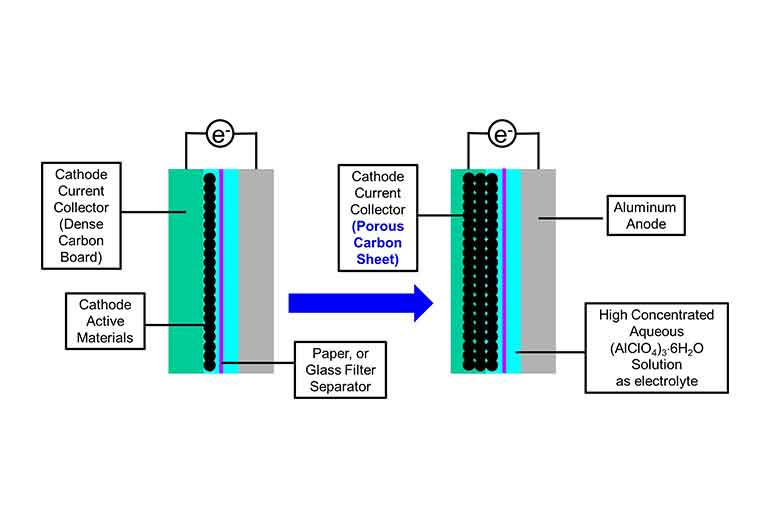
Dr. Ryohei Mori hypothesizes that the improvement in AAIB performance was due to the following mechanism: since the conductive carbon rubber sheet was porous, the supported cathode active material penetrated into the pores to form a 3D composite structure. The conductive carbon in the rubber sheet successfully maintained 3D pathways for electrical conductivity, which enabled efficient and positive interactions with the cathode active material. Furthermore, conductive carbon which is the component of porous rubber sheet itself, is the cathode active materials. As a result, the entire structure—including the current collector—effectively functioned as a cathode. Moreover, porous structure accepted aqueous electrolyte to penetrate into the cathode and current collector which increased the surface area for electrochemical reaction (figure 2). This inference was drawn based on the fact that satisfactory battery performance was not achieved when a dense carbon board was applied as cathode current collector.
He used graphite as cathode active material, commercial cheap paper as separator, and high concentration of aqueous aluminum perchlorate hexahydrate (AlClO4)36H2O solution was applied as an electrolyte which enabled AAIBs to possess rechargeable ability. In addition, Al anode with special composition was used as an anode. Even Al anode has specific metal composition, he confirms that this type of Al is not expensive. As such, these components are obviously extremely cheap as rechargeable battery components. It is said that cost of LIBs is approximately $115 per kWh, while projected costs for Al-ion battery could drop to the $55 to $60 per kWh range at scale. Since manufacturing cost of AAIBs is expected to be even cheaper than ionic liquid type electrolyte based Al-ion battery for above mentioned reason, prepared AAIBs could be even much cheaper than $55 per kWh.
Part of the results will be presented in upcoming international conference (250 th ECS (The Electrochemical Society) Meeting) which will be held at Calgary, Canada, on October 2026.
Dr. Ryohei Mori will keep challenging to improve capacity and cycle stability to create AAIBs for real industrial usage.
 Electrify your feed! Click here to join our Whatsapp group and to get the latest updates, expert insights, and innovations driving India’s energy storage revolution.