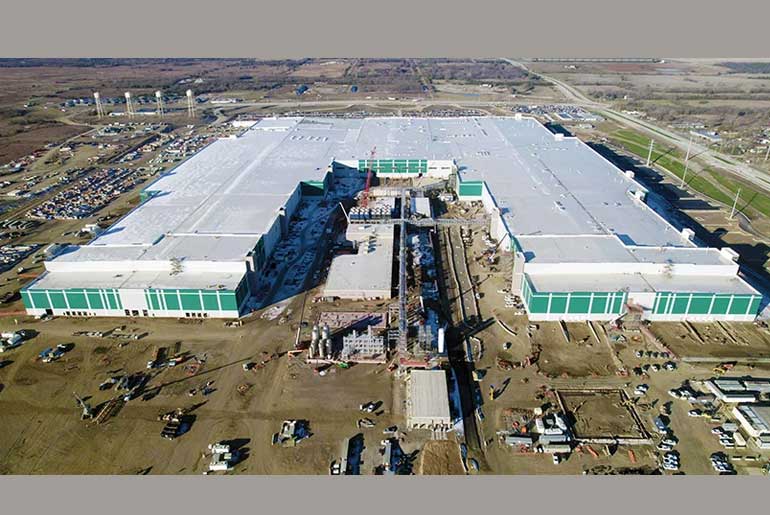
The Panasonic Group firm Panasonic Energy Co., Ltd. declared the formal launch of its new cylindrical lithium-ion battery factory for electric vehicles (EVs). The factory, which is situated in De Soto, just north of Kansas City, is one of the biggest automotive battery facilities in North America. To celebrate the milestone, a grand opening ceremony was staged on July 14. In addition, Panasonic Energy has started mass producing 2170 cells at the Kansas Factory, its second plant in North America, with aspirations to eventually reach an annual manufacturing capacity of about 32 GWh.
The Kansas Factory represents Panasonic Energy’s long-term commitment to investing in and expanding the electric car industry through a dual-region strategy in North America and Japan. It was constructed on a location that is over 300 acres in size, which is equivalent to more than 225 American football fields. The Kansas Factory is the company’s second EV battery production facility in the area, after the Nevada Factory, which has been in operation since 2017 and has an annual capacity of about 41 GWh. When fully operational, the Kansas Factory is expected to greatly increase Panasonic Energy’s U.S.-based production capacity to about 73 GWh. Additionally, the new factory will assist in meeting the demand from automakers that are increasing the manufacturing of electric vehicles.
Panasonic Energy has focused on inventing and perfecting production of high-performance, high-quality cylindrical lithium-ion batteries to meet the range, capacity, and safety demands of North American customers. Starting with EV battery production in Japan, Panasonic Energy has since become an industry leader, expanding the production of these advanced batteries in North America and contributing significantly to the growth of the EV industry. With approximately 30 years of experience in lithium-ion battery manufacturing and around 8 years of production expertise at the Nevada Factory in Sparks, Nevada, the company has grown the Nevada facility into one of the largest lithium-ion battery manufacturing sites in North America in terms of output, employing over 4,000 people and delivering more than 11 billion cells to date. Building on this proven track record, Panasonic Energy aims to further advance manufacturing capabilities and achieve stable mass production at the Kansas plant at an early stage.
The Kansas Factory is anticipated to have a 20 percent increase in productivity over the Nevada Factory by implementing labor-saving manufacturing lines. Panasonic Energy intends to launch products soon that use cutting-edge materials and boost cell capacity by around 5%. This also marks a major advancement in Panasonic Energy’s efforts to fortify the domestic electric car supply chain, which will increase the company’s competitiveness in the North American battery manufacturing market and enhance its sustainability commitment.
The facility is anticipated to generate up to 4,000 direct employment and around 8,000 jobs overall, including jobs in supplier and allied businesses, making it the biggest economic development initiative in Kansas state history. In order to foster long-term industry-academia partnerships centered on technological advancement and specialized talent development, Panasonic Energy is also working with organizations like the University of Kansas. This collaboration not only helps De Soto and the surrounding Kansas region grow economically, but it also helps to revitalize the U.S. manufacturing sector, cultivate a skilled workforce, and ensure the economy’s long-term strength.
Kazuo Tadanobu, CEO of Panasonic Energy stated, “The opening of our Kansas Factory marks a major milestone in our journey to scale advanced battery production in the United States. This achievement would not have been possible without the strong support of our local partners and the State of Kansas. Together, we are accelerating the shift to electrification, reinforcing regional supply chains, and nurturing the next generation of battery talent. This facility represents not only our commitment to the region but also a foundation for long-term collaboration and innovation in the U.S.”
The high-capacity lithium-ion cells from Panasonic Energy have an 800 Wh/L volumetric energy density, which leads the industry. With around 19 billion cells sold as of March 2025, they have powered about 3.7 million EVs and established the benchmark for dependability and safety, resulting in no car recalls to date. Panasonic Energy is still dedicated to promoting the wider use of electric cars as a means of reducing CO2 emissions, and it is working to advance the development of high-performance, high-quality cells.
 Electrify your feed! Click here to join our Whatsapp group and to get the latest updates, expert insights, and innovations driving India’s energy storage revolution.