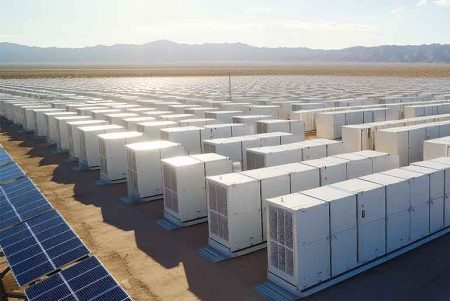
A U.S.-based business called Peak Energy has announced the launch and distribution of their sodium-ion battery energy storage system (ESS), which uses a patent-pending passive cooling design to significantly lower lifetime energy costs. Peak Energy is creating low-cost, giga-scale energy storage technology for the grid. The Electric Power Research Institute (EPRI) reports that 89% of battery storage system fires in the US have a primary cause that Peak Energy eliminates with this milestone.
Peak Energy’s product, which is the largest sodium-ion phosphate pyrophosphate (NFPP) battery system in the world, the first fully passive megawatt-hour scale battery storage system, and the first grid-scale sodium-ion storage solution ever deployed to the U.S. electric grid, is cost-competitive with state-of-the-art products while offering significantly lower operating and maintenance costs. Peak Energy is moving quickly toward its goal of onshore battery manufacture by implementing the technology in a joint pilot with nine top utility and independent power producer (IPP) customers this summer.
The most frequent failure modes in conventional battery storage systems are totally eliminated by Peak Energy’s NFPP grid storage battery architecture, which significantly improves reliability and lowers operating and maintenance costs by doing away with all moving parts, including active cooling and ventilation components. By using the benefits of sodium-ion batteries to provide a more dependable and affordable solution, Peak Energy’s NFPP grid storage technology represents a significant turning point in America’s rapidly growing energy storage industry. Since its chemistry enables operations over a broad range of hot and cold temperatures without the need for supplementary cooling devices, sodium-ion batteries are well-positioned to dominate the storage industry.
Since established lithium-ion technologies need active cooling and ventilation systems to maintain cell life and avoid fires, this discovery is a first-of-its-kind advance in grid-scale energy storage. By removing some of the most failure-pronecomponents included in today’s grid storage solutions, passive cooling enables Peak Energy to provide significant lifetime cost reductions when compared to the industry-leading systems.
Peak’s grid-scale battery storage solution comes at a critical juncture in the development of the US energy sector. The need of building up domestic manufacturing and energy supply chains has increased due to recent changes in federal policy. Battery storage is proven to be crucial for enhancing grid resilience and lowering energy prices as a result of these regulatory factors and the United States’ rapidly increasing energy consumption.
For grid applications, incumbent technologies are more expensive to develop, run, and maintain, are complicated, and present serious fire hazards. Because of the inherent raw material advantage in the US, sodium-ion offers the US the best chance to lead in battery chemistries in addition to its performance advantages. The whole sodium-ion raw material supply chain may be supplied domestically or from allies, and the United States has the biggest stocks of soda ash, the mineral precursor to sodium-ion, in the world.
“We see energy storage not only as an economic imperative, but also as a national security priority. Time is of the essence if the U.S. wants to take ownership and maintain control of its energy future,” stated Landon Mossburg, CEO and Co-Founder at Peak Energy. “We are committed to onshoring the manufacturing of this critical industry, and this launch proves our ability to execute quickly on our vision to establish the U.S. as a global leader in battery manufacturing.”
Peak Energy has conducted extensive performance testing of its ESS, where the results indicate record-level cost savings and reliability for the industry. This includes:
- At least $1 million in annual operational cost savings per gigawatt hour installed, representing up to 90% reduction in auxiliary power use
- Approximately 20% in lifetime cost savings vs. LFP in an average deployment
- 33% reduction in battery degradation over a 20-year project lifespan
“This isn’t just another product launch – it’s a breakthrough in energy storage,” stated Paul Durkee, VP of Engineering at Peak Energy. “We’ve taken a very stable chemistry and invested its benefits back into our passive cooling architecture. The system is dead-simple with no moving parts, no planned maintenance and negligible aux loads. It’s the lowest total-cost grid storage technology to be deployed anywhere in the world. I’m incredibly proud of the creativity and grit our team has shown in bringing our vision to life.”
Peak Energy’s pilot opens up almost 1 GWh of prospective commercial contracts that are already being negotiated and is an important first step in the commercialization of sodium-ion battery storage in the US. Peak Energy expects to make further announcements this autumn and will roll out several hundred megawatt hours of commercial-scale storage devices to service various IPP and hyperscaler partners over the following two years after the pilot. With the construction of its first U.S. cell facility scheduled to begin production in 2026, Peak Energy is currently on pace to meet its pledge to establish grid scale battery supply chains. This disclosure comes less than two years after the company’s 2023 secret debut and only one year after Peak funded its $55M Series A.
 Electrify your feed! Click here to join our Whatsapp group and to get the latest updates, expert insights, and innovations driving India’s energy storage revolution.