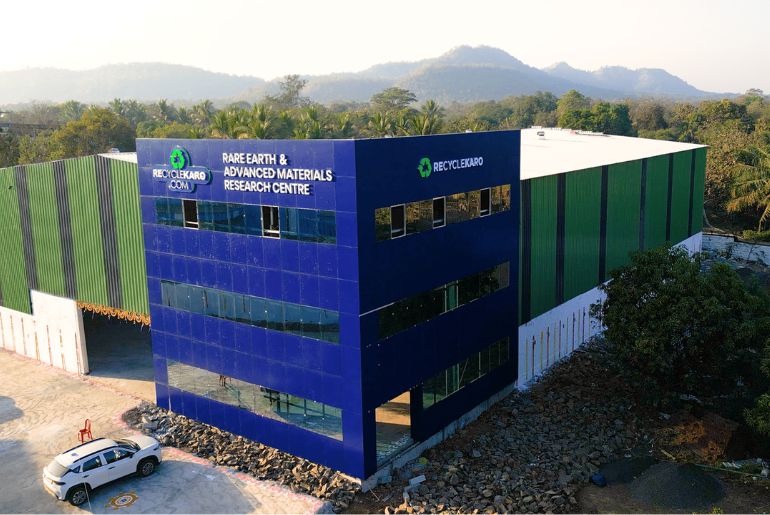
Recyclekaro, a leading e-waste and lithium-ion battery recycling company, has inaugurated its Rare Earths and Advanced Materials Research Centre at Wada in Maharashtra’s Palghar district, a significant step toward urban mining and critical material recovery in India.
Spread across five acres, the new research facility will focus on extracting rare earth elements and other advanced materials from end-of-life electronics, lithium-ion batteries and complex e-waste streams. The initiative is aimed at strengthening India’s mineral security by building domestic recovery pathways and reducing dependence on imports.
Long-Term Research and Scale-Up Plans
The centre has been established as a long-term, R&D-led platform with a five-year roadmap that includes rare earth recovery, advanced separation and purification technologies, battery materials optimisation, and scalable processes to achieve higher material yield and purity. Insights from this research will support Recyclekaro’s plans to expand rare earth processing capacity to 20,000 metric tonnes.
Currently, the company has an annual processing capacity of 24,500 metric tonnes of e-waste and 10,000 metric tonnes of lithium-ion battery waste, forming a strong operational base for future expansion.
Investment and Talent Development
As part of its long-term strategy, Recyclekaro plans to invest approximately INR 500 crore by 2030 to build world-class research infrastructure and nurture scientific expertise. Over the next 12 to 24 months, the company will recruit research scientists, PhDs and specialists in materials science, metallurgy and chemical engineering.
Collaborations and Strategic Focus
To strengthen its research capabilities, Recyclekaro is partnering with leading academic institutions such as IIT Bombay, IIT Kanpur and IIT Hyderabad, while also collaborating with international firms to align its R&D work with global best practices.
Comment from Leadership
Commenting on the launch, Rajesh Gupta, Founder and Managing Director of Recyclekaro, emphasised the importance of recovery in India’s mineral security strategy:
“India’s mineral security must be strengthened not only through imports or mining, but also through what we can recover.”
He added that the centre will help advance the science of urban mining by improving understanding of materials, recovery pathways and process efficiency, turning end-of-life products into a more reliable resource for a circular and self-reliant India.
About Recyclekaro’s Network
With more than 13 years of experience, Recyclekaro manages e-waste for major consumer electronics brands and operates roughly 1,200 collection points across India, playing a key role in expanding the country’s sustainable resource recovery infrastructure.
 Electrify your feed! Click here to join our Whatsapp group and to get the latest updates, expert insights, and innovations driving India’s energy storage revolution.