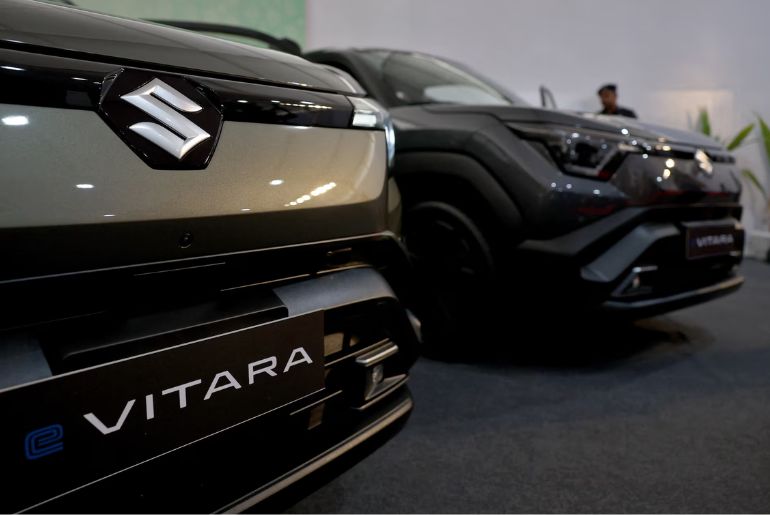
Suzuki Motor on Tuesday introduced its first electric vehicle in India, unveiling the e VITARA SUV with a battery rental plan designed to reduce upfront ownership costs. The model marks the company’s entry into India’s electric passenger vehicle segment, where battery subscription schemes have previously been offered only by SAIC Motor’s Indian venture.
The e VITARA has been developed in partnership with Toyota (7203.T) under a global model-sharing agreement. Production began in India in August last year, and 13,000 units have already been exported to 28 countries in 2025.
The base variant of the SUV has been launched at an introductory price of 1.1 million rupees (around $12,100). Customers opting for the battery rental plan will pay 3.99 rupees per kilometre (0.62 mile).
Known for its affordable small combustion engine vehicles, Suzuki’s pricing strategy was widely seen by analysts as critical to the success of its first EV in its largest market. The vehicle’s commercial rollout comes more than a year after its initial unveiling, as Maruti addressed customer concerns. High battery import costs and limited charging infrastructure had previously contributed to delays.
“The pricing announced is excellent. Whenever Maruti Suzuki enters a new segment, they have a penchant for recreating or disrupting the segment. Battery as a service is also a key factor that will bring buyers to Maruti’s showrooms,” said Gaurav Vangaal, analyst at S&P Global Mobility.
Vangaal estimated the per-kilometre battery cost is likely half of an equivalent combustion engine model.
Following the announcement, Maruti’s shares rose as much as 1.1%, before settling 0.6% higher.
Battery rental plans were first introduced in India by SAIC Motor’s local venture, JSW MG Motor India, in September 2023.
Electric vehicle adoption in India has accelerated amid launches from Tata Motors (TAMO.NS), Hyundai (HYUN.NS), Mahindra & Mahindra (MAHM.NS), and Tesla (TSLA.O). EVs accounted for approximately 5% of India’s car sales in 2025, doubling from a year earlier. The government targets 30% EV penetration in total car sales by 2030.
 Electrify your feed! Click here to join our Whatsapp group and to get the latest updates, expert insights, and innovations driving India’s energy storage revolution.