
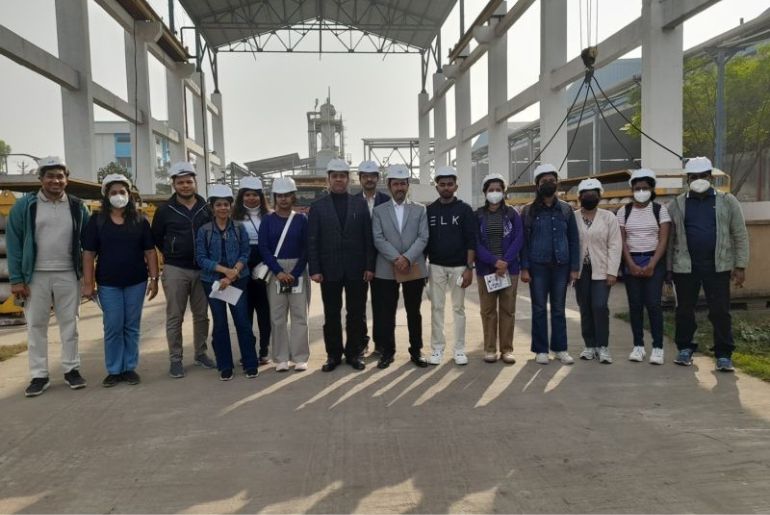
The Energy and Resources Institute (TERI) recently facilitated a high-impact knowledge exchange programme for a delegation of young professionals from the National Cleaner Production Centre Sri Lanka (NCPC), reinforcing regional cooperation on cleaner production and low-carbon industrial development.
Established in 2002 by the United Nations Industrial Development Organization (UNIDO) under the Ministry of Industries, Sri Lanka, the National Cleaner Production Centre plays a critical role in supporting enterprises to adopt resource-efficient and environmentally sustainable practices. The visit to TERI was designed to strengthen technical capacities and expose the delegation to practical approaches for advancing cleaner production and energy transition strategies.
During the programme, the delegation participated in a series of intensive technical and policy-focused sessions conducted by senior TERI experts. These sessions were led by Dr Suneel Pandey, Director, TERI, and Dr Manish Kumar Shrivastava, Associate Director, TERI. Subject-matter expertise was further provided by Dr Reeta Sharma (Ph.D) Sharma, Fellow, TERI; Anupam Buttan, Senior Manager, TERI; Kapil Muddineni, Fellow, TERI; Renuka Shinde, Research Associate; and Utkarsh Singh, Associate Fellow, TERI. The discussions covered key themes related to cleaner production systems, waste-to-energy pathways, sustainable industrial practices, and the policy and institutional frameworks required to enable low-carbon transitions.
As part of the knowledge exchange, the delegation also undertook a technical field visit to the Indian Potash Limited (IPL) Compressed Bio-Gas (CBG) plant located in Muzaffarnagar, Uttar Pradesh. The visit was led by Dinesh Chander Pant, Senior Fellow, TERI, and provided participants with direct exposure to operational waste-to-energy infrastructure. Moving beyond classroom learning, the delegation observed the full process through which organic waste is converted into compressed bio-gas, demonstrating how waste streams can be transformed into valuable and strategic energy resources.
The field visit offered practical insights into the technological, operational, and sustainability aspects of bio-gas production, highlighting its relevance for circular economy models and renewable energy integration. For the visiting young professionals, the experience underscored the potential of such solutions to address waste management challenges while simultaneously contributing to energy security and emissions reduction.
Overall, the engagement served as a forward-looking learning platform for the delegation, equipping them with knowledge and perspectives relevant to future-proofing Sri Lanka’s industrial landscape. By focusing on cleaner production practices and the transition to low-carbon energy systems, the programme aimed to support the next generation of professionals in driving sustainable industrial development within their national context.
 Electrify your feed! Click here to join our Whatsapp group and to get the latest updates, expert insights, and innovations driving India’s energy storage revolution.