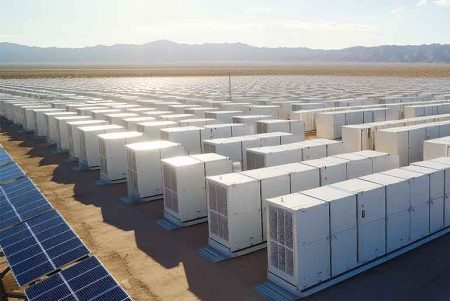

UL Solutions, a global leader in applied safety science, has announced significant enhancements to the testing methods for battery energy storage systems (BESS), which are critical for storing energy from renewable sources like solar and wind.
The new testing methods address industry innovations, including test methods for non-lithium-ion battery chemistries, such as sodium-ion batteries, that reflect the evolution of battery technology while continuing to address fire risk mitigation.
The changes in UL Solutions test methods reflect updates found in the fifth edition of ANSI/CAN/UL 9540A, the Standard Test Method for Evaluating Thermal Runaway Fire Propagation in Battery Energy Storage Systems, the American and Canadian national standard for addressing thermal runaway propagation for energy storage systems. The fifth edition was published by UL Standards & Engagement after collaboration with the energy storage industry, regulatory authorities and others serving on the standard’s technical committee.
“We are committed to working with industry to bring safer products to market and empower the safe and sustainable growth of the energy storage market,” said Wesley Kwok, vice president and general manager of the Energy and Industrial Automation group at UL Solutions. “These collaborative efforts with industry stakeholders and the fire safety community ultimately enhance the resilience of our energy infrastructure and protect communities worldwide.”
ANSI/CAN/UL 9540A provides a standardized test method to determine a battery technology’s susceptibility to thermal runaway, a chemical reaction that causes a battery to increase in temperature and pressure rapidly and can lead to significant safety issues, such as fire and explosions. The test method also evaluates fire and explosion hazards due to thermal runaway, such as the ejection of hot particles. After testing, a report provides data used to determine the necessary fire and explosion protection needed for tested BESS installations. The data from this test method helps bolster practical and effective safety measures within the industry.
The data from the report is also used for demonstrating compliance with codes and installation standards, which address public and first responder safety and property protection. These include NFPA 855, Standard for the Installation of Stationary Energy Storage Systems, and fire codes, including the International Fire Code®, the International Residential Code® and NFPA 1, Fire Code.
The original testing methods for thermal runaway propagation for energy storage systems were developed in 2017. These test methods were subsequently revised multiple times in 2018 and served as the proposed requirements, which were later published in the fourth edition of the consensus standard ANSI/CAN/UL 9540A in 2019. Key enhancements to the latest fifth edition include clearer criteria for cell-to-cell propagation, high-temperature test methods for various battery chemistries and testing protocols for emerging applications such as rooftop and open-garage BESS installations.
While ANSI/CAN/UL 9540A focuses specifically on the test method, the related UL standard, UL 9540, the Standard for Energy Storage Systems and Equipment, provides comprehensive product safety criteria and the basis for UL certification of the complete BESS itself. This includes its battery cells, modules and racks, and power conversion, battery management, energy management, communication and safety systems. The coordinated application of UL 9540A and UL 9540 and adherence to relevant installation codes help support the safe deployment of BESS.
“The rapid integration of energy storage across all sectors demands unwavering focus on mitigating fire and explosion risks and close engagement with industry, regulators and other experts. This must be accomplished with a strong foundation of science, as safety and reliability are paramount to the global energy transition,” said Ken Boyce, vice president of Principal Engineering at UL Solutions.
With the number of BESS increasing as energy demand widens, global concerns regarding BESS safety, particularly for large-scale installations, have increased. UL Solutions is also actively involved in developing large-scale fire testing (LSFT) methodologies. In collaboration with the NFPA Technical Committee, a dedicated task group is working to enhance guidance and consensus-based standards for LSFT. UL 9540A remains the only consensus standard explicitly referenced in NFPA 855 for LSFT in the U.S. and Canada.
 Electrify your feed! Click here to join our Whatsapp group and to get the latest updates, expert insights, and innovations driving India’s energy storage revolution.