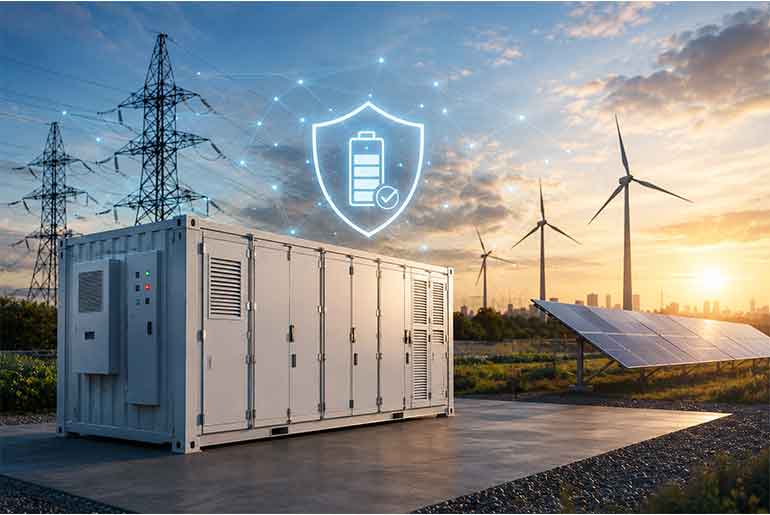
Viridi has entered into a strategic partnership with Oak Ridge National Laboratory (ORNL), a U.S. Department of Energy (DOE) national laboratory, to support research focused on next-generation utility grid technologies. The collaboration aims to advance grid resilience and reliability as utilities increasingly integrate energy storage and distributed energy resources into power networks.
Under the partnership, Viridi’s battery energy storage system (BESS) was selected for installation at ORNL’s Grid Research Innovation and Development Center (GRID-C), where it became part of a testing platform for a DOE resource integration and evaluation project.
The research builds on ORNL’s work to develop a system capable of controlling clusters of grid resources according to utility requirements. The technology was initially evaluated in an indoor laboratory using emulated energy sources and battery storage. Researchers subsequently moved to testing with real electrical equipment and a live grid environment to better understand challenges arising from equipment interactions and actual battery charging behaviour.
Viridi’s RPS 150 battery energy storage system was deployed at GRID-C’s Power Distribution Field Test Site for the programme. ORNL integrated its converter system with the battery to evaluate and validate the technology under real-world operating conditions. Testing has now been completed, and ORNL is expected to share the project findings in the coming months.
“This project bridges an important gap by integrating real electrical equipment to understand realistic performance challenges, proving the robustness of ORNL’s new control strategies and AC/DC architecture for supporting the future grid,” said Dr. Madhu Sudhan Chinthavali, Electrical Systems Integration Program Manager at Oak Ridge National Laboratory. “Viridi’s battery integrated seamlessly with our management system, and its engineering team supported our researchers throughout testing and integration, making them a valuable partner.”
Battery energy storage systems are becoming increasingly important to power infrastructure as electricity demand grows and utilities work to modernise ageing grids. The integration of distributed energy resources, alongside the need to strengthen resilience against disruptions, is creating demand for technologies capable of coordinating energy storage and other resources across different parts of the grid.
Viridi sees its participation in the ORNL programme as an important validation of its battery technology and its potential role in grid-modernisation applications.
“Being selected by Oak Ridge National Laboratory to support the project is a milestone for Viridi and a validation of what we have built”, said Jon M. Williams, CEO, Viridi “When a DOE national lab chooses your technology to support their research, it is the highest bar a battery system can meet. We built Viridi’s fail-safe BESS to perform in exactly these kinds of environments, and we are proud to be partnering with ORNL to advance the grid modernization solutions that utilities across the country need.”
The partnership is expected to extend beyond the completed testing programme, with Viridi and ORNL planning additional collaborative research projects. For Viridi, the initiative expands the role of its energy storage technology from grid-modernisation research towards potential real-world utility applications.
Viridi develops battery energy storage systems based on its proprietary lithium-ion technology, incorporating anti-propagation measures designed to prevent thermal events from spreading between battery cells. Its commercial-scale systems also combine connectivity and AI-enabled capabilities for remote monitoring and energy optimisation. The company is positioning the technology for applications where battery safety, reliability and integration flexibility are particularly important.
To understand the significance of the partnership and the growing role of commercial energy storage, Shweta Kumari, Sub-Editor of The Battery Magazine spoke with Chavonne Yee, Head of Regulatory Development, Viridi and Madhu Chinthavali, ORNL Electrical Systems Integration Program Director.
ORNL’s project moved from a controlled indoor environment to live-grid testing with real battery storage. What were the most important lessons from that transition, particularly around coordinating battery systems with other distributed energy resources under real operating conditions?
Madhu Chinthavali, ORNL Electrical Systems Integration Program Director: When resources made by different vendors must work together in the grid and respond in coordinated ways, interoperability is often a challenge. ORNL overcame this barrier during development of its grid management node technology through field testing at its Grid Research Innovation and Development Center (GRID-C).GRID-C’s Power Distribution Field Test site incorporated a battery from industry partner Viridi as well as distributed energy generation made by another company. Researchers were able to demonstrate that the ORNL node, a hardware/software platform, can seamlessly integrate communication and controls for hierarchical management of all the resources within a distribution grid.Working out technical challenges with real resources at GRID-C reduces utility risk and builds utility confidence in adopting grid modernization technologies.As utilities contend with rising electricity demand from electrification, AI, and data centers, how can fail-safe battery energy storage systems and advanced grid-control technologies work together to strengthen grid reliability and accelerate modernization at scale?
Chavonne Yee, Head of Regulatory Development, Viridi: As electricity demand continues to grow from electrification, AI, and data centers, utilities need greater flexibility to manage an increasingly dynamic grid. Fail-safe battery energy storage systems and advanced grid-control technologies work together to help utilities respond to changing conditions in real time, improve reliability, and maximize the use of existing infrastructure.Research at ORNL has shown that strategically deployed battery energy storage can help defer costly transmission and distribution upgrades by storing excess energy and delivering it where and when it is needed most. Instead of building larger transmission lines to accommodate short periods of peak demand or fluctuations in renewable generation, utilities can use battery storage to relieve congestion, improve asset utilization, and strengthen grid resilience.Battery energy storage also helps maintain power quality by rapidly injecting or absorbing power to improve voltage regulation, reduce feeder losses, and stabilize local distribution networks. These capabilities are particularly valuable in rural areas, where long distribution lines and limited transmission infrastructure can make reliable service more challenging.As AI and data centers introduce increasingly variable electrical loads, battery storage becomes even more important. AI workloads can create sudden spikes and drops in power demand as computing resources ramp up and down. Battery systems respond in milliseconds, smoothing these fluctuations before they affect the broader grid. This helps reduce stress on local infrastructure and provides utilities with a more stable and predictable load profile.For rural communities attracting new data centers and other large industrial customers, battery energy storage can provide an effective bridge while long-term grid upgrades are underway. Utilities can use storage to manage local congestion, support voltage stability, integrate renewable energy resources, and accelerate service to new loads without waiting for major transmission projects to be completed.When paired with advanced grid-control technologies, fail-safe battery energy storage systems provide utilities with a practical way to modernize the grid, improve reliability, and support growing electricity demand in a safe, resilient, and cost-effective manner.
 Electrify your feed! Click here to join our Whatsapp group and to get the latest updates, expert insights, and innovations driving India’s energy storage revolution.