India’s goal for renewable energy is no longer limited by how much it can generate, but by how well it can store energy on a large scale.
As solar and wind power continue to grow quickly, the focus is shifting to making sure that this energy can be stored and used when needed. Battery Energy Storage Systems (BESS) are now the most important part of making sure that power is available all the time, the grid is stable, and peak demand is managed.
With policy push, rising investments, and increasing participation from developers and utilities, India’s BESS market is transitioning from early-stage deployments to large-scale integration. However, the path forward is not defined by a single technology it is being shaped by a mix of chemistries, cost considerations, and real-world execution constraints.
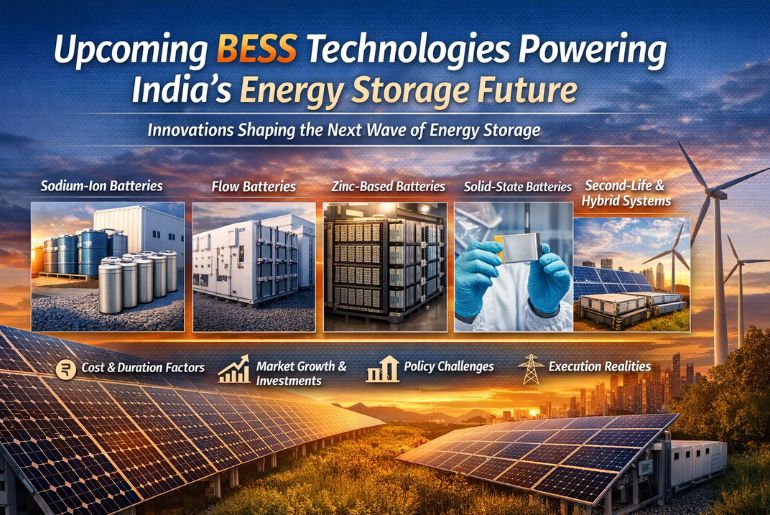
This article examines five key emerging BESS technologies through that lens.
The Technology Landscape: Beyond Lithium-Ion
Lithium-ion batteries are still the most popular type of battery for current uses because they have a long history of success and are easy to get money for. However, a new wave of storage technologies is on the way. Each one has a unique value proposition that fits certain use cases and time requirements.
1. Sodium-Ion Batteries
A Cost-Efficient Alternative on the Horizon
Sodium-ion batteries are becoming more popular as a possible replacement for lithium-ion batteries, especially for stationary storage uses. These batteries use sodium, which is a common and widely available element. This makes them a way to reduce dependence on raw materials and make the supply chain more resilient.
They are well-suited for India’s climate because they are thermally stable, and major industrial players are continuing to invest in them, which shows that they are becoming more confident in their long-term potential. The technology is still in its early stages of being sold to businesses, so there haven’t been many large-scale deployments yet.
As manufacturing ecosystems develop and costs decline, sodium-ion batteries are expected to gradually enter mainstream adoption, particularly in cost-sensitive grid applications.
2. Flow Batteries
Unlocking Long-Duration Storage
Flow batteries, particularly vanadium redox systems, are becoming an important way to store energy for a long time. They store energy in liquid electrolytes instead of solid ones, which makes them easier to scale and gives them a longer life.
As India moves toward round-the-clock renewable energy supply, the ability to store energy for 6 to 12 hours or longer becomes increasingly important. Flow batteries address this need effectively, offering minimal degradation over time.
However, their deployment is influenced by practical considerations such as land requirements, cost structures, and limited domestic manufacturing capabilities. As a result, their adoption is likely to be concentrated in large utility-scale projects where long-duration storage is essential.
3. Zinc-Based Batteries
Safe, Sustainable, and Cost-Focused
People are interested in zinc-based batteries because they are safe, last a long time, and are cheap. These systems fit well with India’s push for environmentally friendly energy solutions because zinc is safe to use and easy to find.
Their inherent safety makes them particularly suitable for applications where risk mitigation is critical, such as distribution networks and rural electrification projects. At the same time, their potential for competitive pricing adds to their appeal in cost-sensitive markets.
While still evolving, zinc-based technologies are expected to play a growing role as performance validation improves and deployment experience expands.
4. Solid-State Batteries
A Future-Focused Innovation
Solid-state batteries represent a significant leap in battery technology, replacing liquid electrolytes with solid materials to enhance safety and energy density. These characteristics make them particularly attractive for high-performance applications.
In India’s energy landscape, where safety and durability are very important, solid-state batteries have the potential to last a long time. But the technology is still in the early stages of research and commercialisation, and cost and manufacturing problems are making it hard to use right away.
Over time, as these barriers are addressed, solid-state batteries are expected to find applications in specialized and high-value segments.
5. Second-Life Batteries & Hybrid Systems
Practical Solutions for Today’s Market
The reuse of electric vehicle batteries for stationary storage is emerging as a practical and cost-effective solution. Second-life batteries extend asset utilization while supporting sustainability goals.
At the same time, hybrid BESS configurations, which combine different battery technologies, are becoming more popular as developers try to find the right balance between cost, performance, and flexibility. These systems let you manage energy use in the best way possible for different times and situations.
Although integration complexity remains a challenge, such approaches are increasingly being explored in large-scale renewable projects.
Market Reality
Bankability Still Drives Technology Adoption
Lithium-ion still rules India’s BESS market, even though many other storage technologies have come out. This dominance is based on more than just performance. It’s also based on bankability, which comes from its proven track record, established supply chains, and acceptance among financiers.
In reality, developers usually choose technologies that lower the risk of execution and guarantee returns that are easy to predict. So, new technologies are slowly making their way onto the market, adding to existing solutions rather than replacing them.
Cost vs Duration
The Real Decision Framework
Storage decisions in India are increasingly based on application and duration requirements rather than a single preferred technology.
- Short duration (0–4 hours): Dominated by lithium-ion
- Medium duration (4–8 hours): Emerging alternatives like zinc-based systems
- Long duration (8+ hours): Flow batteries gaining relevance
This shift reflects a more nuanced approach to storage planning, where different technologies are deployed based on specific project needs.
Execution Challenges
Bridging Policy and Ground Reality
While policy support is accelerating market growth, execution on the ground presents several challenges:
- Land constraints near substations
- Transmission infrastructure limitations
- Financial health of DISCOMs
- Lack of standardized integration frameworks
Addressing these issues will be critical to scaling BESS deployments effectively across the country.
Policy Push & Investment Momentum
Government programs like viability gap funding and storage requirements in renewable tenders are sending strong signals that BESS is needed. At the same time, more private developers and global investors are getting involved, which is bringing more money into the sector.
This combination of policy support and market interest is expected to significantly expand India’s storage capacity in the coming years.
The Road Ahead
A Multi-Technology Future
India’s energy storage market is changing into a multi-technology ecosystem where different types of batteries work together and do different things.
Lithium-ion will still be the most popular type of battery for a while, but new technologies like sodium-ion, flow batteries, and zinc-based systems will slowly become more common. The market will also be shaped by hybrid systems and new ways of deploying them.
As India moves toward a renewable-driven energy system, the success of this transition will depend not only on how much energy is generated but on how effectively it is stored, managed, and delivered.
Energy storage is no longer a supporting component of the power sector it is becoming its backbone.
 Electrify your feed! Click here to join our Whatsapp group and to get the latest updates, expert insights, and innovations driving India’s energy storage revolution.