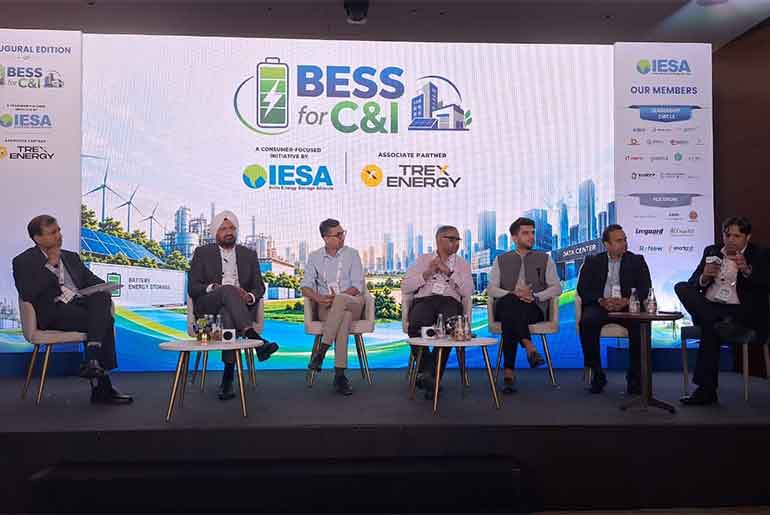
The India Energy Storage Alliance (IESA) has launched its “BESS for C&I” initiative at the Jio World Convention Centre in Mumbai to accelerate battery energy storage adoption among commercial and industrial (C&I) consumers. The initiative comes as India’s C&I battery storage capacity rises from 40 MWh to 650 MWh and is projected to reach nearly 4 GWh by FY2027. IESA aims to support 300 C&I consumers with energy storage solutions over the next three years while addressing key adoption challenges, including high upfront costs, evolving regulations, limited financing options and gaps in consumer awareness.
BESS for C&I will host monthly sessions from October 2026, bringing together industry, developers, and policymakers to discuss deployment, economics, and best practices.
Debmalya Sen, President of IESA, said, “The BESS for C&I platform is designed to address the unique challenges faced by commercial and industrial energy consumers as battery storage becomes essential for grid flexibility and business resilience. No single technology can meet all system needs; collaboration, knowledge-sharing, and innovation across the value chain are critical to accelerating adoption and shaping India’s battery storage future.”
This initiative creates a dedicated, free workgroup for commercial and industrial consumers. With battery storage now essential for India’s C&I sectors to manage rising power demand, control costs, and integrate renewables, IESA and industry leaders are calling for immediate policy action and targeted incentives to accelerate C&I battery storage adoption.
Bharat Chhittarka, Director, Trex Energy, remarked, “To make India a global hub for battery manufacturing, we must expedite cell manufacturing and reduce dependence on imported raw materials, which currently account for 60-70% of battery costs. Battery energy storage is essential for managing time-of-day tariffs and accessing clean energy, especially as policies like Maharashtra’s TOD offer major savings. I recommend that all states create clear policies on TOD, energy arbitrage, and peak shaving, following Maharashtra’s example, to accelerate large-scale BESS adoption.”
This community-driven platform will bring together industry stakeholders, policymakers, and energy users to share credible information, practical solutions, and best practices, empowering India’s C&I sector to unlock the full value of battery storage and accelerate the nation’s clean energy transition.
Bimal Jindal, CEO, Energy Business, JBM Renewables Private Limited, said, “To make India a global hub for battery manufacturing and supply chain, we must build a complete domestic ecosystem, including component-level manufacturing, securing lithium carbonate and cell production, and investing in R&D. The expansion of battery energy storage systems will be crucial for achieving net-zero goals, reducing long-term operating costs, and enabling the sale of green products internationally, despite initial cost challenges. The Government may consider increasing the mandated share of BESS deployment across relevant projects and reducing the GST on BESS from 18% to 5%, in line with solar panels.”
The group meets monthly to share policy updates, technology trends, and pricing insights, while offering exclusive access to B2B meetings, tech tours, and masterclasses.
Sushmita R. Ajwani, Head of Business Development (C&I), Aditya Birla Renewables, said, “For India to become a global leader in battery manufacturing, we must move beyond assembly and invest in internal cell manufacturing, backed by strong policy and financial support. Battery storage ensures reliable renewable supply, especially during peak demand. Although prices remain volatile, adoption will grow rapidly with clear regulatory guidelines and targeted incentives or rebates for BESS-backed renewable solutions.”
Despite growth, battery storage faces project cost volatility, with utility-scale capex rising 15% in recent months. However, the right policy support and strong local supply chains will unlock the next phase of transformation.
Inder Bhambra, COO-BESS and Chief Business Officer, India region, Envision Energy India Limited said, “To establish India as a global BESS manufacturing hub, we need to develop cell technologies and speed up assembly of DC containers locally, pack onwards. BESS enables an effective arbitrage against the rising peak tariffs and prepares the market for the upcoming new regulations, prescribing storage with every generation asset and mandating grid-forming features. The government must rationalise open access, removing transmission-related charges for charging of BESS, including the maximum demand charge, creating a supportive environment for large-scale deployment.”
Through IESA Connect, IESA will take this conversation to cities and industrial clusters nationwide, so C&I consumers help shape policy, standards and safety, not just buy the technology.
 Electrify your feed! Click here to join our Whatsapp group and to get the latest updates, expert insights, and innovations driving India’s energy storage revolution.