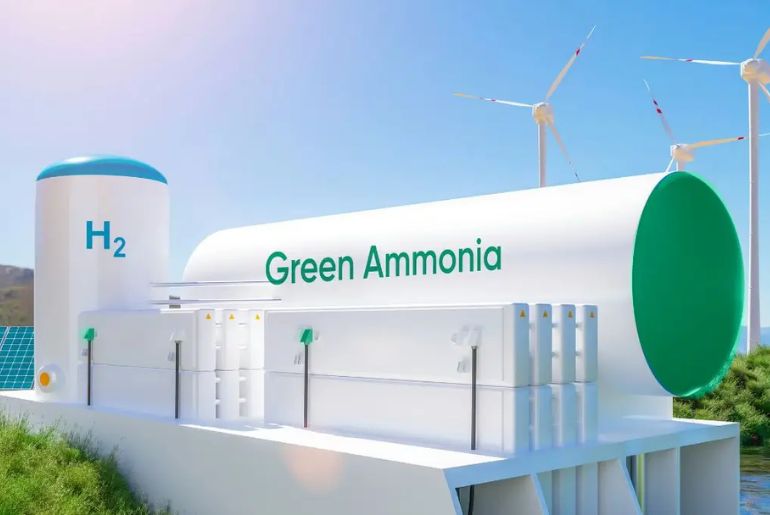
AM Green has commenced construction of its 1.5 million tonnes per annum (MTPA) green ammonia complex at Kakinada, Andhra Pradesh, marking a key milestone in India’s clean‑energy transition and industrial revival efforts. The project’s first major equipment was erected at a ceremony attended by Andhra Pradesh Chief Minister N. Chandrababu Naidu and Deputy Chief Minister K. Pawan Kalyan, officially kick‑starting the build‑out of what is set to become one of the world’s largest green ammonia facilities.
The Kakinada facility is being developed on the site of a legacy industrial complex, repurposed through a brownfield conversion to support large‑scale clean energy production. The integrated project combines 7.5 GW of solar and wind renewable capacity, 2 GW of pumped storage, and 1,950 MW of electrolyser capacity, enabling the production of green ammonia without carbon emissions. Once operational, the complex is expected to set new benchmarks for sustainable industrial infrastructure and strengthen India’s global position in clean‑energy exports.
during the inauguration Andhra Pradesh Chief Minister N. Chandrababu Naidu said “This project represents a historic advancement for Andhra Pradesh and for India’s renewable energy journey. Green ammonia offers a cleaner alternative for applications ranging from sustainable fertilisers to clean fuels, contributing meaningfully to India’s decarbonisation goals and global climate efforts,”.
He added that the facility will help position the state as a net exporter of green energy, with green ammonia from Kakinada destined for markets such as Germany and other international destinations.
The project is anticipated to generate significant economic benefits, including the creation of thousands of jobs during construction and operations, and to catalyse the development of a broader clean‑energy ecosystem in the region. It also aligns with Andhra Pradesh’s Integrated Clean Energy Policy, which aims to establish the state as a central hub for green hydrogen and green ammonia production in India.
With a total investment of around $10 billion, the project is among the country’s most significant clean‑energy investments, drawing global attention for its scale and export potential. Long‑term offtake agreements with international partners are already in progress, underscoring India’s growing role in the global clean‑energy market.
Phased commissioning of the complex will begin as early as 2027, with full capacity expected by 2030. Once operational, the green ammonia produced here will support international climate goals and provide a pathway for decarbonising sectors such as shipping, power generation and chemical production.
 Electrify your feed! Click here to join our Whatsapp group and to get the latest updates, expert insights, and innovations driving India’s energy storage revolution.