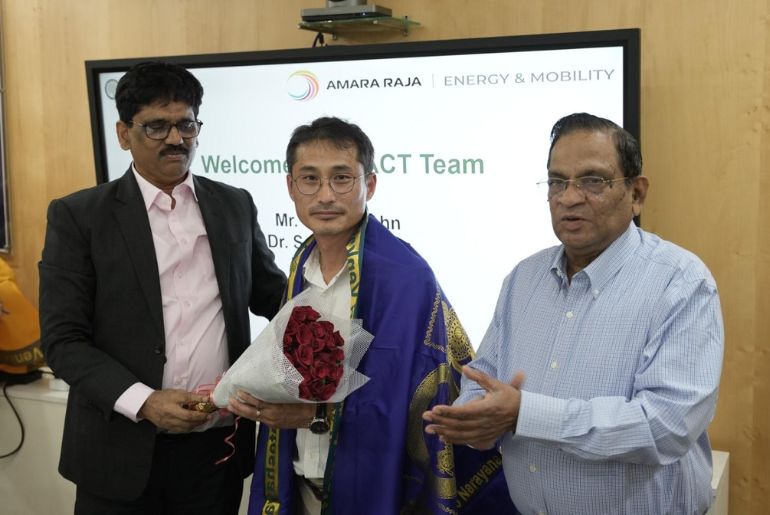
An expert delegation from Amara Raja Advanced Cell Technologies (ARACT) visited SRM University- AP to review ongoing research and outline the roadmap for Phase II of the SRMAP Amara Raja Centre for Energy Storage Devices. The Centre of Excellence, established in 2020 in collaboration with Amara Raja Batteries Ltd., has been actively engaged in advanced battery research, focusing on next-generation energy storage technologies.
The visit was a chance to look at how Phase I was going and make sure that future research is in line with changing needs in the industry.
Focus Areas and Research Advancements
Prof. D Narayana Rao, the SRM Group of Institutions’ Executive Director of Research, welcomed the group and talked about how important it was for them to work together. He also thanked Amara Raja for their ongoing help. He said that the Centre’s work includes new battery chemistries, advanced electrode materials, and recycling technologies that are good for the environment. He also said that people need to work harder in Phase II.
Vice Chancellor Prof. Ch Satish Kumar emphasised the university’s goal of transitioning from research-led outcomes to product-oriented innovation. He stated that while significant research progress has been made, the next phase will prioritise prototyping and commercialisation, underlining the importance of industry partnerships in translating academic research into practical solutions.
Delegation Interaction and Facility Review
The ARACT group included experts like Dr. Ravi Kali, Dr. Satyanarayana, Dr. K. Sushoban, Dr. Bhuvaneshwari, and Dr. Priscilla Grace. They engaged with faculty, researchers, and university leadership, reviewing ongoing projects and proposed directions for Phase II.
During the interaction, faculty members talked about their research on making battery materials that are cheap and work well. This included better cathodes for lithium-ion and sodium-ion batteries, solid electrolytes for safer all-solid-state batteries, and new lithium-sulfur technologies. Other tasks include making models of batteries, finding ways to charge them quickly, and recycling the materials from old batteries.
The delegation also toured the Amara Raja Centre and associated research facilities, appreciating the infrastructure and collaborative ecosystem.
At the end of the visit, both teams reaffirmed their commitment to moving forward with the Phase II program, which aims to create energy storage solutions that are both sustainable and ready for use in the industry, as well as to strengthen India’s position in the development of advanced battery technology.
 Electrify your feed! Click here to join our Whatsapp group and to get the latest updates, expert insights, and innovations driving India’s energy storage revolution.