The Ministry of Statistics and Programme Implementation’s (MoSPI) latest quarterly update of the PAIMANA (Project Assessment, Infrastructure Monitoring & Analytics for Nation-building) Performance Dashboard projects that storage requirements will increase from 87 GWh in FY2027–2028 to 888 GWh by FY2035–2036. This suggests that throughout the next ten years, India’s energy storage market will undergo a significant change.
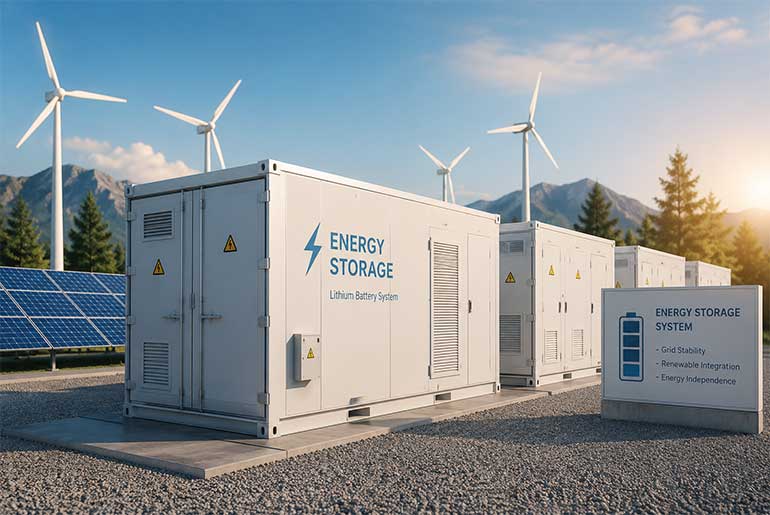
The latest projections underscore the growing importance of energy storage in supporting India’s expanding renewable energy capacity, with large-scale deployment of Battery Energy Storage Systems (BESS) and Pumped Storage Plants (PSPs) set to play a central role in maintaining grid stability and ensuring reliable power supply. The report indicates that both battery-based and hydro-based storage technologies will witness substantial capacity additions over the coming years.
Installed Pumped Storage Plant (PSP) capacity is expected to increase to 94 GW by FY2035-36, while Battery Energy Storage System (BESS) capacity is projected to reach 80 GW during the same period. The ministry noted that scaling up these storage assets will be essential for balancing intermittent renewable energy generation, improving grid flexibility, and enabling higher penetration of clean energy across the national electricity network.
As India continues to expand its renewable energy portfolio, the need for flexible storage infrastructure is becoming increasingly critical. The projected tenfold increase in storage demand reflects the country’s broader strategy to strengthen power system resilience while accommodating larger shares of solar and wind generation.Energy storage is expected to serve as a key enabler for round-the-clock renewable power, helping utilities manage demand fluctuations, reduce curtailment of renewable electricity, and improve overall grid reliability.
Launched on 16 April 2026, the PAIMANA Performance Dashboard provides a standardised framework for monitoring India’s key infrastructure sectors. Developed by MoSPI, the platform brings together official performance indicators to support evidence-based policymaking, improve infrastructure monitoring, and enhance public access to government data through periodic updates.
The PAIMANA dashboard showed advancements in other infrastructure sectors in addition to those in the power industry. With the number of mobile towers rising 3.7% annually to 8.55 lakh and Base Transceiver Stations (BTS) rising 7.4% to 32.25 lakh, India’s telecom network kept growing. In FY2025–2026, national teledensity also increased to 93.26%. The dashboard also showed strong development in electronic toll collection, with FASTag transactions totalling 88 crore during FY2026–2027 (up to May), a 39.7% year-over-year rise.
 Electrify your feed! Click here to join our Whatsapp group and to get the latest updates, expert insights, and innovations driving India’s energy storage revolution.