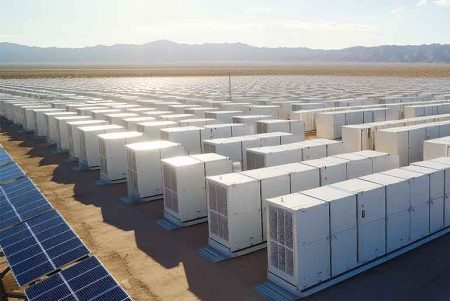

Union Minister of State for New and Renewable Energy, Shri Shripad Yesso Naik, submitted a written report in Rajya Sabha stating that the cost of Battery Energy Storage Systems (BESS) discovered through tariff-based competitive bidding has declined significantly in recent years, and during 2022–23, the discovered cost was about ₹10.18 per kWh when the storage system was utilised for two cycles per day.
In contrast, recent competitive bidding has revealed a substantially lower BESS cost of around ₹2.1 per kWh, even without Viability Gap Funding (VGF), assuming two daily cycles of usage. However, based on prevailing market trends, BESS utilisation is expected to average about 1.5 cycles per day, which corresponds to an estimated storage cost of ₹2.8 per kWh.
At the same time, the average tariff for electricity generated from solar projects, as seen in recent tenders, is in the range of ₹2.5 per kWh.
To improve the affordability of battery storage, the Ministry of Power is administering a VGF scheme for the development of 13,220 MWh of BESS capacity, supported by a budgetary allocation of ₹3,760 crore. In addition, in June 2025, the Ministry of Power launched another VGF scheme for the development of 30 GWh of BESS capacity, with financial support of ₹5,400 crore through the Power System Development Fund (PSDF).
The government has also extended waivers on Inter-State Transmission System (ISTS) charges to encourage BESS deployment. For co-located BESS projects commissioned by June 2028, ISTS charges are waived for 12 years. For non-co-located BESS projects, ISTS charge waivers are available for projects commissioned before June 2025, after which the waiver will be reduced annually in graded steps of 25 per cent.
Separately, the Ministry of Heavy Industries is implementing the Production Linked Incentive (PLI) scheme titled “National Programme on Advanced Chemistry Cell (ACC) Battery Storage.” The scheme aims to establish 50 GWh of domestic ACC manufacturing capacity, of which 10 GWh has been earmarked for Grid Scale Stationary Storage (GSSS) applications. Approved in May 2021, the scheme has a total outlay of ₹18,100 crore.
The PLI initiative is expected to promote investment in domestic manufacturing of battery cells for grid-scale applications, reduce reliance on imports, and lead to lower BESS costs in the future.
 Electrify your feed! Click here to join our Whatsapp group and to get the latest updates, expert insights, and innovations driving India’s energy storage revolution.