In the past few years, India has witnessed a rapid shift toward electric mobility. As the world looks to reduce carbon emissions and dependence on fossil fuels, electric vehicles (EVs) have become an important part of sustainable transport solutions. But no matter how popular EVs become, charging challenges and long wait times have remained key obstacles.
This is where battery swapping technology steps in – offering a way to quickly change a discharged battery for a fully charged one in just a few minutes, similar to refueling a petrol/diesel vehicle. In India, several innovators are actively building this ecosystem.
Today, we explore the major battery swapping players in India, how the system works, and why it might be a game-changer.
What Is Battery Swapping?
Instead of charging an electric vehicle’s battery at a charging station, battery swapping lets you take out the dead battery and put in a fully charged one at a swapping station. This method has some important benefits:
- Fast turnaround – Swap takes only a few minutes.
- Lower upfront cost – Because vehicles can be sold without the battery (battery-as-a-service).
- Higher vehicle uptime – Especially beneficial for delivery fleets and shared mobility.
- Standardization potential – Batteries can be interoperable across different brands.
As more people in India buy electric vehicles (EVs), battery swapping companies are getting more attention from the government, investors, and car makers.
Why Battery Swapping Matters in India
India has a unique vehicle landscape:
- Two-wheelers and three-wheelers form a substantial portion of traffic.
- Last-mile delivery vehicles are growing in number due to e-commerce.
- Consumers are price sensitive and seek fast, affordable solutions.
Charging stations that are already in place can take several hours to fully charge, which slows down daily operations for vehicles that use a lot of power. Battery swapping solves this problem by allowing for quick battery changes, which cuts down on downtime and makes the batteries more useful for both commercial fleets and individual drivers.
Because of this, battery-swapping players in India are becoming more and more important to the EV revolution.
Key Battery Swapping Players in India
Here are the most notable players building this ecosystem, categorized by their focus:
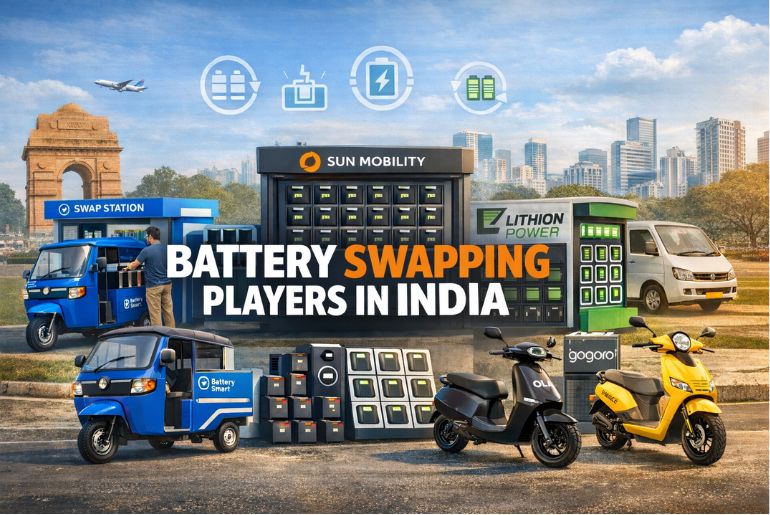
1. Battery Smart – Leader in 2W & 3W Swapping
Battery Smart is among the most prominent battery swapping players in India, focusing on electric two- and three-wheelers. The company has set up a large network of swap stations across multiple cities. These stations allow drivers of e-rickshaws, delivery scooters, and other light electric vehicles to exchange batteries within minutes instead of waiting hours to charge.
According to reports, Battery Smart has completed millions of battery swaps using a network of over 500 swap stations and more than 50,000 batteries in circulation.
The company uses a Battery-as-a-Service (BaaS) model, which significantly reduces upfront costs for vehicle owners.
Battery Smart works with electric vehicle (EV) retailers like ElectroRide on a regular basis to add more swap stations in important areas like Delhi and Uttar Pradesh. These expansions are meant to help even more vehicles and people.
Why Battery Smart Matters
- One of the largest networks among battery swapping players in India.
- Focus on fleet operators, delivery vehicles, and urban EV adoption.
- Strategic partnerships boost rapid deployment of swap stations.
2. Sun Mobility – Modular Solutions & Smart Batteries
Sun Mobility is another big player in India’s battery swapping market. People who have worked in the electric vehicle (EV) industry for a long time started Sun Mobility. The company’s main goal is to make smart batteries that can be switched out and SwapX stations that work with electric bikes and scooters.
Sun Mobility’s system is modular, meaning batteries can be used across different EV models, and the company works with vehicle manufacturers to integrate smart battery technology into fleets. SwapX stations are small and efficient, which makes it easy to quickly build up the swapping infrastructure in cities.
Key Strengths
- Smart, modular battery platforms.
- Partnerships with OEMs (Original Equipment Manufacturers).
- Strong presence in major metropolitan areas.
3. Ola Electric – Swap-Ready Scooters & Urban Hubs
Ola Electric is one of India’s most talked-about electric vehicle brands and one of the companies that lets you swap batteries. The company has said that it will put out scooters that are ready to be swapped, which means that they are built to easily accept standard batteries at swap stations.
Ola is integrating battery swapping into its broader EV strategy, aiming to support urban commuters and subscription models that reduce vehicle ownership costs.
What Ola Brings
- Scooter models designed for battery swapping.
- Urban swapping hubs that cater to daily commuters.
- A strong brand with wide public visibility.
4. Bounce Infinity – Subscription-Based Swapping
Bounce Infinity operates a slightly different model among battery swapping players in India. Instead of just setting up swap stations, Bounce offers battery subscription plans tied to its electric scooters. Customers can subscribe to a battery plan that allows them to swap batteries at designated outlets without owning the battery.
This reduces the initial purchase cost of EVs and makes adoption easier for many customers. It also encourages a service-oriented shift in the EV market.
Highlights
- Subscription models reduce consumer risk.
- Swap access integrated with scooter ownership.
5. Gogoro – Global Battery Swapping Pioneer Entering India
Gogoro is a Taiwanese company that is known for its advanced battery swapping network in Taiwan and other places. Gogoro’s business model is built around a large network of swap stations and smart scooters that make it easy for riders to change batteries.
Gogoro has started pilots in the Delhi NCR area with local companies like Zypp Electric. These pilots are focused on quick delivery and ways to get around in cities.
Why Gogoro Matters
- Proven global experience with battery swapping.
- Technology that supports large-scale networks.
- Potential to influence India’s swap standards and policies.
6. Emerging & Local Innovators
A number of other companies are also trying to make a name for themselves in India’s battery swapping market, in addition to these big ones. Some of these are:
- Lithion Power – targeting logistics fleets.
- Honda Mobile Power Pack e: – battery swapping system developed by Honda and partners, planned for use in upcoming scooters and networks.
These firms are contributing to a diverse landscape of battery swapping, pushing innovation and competition.
India’s Battery Swapping Reality (2025)
According to recent market insights:
- There are about 1,200 battery swapping stations operating across India.
- Almost 300,000 battery swaps are conducted daily.
- The vehicles benefiting most include delivery scooters, e-rickshaws, and shared EV fleets.
This rapid adoption has been driven by technology innovation, cost savings, and policy advocacy.
Government and Industry Support
The India Battery Swapping Association (IBSA) is an important group of manufacturers, swap providers, and industry experts. It works with the government to make battery designs the same, improve swap station infrastructure, and help the country’s electric vehicle (EV) goals.
This kind of advocacy helps shape supportive policies that make it easier for battery swapping players in India to scale their deployments.
Benefits of Battery Swapping
Battery swapping offers several major advantages for EV adoption:
1. Quick Turnaround
Users can exchange their battery in minutes cutting down waiting time compared to charging. This is especially helpful for delivery fleets and daily commuters.
2. Lower EV Cost
Battery-as-a-service (BaaS) makes electric vehicles (EVs) more affordable for middle-class buyers because they cost less up front.
3. Better Battery Management
Centralized charging and maintenance ensures batteries are kept in good condition, extending their life and safety.
4. Scalability
Swap stations can charge more than one vehicle at a time without needing a lot of power, which is especially important when the power grid is weak.
Challenges Ahead
Battery swapping is promising, but it isn’t without hurdles:
- Standardization: It’s hard to swap batteries around because they come in different sizes and shapes.
- Capital Costs: You have to spend money to build swap stations.
- Policy Clarity: National guidelines are still being worked out.
Even with these problems, the fact that so many battery swapping companies are getting involved in India shows that things are moving quickly.
The Road Ahead
Battery swapping could become a big part of India’s electric vehicle infrastructure in the next ten years, especially for two- and three-wheelers, heavy vehicles, and commercial fleets. As more companies join the market, competition will lead to new ideas, better coverage, and a better experience for customers.
Battery swapping has the potential to make EV usage faster, cheaper, and more convenient for everyday users. With the combined efforts of startups, established companies, and policy advocates, India is poised to lead in next-generation EV services.
Battery swapping is no longer just a cool idea for the future; it’s a real thing that’s happening in India. In India, some of the most important companies that swap batteries are Battery Smart, Sun Mobility, Ola Electric, Bounce Infinity, and Gogoro.
Their work shows that this model is ready to expand. Battery swapping could play a big role in India’s electric future if new ideas keep coming up, policies that support it are put in place, and people are interested in it.
 Electrify your feed! Click here to join our Whatsapp group and to get the latest updates, expert insights, and innovations driving India’s energy storage revolution.