

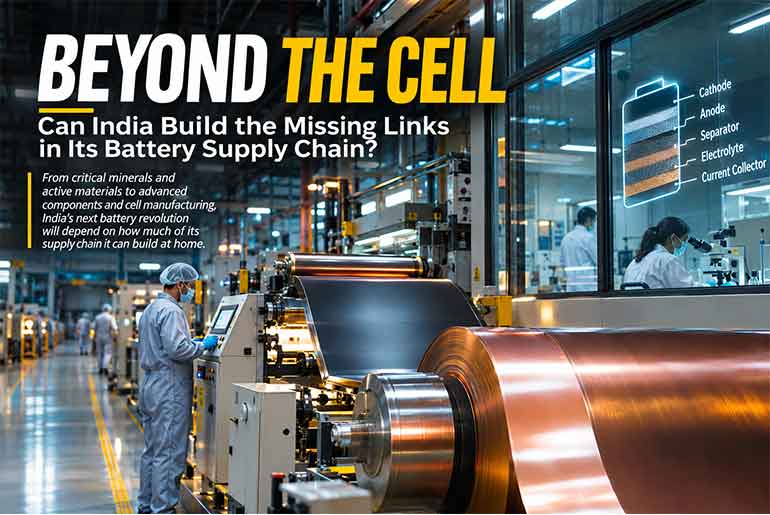
A battery may appear to be a single product, but behind every cell lies an intricate network of materials, chemical processes, specialised components, precision equipment and manufacturing technologies. The strength of this network determines not only how efficiently a battery performs, but also how competitively it can be produced and supplied. For India, building this network could prove to be one of the most consequential industrial challenges of its energy transition.
The country has made considerable progress in positioning itself as an emerging destination for electric mobility, renewable energy and grid-scale energy storage. Battery demand is expanding, domestic cell manufacturing investments are gathering momentum, and developers are increasingly looking towards storage to support a power system with a growing share of renewable energy. Yet, beneath this momentum lies a structural weakness: India’s battery manufacturing ambitions are still heavily dependent on components and materials sourced from overseas.
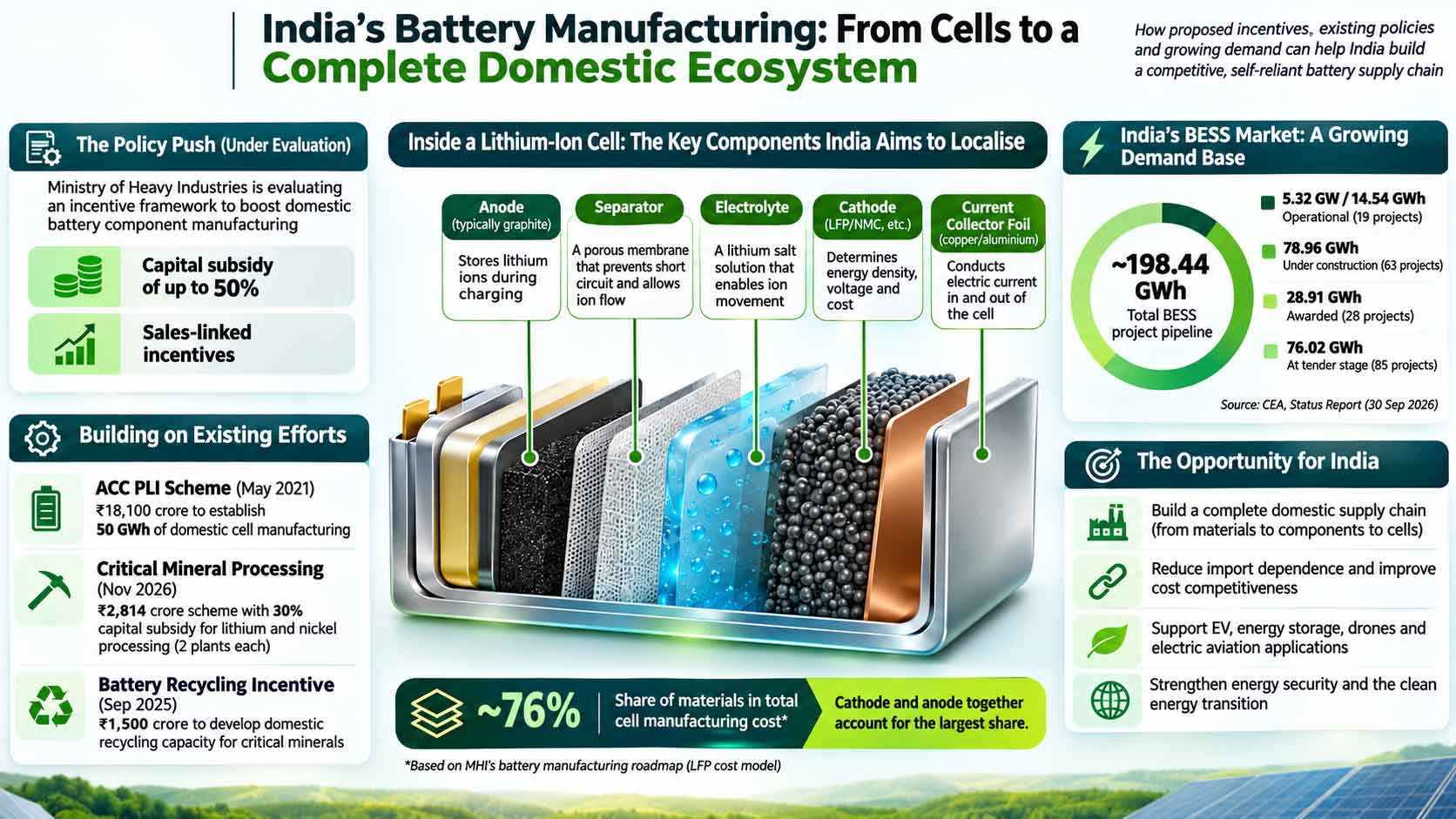
The Ministry of Heavy Industries (MHI) is now evaluating a proposed incentive framework that could offer capital subsidies of up to 50% and sales-linked support to encourage domestic manufacturing of critical battery components. Reported proposals include support for cathode active materials, anode active materials, electrolytes, separators and battery-grade copper foil. The proposed measures are intended to address the cost disadvantages faced by Indian manufacturers, attract investment and strengthen the domestic supply chain.
While the final contours of the proposed scheme remain under consideration, the policy discussion signals an important shift in India’s manufacturing priorities. The focus is gradually moving beyond establishing cell factories towards building the industrial ecosystem that feeds them.
The question, therefore, is no longer simply how many gigawatt-hours of battery capacity India can announce. It is how much of the technology, materials and manufacturing value behind those gigawatt-hours can actually be produced within the country.
The supply chain behind every battery
To understand the significance of the proposed incentives, it is important to look inside a lithium-ion battery cell.
A cell is built around several interconnected components, each performing a distinct electrochemical function. The cathode determines important characteristics such as energy density, voltage and cost, while the anode stores lithium ions during charging. The electrolyte enables ion movement between the electrodes, and the separator prevents direct electrical contact while allowing ions to pass through. Current collector foils provide the conductive pathways needed to collect and transfer electrical current.
These components are not interchangeable commodities. Their chemical composition, purity, particle characteristics, consistency and manufacturing quality directly influence battery performance, safety, lifespan and reliability.
Cathode and anode active materials also account for a substantial share of cell costs. The Ministry of Heavy Industries’ battery manufacturing roadmap, drawing on process-based cost modelling for LFP chemistry, estimates that materials account for approximately 76% of total cell manufacturing costs. Within the material cost structure, cathode and anode together account for the largest share.
This explains why component manufacturing deserves far greater attention. A country may assemble battery packs, integrate imported cells into energy storage systems and even establish cell manufacturing facilities, but its industrial value addition remains limited if the most critical inputs continue to arrive from external suppliers.
India’s dependence is particularly visible in the upstream and midstream stages of the value chain. A November 2026 assessment by the Council on Energy, Environment and Water (CEEW), titled Localising Battery Electrolyte Manufacturing in India, describes the domestic cell industry as almost entirely dependent on imported components, predominantly from China. The report identifies cathode active materials, anode active materials, electrolytes and separators as important gaps.
The challenge is therefore deeper than import substitution. India needs to establish capabilities in material processing, chemical formulation, precision manufacturing, quality control and industrial-scale production.
The China factor: Closing the competitiveness gap
China’s dominance in the global battery supply chain offers an important explanation for the urgency behind India’s latest policy discussions.
Over the years, China has developed an extensive manufacturing ecosystem covering mineral processing, cathode and anode materials, electrolytes, separators, battery cells and associated equipment. Its competitive advantage is not simply the result of lower labour costs. It reflects manufacturing scale, established supplier networks, technology development, integrated industrial clusters and years of investment across the value chain.
For Indian manufacturers, entering this market means competing against suppliers that already benefit from mature production infrastructure and established economies of scale.
A study titled Accelerating India’s ACC Component Manufacturing Ecosystem, prepared by the Net-Zero Energy Transition Association (NETRA) in collaboration with ARCI, CSIR-NCL, IIT Madras and Deloitte, and launched by the Ministry of Heavy Industries in November 2026, highlights the scale of this challenge. Drawing on information from more than 20 Indian companies, the assessment identifies domestic manufacturing costs that are approximately 18% to 61% higher than landed Chinese benchmarks, depending on the component.
The differences are particularly significant in graphite-based anode materials and LFP cathode production. The report also identifies substantial cost disadvantages in electrolytes, separators and copper foil.
The consequences extend beyond the factory gate. Higher input costs can make domestically manufactured cells more expensive, affect the economics of electric vehicles and energy storage projects, and discourage downstream manufacturers from sourcing locally.
Financial assistance alone cannot reproduce the industrial advantages built over decades elsewhere. India will need to address the underlying reasons for its cost disadvantage, including manufacturing yields, technology access, raw material availability, equipment dependence, energy costs and supplier qualification.
From cell ambitions to component capabilities
India’s existing policy framework provides an important starting point.
In May 2021, the Union Cabinet approved the Production Linked Incentive scheme for the National Programme on Advanced Chemistry Cell Battery Storage, with a financial outlay of ₹18,100 crore. Its objective was to establish 50 GWh of domestic advanced chemistry cell manufacturing capacity.
The programme represented a major attempt to attract large-scale investment and establish a competitive domestic battery manufacturing industry.
However, the distance between announced capacity and operational manufacturing has remained a concern. In a February 2026 parliamentary response, the Ministry of Heavy Industries reported that 40 GWh had been awarded to four beneficiary companies. Against this, the installed capacity reported under the scheme stood at just 1 GWh as of 31 December 2025. The ministry also identified limited technology availability, skilled manpower gaps, dependence on imported machinery and the non-availability of upstream components as implementation challenges.
These findings are particularly important. They demonstrate that manufacturing capacity cannot be created through financial commitments alone. A cell factory requires an entire ecosystem of qualified suppliers, process technologies, specialised machinery and trained personnel.
There has nevertheless been renewed activity. On 12 November 2026, the Ministry of Heavy Industries announced that it had received 22 bids for 10 GWh of additional ACC manufacturing capacity under the existing PLI programme. The capacity is earmarked for grid-scale stationary storage applications. This is a significant indication of industry interest, although bids should not be confused with awarded projects or commissioned factories.
The proposed component manufacturing incentives could address a different but closely connected part of the problem. By supporting domestic suppliers of critical materials, the government could help create a more dependable industrial base for cell manufacturers.
The two policy approaches need to work together. Cell manufacturing requires component suppliers, while component manufacturers require assured demand from cell producers. Without coordination, both sides risk waiting for the other to invest first.
The opportunity extends beyond lithium-ion
While lithium-ion technology currently occupies a central position in electric mobility and stationary storage, India’s manufacturing strategy must also account for evolving battery chemistries and specialised applications.
LFP and nickel manganese cobalt (NMC) batteries require different material compositions and manufacturing processes. Sodium-ion batteries, meanwhile, offer another potential pathway for applications where cost, material availability and operating requirements may favour alternatives to lithium-based systems.
The opportunity for Indian manufacturers is not restricted to producing conventional battery components. It also includes developing advanced materials, battery management technologies, thermal management systems, specialised enclosures, testing equipment and precision manufacturing processes.
For instance, the electrolyte segment illustrates how existing industrial capabilities could be redirected towards battery manufacturing. CEEW’s November 2026 research identifies India’s established strengths in fluorochemicals, petrochemicals, pharmaceuticals and fine chemicals as potential foundations for developing domestic battery-grade electrolyte production.
The opportunity lies in translating these capabilities into battery-specific manufacturing. Industrial chemicals alone are not sufficient; manufacturers must achieve the required purity, formulation consistency, electrochemical performance and quality standards.
This is where collaboration between chemical manufacturers, research institutions, cell producers and technology developers becomes essential.
The same principle applies to other components. Existing expertise in speciality chemicals, graphite processing, metallurgy, industrial equipment and advanced materials could support the development of a broader battery supply chain, provided companies can bridge the technological and commercial requirements of the sector.
Industry Voices: What manufacturers expect from the policy push
The proposed incentives have generated interest among companies operating across different parts of the battery ecosystem. Their perspectives also highlight why domestic manufacturing must be approached as a combination of industrial capacity, technological development and market readiness.
Saurabh Jain, CEO, Energy Storage, GEON
“The proposed capital subsidies of up to 50% and sales-linked incentives could be a significant step towards strengthening India’s domestic battery manufacturing ecosystem. As the demand for electric mobility and energy storage solutions grows, building a reliable local supply chain for battery components will be essential to reducing import dependence and improving cost competitiveness. Such incentives can encourage investments in manufacturing capacity, advanced technologies and component development, while creating opportunities for domestic players to scale their capabilities. However, the focus must also remain on quality, performance, safety standards and technological innovation to ensure that Indian manufacturers can compete globally. A strong domestic battery ecosystem will not only support the growth of the electric mobility sector but also strengthen India’s broader energy transition ambitions.”
Kajal Shah, CEO and Co-Founder, Dreamfly Innovations
“The proposed incentives are certainly a good initiative, because a battery is only as robust as the supply chain behind it. Manufacturing the components that go into a battery inside the country should go a long way towards ensuring consistent supply, better lead times, and a more dependable production process that suits Indian conditions. In the long run, it should also help with costs, through lower logistics expenses, less exposure to currency swings and fewer delays. In specialised fields such as drones and aviation, where volumes are low but consistency is critical, it would help if the policy also covers testing and certification facilities, so that smaller manufacturers can benefit too. This can strengthen the wider battery ecosystem in India, provided that it’s done well.”
Udyut Goyal, Business Development Head, AmpereHour Energy
“The proposed capital subsidies and sales-linked incentives could provide a significant boost to India’s ambition of building a robust domestic battery manufacturing ecosystem. While India has made considerable progress in battery energy storage deployment, strengthening the component manufacturing base will be equally important to reduce import dependence and build a resilient supply chain. Incentives of up to 50% can encourage investments in domestic manufacturing capabilities, advanced technologies and local sourcing, while helping manufacturers achieve economies of scale and improve cost competitiveness. However, the long-term impact will depend on how effectively these measures translate into technology development, quality standards and sustained industry participation. As renewable energy integration and grid-scale storage requirements grow, developing a strong domestic battery ecosystem will be critical to ensuring energy security, supporting the clean energy transition and positioning India as a competitive player in the global energy storage market.”
Storage demand: The market that can pull manufacturing forward
The case for domestic component manufacturing becomes even stronger when viewed against India’s rapidly developing energy storage market.
As renewable energy capacity expands, the power sector increasingly needs solutions that can manage variability, shift electricity across different periods of the day and support grid stability. Battery Energy Storage Systems (BESS) are becoming an important part of this transition, creating an additional source of demand for cells, battery packs, power conversion systems and associated technologies.
According to the Central Electricity Authority’s (CEA) status report dated 30 September 2026, India had 19 BESS projects in operation, representing approximately 5.32 GW and 14.54 GWh of capacity. Another 63 projects, totalling approximately 78.96 GWh, were under construction. A further 28 projects representing 28.91 GWh had been awarded, while 85 projects representing approximately 76.02 GWh were at the tender stage.
Together, these categories account for nearly 198.44 GWh of identified BESS project capacity. Importantly, this is a combination of operational capacity and projects at different stages of development, not an installed-capacity figure.
The scale of this pipeline illustrates the potential demand that could emerge for domestic battery manufacturers. However, a growing storage market does not automatically translate into a domestic manufacturing advantage. If developers continue to depend on imported cells and critical components, much of the manufacturing value will remain outside the country.
For companies such as AmpereHour Energy, which operate in the BESS solutions and integration segment, a stronger domestic component ecosystem could create opportunities to improve sourcing resilience and support the long-term economics of energy storage projects.
The opportunity is therefore two-sided: India’s expanding demand can provide a market for local manufacturers, while a stronger manufacturing base can support the cost and supply requirements of the energy transition.
Critical minerals and recycling: Completing the upstream picture
No discussion of battery localisation would be complete without examining the raw materials that feed the manufacturing chain.
Lithium, nickel, cobalt, graphite and other critical minerals are essential inputs across different battery chemistries. Yet mining is only one part of the challenge. Extracting minerals, refining them to the required purity, converting them into battery-grade chemicals and processing them into active materials require specialised infrastructure and technological capabilities.
Recognising this gap, the government has been expanding its focus on critical mineral security. The National Critical Mineral Mission, approved in January 2025, seeks to strengthen the country’s capabilities across exploration, mining, processing and recovery.
A further step came in November 2026, when the Union Cabinet approved the ₹2,814-crore Capex Support Scheme to Promote Critical Mineral Processing. The programme offers a 30% capital subsidy for establishing two lithium and two nickel processing plants. It is expected to attract approximately ₹10,000 crore in investment and will run from FY2026–27 to FY2030–31.
This initiative is particularly relevant because the availability of mineral resources does not automatically translate into battery-grade material production. Domestic refining and processing capabilities will be essential if India is to reduce its exposure to imported intermediates.
Recycling offers another route towards strengthening material security. Under the ₹1,500-crore incentive scheme approved in September 2025, the government aims to develop domestic recycling capacity for recovering critical minerals from lithium-ion battery scrap, electronic waste and other eligible secondary sources.
The scheme provides capital and operating incentives for eligible recycling activities, with support focused on the extraction of critical minerals rather than merely producing black mass.
For the battery industry, this creates an opportunity to connect manufacturing with circularity. End-of-life batteries and manufacturing scrap can become secondary sources of valuable materials, reducing the pressure on primary resources while supporting a more resilient supply chain.
A well-developed recycling ecosystem will not eliminate the need for primary mineral imports, but it can become an increasingly important contributor to domestic material availability over time.
What will determine whether the incentives succeed?
The proposed component manufacturing incentives could provide an important financial foundation, but their effectiveness will depend on how the policy is designed and implemented.
First, incentives must reflect the differences between components. Cathode materials, anode materials, electrolytes and separators have different capital requirements, technology barriers, production cycles and cost structures. A uniform support mechanism may not address the individual challenges faced by each segment.
Second, domestic manufacturers need access to technology and specialised equipment. Battery component production requires precision processes, controlled manufacturing environments, testing capabilities and consistent quality. Encouraging technology partnerships, domestic R&D and collaboration with research institutions will be essential.
Third, supplier qualification must become a priority. Battery manufacturers cannot change suppliers simply because a local alternative becomes available. Components must undergo extensive validation to establish their safety, performance, durability and consistency. Developing reliable testing and certification infrastructure can shorten this process and improve confidence in domestic suppliers.
Fourth, policy support must encourage actual production rather than announcements alone. Linking incentives to commissioned facilities, domestic value addition, manufacturing output, sales and quality benchmarks could help ensure that public investment translates into measurable industrial capacity.
Finally, the ecosystem must remain open to smaller technology developers and specialised manufacturers. As Kajal Shah points out, specialised applications such as drones and electric aviation may not offer the volumes of conventional automotive manufacturing, but they require high levels of consistency and reliability. Testing facilities, certification support and access to manufacturing infrastructure could help such businesses participate in the wider ecosystem.
The objective should not be to manufacture every component domestically at any cost. It should be to develop competitive, technologically sound and commercially sustainable capabilities in strategically important segments, while building diversified international partnerships for materials and technologies that cannot be sourced locally in the immediate future.
The real measure of self-reliance
India’s battery manufacturing story is entering a more demanding phase. The initial challenge was to attract investment and establish domestic cell production. The next challenge is to build the industrial depth that allows those factories to operate with greater domestic sourcing, reliable inputs and globally competitive economics.
The proposed incentives for battery components could become an important part of this transition. Alongside the existing ACC PLI programme, the National Critical Mineral Mission, mineral processing support and recycling initiatives, they offer an opportunity to address different stages of the battery value chain.
But the ultimate measure of success will not be the size of the subsidy, the number of announced factories or the capacity written into investment proposals. It will be the number of facilities that achieve commercial production, the quality of the materials they manufacture, the extent of domestic value addition and the ability of Indian suppliers to compete in international markets.
For India, building a battery industry is no longer just about assembling cells or integrating storage systems. It is about developing the chemistry, materials, machinery, expertise and industrial relationships that make those products possible.
The next chapter of India’s battery revolution will be written not only inside its gigafactories, but also in the component plants, chemical facilities, research laboratories and recycling units that sustain them.
The real question is not whether India can manufacture batteries. It is whether India can manufacture the ecosystem behind them.
 Electrify your feed! Click here to join our Whatsapp group and to get the latest updates, expert insights, and innovations driving India’s energy storage revolution.