As India accelerates its transition towards a cleaner energy future, the conversation is no longer centred solely on expanding renewable energy capacity—it is increasingly focused on ensuring that clean power is reliable, resilient, and available whenever it is needed. The next phase of the energy transition demands more than solar parks and wind farms; it calls for robust energy storage systems, flexible grids, diversified technologies, and forward-looking policy frameworks capable of balancing sustainability with energy security. As the country pursues its ambitious net-zero aspirations, integrating renewables into the grid while strengthening storage infrastructure and supply chains will be critical to building a dependable low-carbon energy ecosystem.
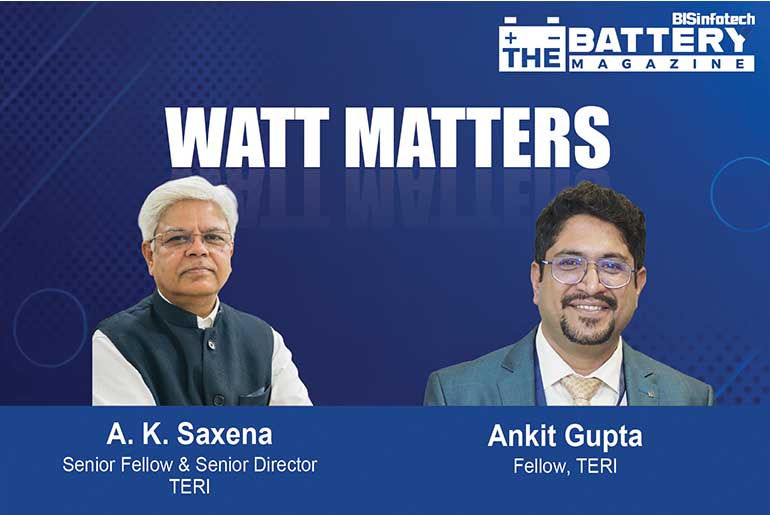
Against this backdrop, Shweta Kumari, Sub-Editor of The Battery Magazine, engaged in an insightful conversation with Sh. A. K. Saxena, Senior Fellow & Senior Director, and Ankit Gupta, Fellow, at TERI (The Energy and Resources Institute). Sharing their perspectives on renewable energy integration, energy storage technologies, grid flexibility, critical minerals, and the future of thermal energy storage, they outlined the strategic priorities that will shape & evolving energy landscape.
Let us delve into the conversation.
India has set ambitious renewable energy targets, but increasingly the conversation is shifting from capacity addition to system integration. In your view, what are the most underestimated challenges India must overcome to build a truly reliable renewable-powered energy system?
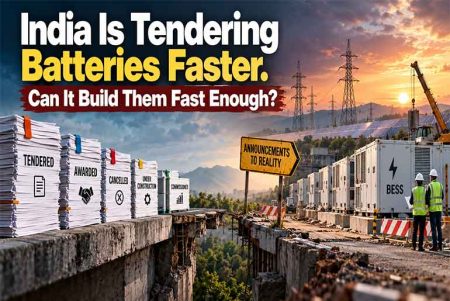
The pace of renewable energy (RE) capacity addition in India has accelerated sharply, from roughly 20 GW a year up to FY 2024 to about 55 GW in FY26. This is very encouraging. However, growth in actual RE generation is not keeping pace with the growth in RE capacity. Many DISCOMs do not come forward to sign PPAs before bidding by aggregators such as SECI, and they continue to delay signing PPAs for capacity already awarded competitively, probably hoping for even lower tariffs in subsequent auction rounds. As of May 2026, awarded RE capacity of the order of 45 GW remains without executed PPAs. The slow pace of energy storage deployment compounds this problem, since it has not yet given DISCOMs the confidence to contract RE or RE-plus-storage at scale in place of fossil-fuel-based generation.
At the system level, challenges are layered across timescales: steep evening net-load ramps as solar output declines while demand peaks, reduced system inertia and high rate of change of frequency as synchronous generation is displaced by converter-interfaced renewables, degraded fault current levels and protection coordination difficulties in inverter dominated system, voltage regulation issues and transmission congestion arising from the mismatch between RE-rich resource zones and load centres.
Battery Energy Storage Systems are often described as the backbone of future grids. However, are we at risk of viewing batteries as a universal solution when a diversified storage portfolio may be required? How should policymakers approach this balance?
India needs a suite of energy storage technologies to meet intraday, long-duration, and seasonal requirements rather than relying on a single type of energy storage. A combination of top-down and bottom-up approaches to developing energy storage options would help achieve the appropriate mix. The demand profile of a DISCOM, together with the capacity mix in their generation portfolio, should guide decisions on the required type and quantum of energy storage portfolio. Integrated Resource Planning (IRP) and Resource Adequacy (RA) studies can identify the estimated ESS requirements and inform plans and targets for different storage technologies. According to CEA’s National Electricity Plan, of the total energy storage requirement of ~ 411 GWh by 2031–32, 175 GWh is projected to come from Pumped Storage Projects (PSP) and 236 GWh from BESS.
Lithium-ion BESS, particularly lithium iron phosphate (LiFePO₄), or LFP, systems with round-trip efficiencies of 82–90% are well suited for intraday balancing, frequency regulation, and solar firming over 2–6-hour windows. India’s recent tenders confirm this commercial momentum. As of May 2026, 12.3 GW of BESS capacity had been awarded. While BESS is well suited for short-duration services, PSP, flow batteries, thermal energy storage, CO2 batteries, Compressed Air Energy Storage (CAES) and green hydrogen storage and its utilisation through fuel cells can support long-duration balancing, including at remote locations where diesel generation is prohibitively costly and unsustainable from environmental considerations.
Therefore, policymakers must focus on service-specific, technology-agnostic procurement frameworks that recognise and value the duration and dispatchability required for grid services.
Long-duration energy storage remains one of the most discussed challenges globally. Beyond lithium-ion batteries, which technologies do you believe have the greatest potential to contribute meaningfully to India’s future energy mix, and why?
A multi-technology energy storage portfolio is an operational necessity for serving India’s demand profile with the generation mix that is likely to evolve in the times to come.
PSP remains the most mature long-duration option (TRL 9), with 70–85% round-trip efficiency and the capability to supply power for 6–12 hours. India has approximately 7 GW of operational PSP capacity, about 13 GW under construction, and a further 92 GW at various stages, ranging from concurrence to survey.
Concentrated Solar Power (CSP) with Thermal Energy Storage (TES) deserves much more attention for meeting emerging summer duck curve and winter camel curve by shifting solar energy to evening and other high-demand hours. It provides firm, dispatchable renewable electricity (FDRE) through various options, such as molten-salt systems capable of 8–16 hours of storage at heat-to-heat efficiencies of 80–95%.
Sodium-ion batteries are close behind lithium-ion batteries in maturity and a natural complementary chemistry. Global shipments roughly doubled in 2025, and Chinese manufacturers have begun signing multi-gigawatt-hour supply contracts in 2026.
Vanadium redox flow batteries (TRL 8–9, with 8–10-hour duration) offer independent scaling of power and energy, along with very high circularity through electrolyte recovery.
CO2 battery technology is being deployed in India. NTPC is constructing a 20 MW/160 MWh CO2 battery using Energy Dome’s technology at its Kudgi plant in Karnataka. It is one of the first such deployments outside Italy, using steel as the sensible-heat storage material, along with water and CO2 sans any critical minerals.
Green hydrogen addresses days-to-seasonal storage requirements; its cost-effectiveness will pave the way for its acceleration.
Iron-air batteries (TRL 5) and gravity storage remain at early stages of development or pilot scale, but they are attractive because of their simplicity and reduced/no import exposure of critical minerals.
As renewable penetration rises, grid flexibility is becoming as important as generation capacity itself, and many believe the next phase of the transition will be driven as much by market design as by technology. What policy and market reforms from ancillary services and capacity mechanisms to regulatory reform would do the most to value flexibility, storage, and dispatchability, and have the most transformative impact over the next decade?
The Government’s Viability Gap Funding (VGF) framework for BESS, supporting 4,000 MWh with VGF of up to 40% of capital cost, and the second tranche of 30 GWh of BESS with ₹18 lakh/MWh of capital subsidy provide valuable policy support. This is expected to develop the market and reduce costs in due course through competitive bidding.
India’s electricity markets reward energy kilowatt-hours (kWh) generated far more effectively than they reward flexibility and dispatchability. Closing that gap needs reform on several fronts.
Three instruments deserve particular attention and examination:
- Capacity markets, which pay resources for being available and dispatchable rather than only for energy delivered. CERC has already initiated discussions on a capacity market for electricity in India. Contracts for Difference (CfDs), which fix a long-term price while allowing developers to sell into the spot market, thereby de-risking investment in higher-cost technologies.
- Time-of-Day (ToD) tariffs, which send clear price signals to both consumers and market participants by aligning electricity prices with system conditions. India’s ToD framework, introduced through amendments to the Electricity (Rights of Consumers) Rules, provides lower tariffs during solar hours and higher tariffs during peak-demand periods. As smart meter deployment expands, ToD tariffs can incentivise demand shifting, improve renewable energy absorption, reduce peak demand, and increase the value of storage assets that charge during low-price periods and discharge during high-price periods. This makes ToD one of the most powerful demand-side tools for enhancing system flexibility and reducing integration costs of variable renewables.
- Market-based ancillary services have already enabled BESS participation in Tertiary Reserve Ancillary Services (TRAS), while Grid-India’s AGC pilot has demonstrated the technical feasibility of BESS for Secondary Reserve Ancillary Services (SRAS). Under the current SRAS framework, Nodal Agency dispatches the resources required based on Rate and Cost Participation factor, and providers that remain available but are not dispatched, receive only a nominal commitment charge. Reviewing the commitment/availability charge for such reserve capacity would improve the viability of BESS while ensuring availability of adequate flexible resources.
The global race for critical minerals is intensifying. How should India navigate resource security, recycling, circular economy principles, and international partnerships to build a resilient battery value chain?
India’s ambition for the battery storage value chain must be grounded in both mineral endowments and strategic dependencies. The PLI Scheme for Advanced Chemistry Cell storage (₹18,100 crore) is a significant commitment to domestic manufacturing. An Approved List of Battery Manufacturers (ALBM), modelled on the solar PV sector’s Approved List of Models and Manufacturers (ALMM), could further reduce import dependence in government-backed projects through localisation.
Since India has limited domestic reserves of lithium, cobalt, and nickel, securing supplies from other countries is critically important. As part of the National Critical Mineral Mission, the Government of India has set targets for domestic exploration, overseas acquisition, recycling, processing, and stockpiling by 2030. The resilience of supply of critical minerals from overseas could be strengthened through equity stakes, offtake agreements, and government-to-government partnerships. Trade agreements that ease access to battery-grade minerals, while preserving space for domestic manufacturing to mature, would complement PLI-ACC and ALBM.
Recycling maturity varies by technology. Lithium-ion hydrometallurgical recycling is commercially established, with high recovery rates for cobalt, nickel, lithium, and manganese. VRFBs offer the highest circularity of any storage technology because their electrolyte can be recovered and reused almost indefinitely. Sodium-ion batteries offer weaker recycling incentives but rely on more abundant, lower-risk materials.
TERI has extensively worked on pathways toward net-zero and sustainable development. What critical energy transition risks do you believe are currently receiving insufficient attention from industry and policymakers?
Three issues deserve more attention.
First, energy security that has largely been viewed as the creation of domestic manufacturing capacity, should encompass the complete supply chains. For example, an energy storage transition built primarily on a single chemistry or on supplies from a handful of mineral-rich countries would merely swap one form of insecurity with another. Moving forward, the focus should increasingly shift towards the technologies for which the supply chains can be completely developed in the country. Equally important are technologies that benefit from stable trade relationships, diversified sourcing channels, and relatively straightforward end-of-life recovery and recycling pathways.
Second, the quality and cost-effectiveness of domestic manufacturing require critical attention for domestic as well as export market. Testing, certification, and quality-assurance infrastructure need to keep pace with the thrust for domestic content to avoid the risk of underperformance over the life of asset.
Third, and most underappreciated, is skill development. Building and operating large-scale BESS, PSP, CO2 battery, and CSP+TES capacity require a workforce skilled in installation, testing, commissioning, operations, and maintenance. Adequate training facilities need to be planned and developed at the required scale and speed.
TERI recently brought together stakeholders to discuss Concentrated Solar Power with Thermal Energy Storage (CSP-TES) as a pathway toward firm and dispatchable renewable energy. How do you envision the future role of thermal storage technologies within India’s broader energy transition strategy?
Thermal Energy Storage (TES) addresses long-duration storage needs that electrochemical batteries cannot meet cost-effectively, particularly during India’s post-sunset evening peak.
TES offers multiple benefits ranging from balancing the intermittency of renewables, peak load management, and improving resilience, flexibility and reliability, etc., in the transition towards sustainable power systems and modern energy landscapes. These systems help to store the thermal energy at higher temperatures for various applications including Solar Thermal based round-the-clock renewable energy.
Molten-salts, sensible-heat TES is the most mature option (TRL 8–9), delivering 8-16 hours of heat 80–95% heat-to-heat efficiency. Spain’s Gemasolar plant has demonstrated round-the-clock generation from a 19.9 MW tower with 15 hours of TES since 2011. China had installed 1.7 GW of CSP+TES by 2025.
Latent heat thermal storage using Phase Change Materials (PCMs) represents another promising pathway. By storing and releasing energy through phase transitions, PCMs can achieve significantly higher energy density than sensible heat systems while maintaining a nearly constant temperature during charging and discharging. This makes them attractive for both CSP applications and industrial heat storage, particularly where compact storage footprints and stable thermal output are required.
Solid-media heat storage and phase-change materials (TRL 7–9) with durations of 6–20+ hours, open a path for industrial decarbonisation by supplying high-temperature process heat round the clock to the cement, steel, and chemicals industries.
For India, the immediate opportunity is to deploy CSP+TES adjacent to existing large solar parks wherever possible, leveraging transmission infrastructure already built for solar PV. Rajasthan, Gujarat, and Leh-Ladakh, with their high direct normal irradiance (DNI), are promising locations for CSP+TES deployment. A dedicated national mission with a phased approach, starting with tenders in the range of 50–500 MW and requiring at least 6–8 hours of storage would explicitly procure Firm and Dispatchable Renewable Energy (FDRE) and unlock market interest.
 Electrify your feed! Click here to join our Whatsapp group and to get the latest updates, expert insights, and innovations driving India’s energy storage revolution.