


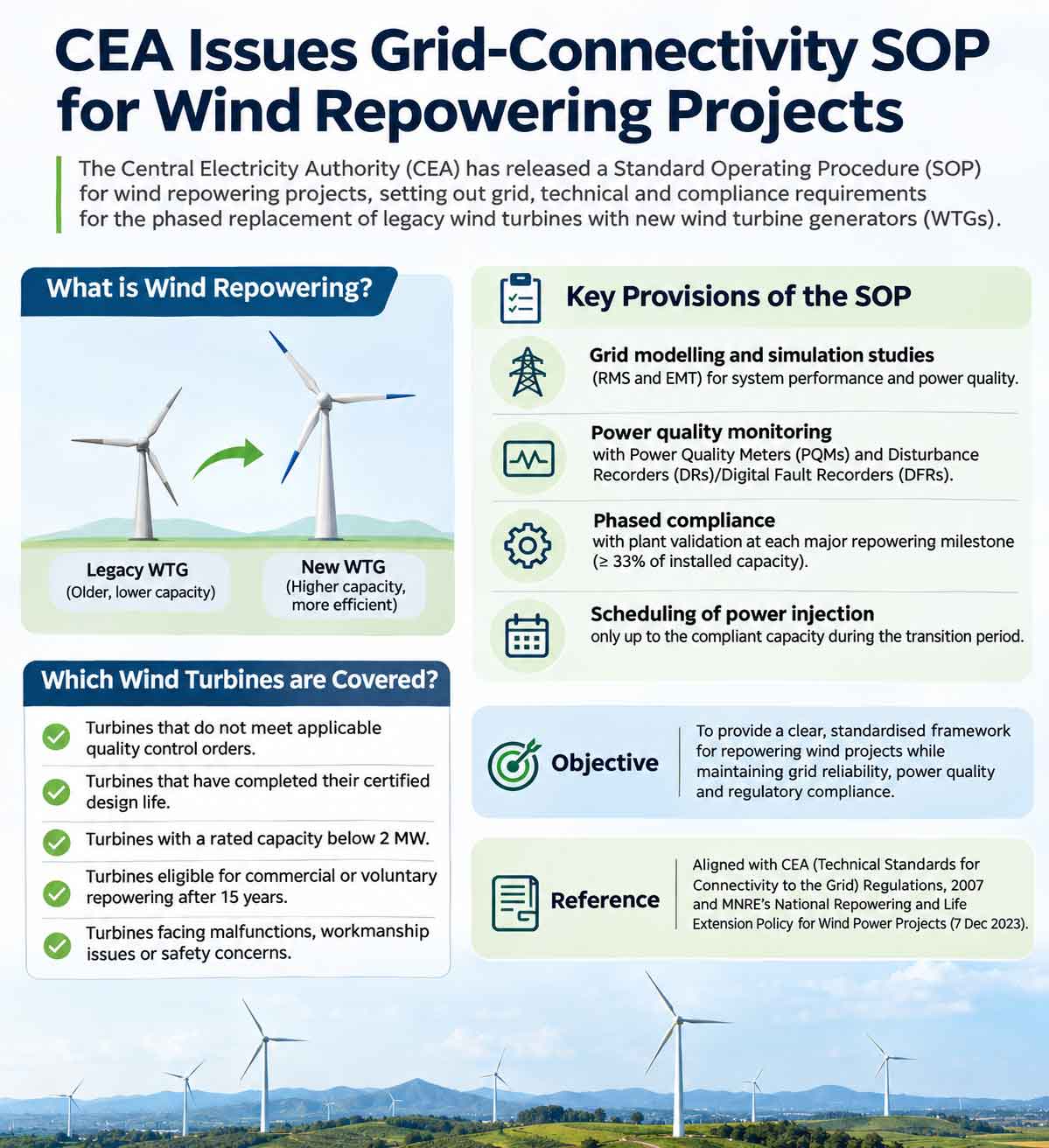
The Central Electricity Authority (CEA) has issued a Standard Operating Procedure (SOP) establishing technical and grid connectivity requirements for wind power projects replacing older wind turbine generators (WTGs) with newer machines in phases. The framework addresses projects where legacy and new turbines operate together at an existing site during the repowering process, setting out requirements for grid compliance, simulation studies, monitoring and plant-level validation.
Titled SOP for Repowering of Wind Power Projects with Mixed WTGs under the CEA Connectivity Regulations, the document has been formulated with reference to the CEA (Technical Standards for Connectivity to the Grid) Regulations, 2007, and subsequent amendments. It also draws on the Ministry of New and Renewable Energy’s (MNRE) National Repowering and Life Extension Policy for Wind Power Projects, issued on 7 December 2023.
Which wind turbines are eligible?
Under the MNRE’s 2023 policy, turbines may qualify for repowering or refurbishment if they do not comply with applicable quality control orders, have completed their certified design life, or have a rated capacity below 2 MW. Turbines may also be considered for commercial or voluntary repowering after 15 years of installation. Those experiencing malfunctions, workmanship issues or safety concerns during their design life are also covered.
The SOP applies to wind repowering projects across the country governed by the MNRE policy. It also covers partially commissioned renewable energy projects seeking to utilise connectivity up to the quantum granted by the Central Transmission Utility of India (CTUIL) or the State Transmission Utility (STU), subject to system feasibility, network availability and consultation with the relevant stakeholders.
Grid monitoring and technical compliance
A key provision concerns the treatment of legacy turbines that do not meet current CEA connectivity standards. For steady-state simulation studies, their active and reactive power injections must be considered zero. This treatment will continue until the earliest of three milestones: completion of repowering, completion of the project’s certified life, or expiry of its valid Power Purchase Agreement (PPA) or Energy Wheeling Agreement (EWA).
Beyond that point, all turbines, whether replaced or retained, must demonstrate compliance with the applicable CEA connectivity regulations or be decommissioned or repowered. The SOP also clarifies that older turbines commissioned before the February 2019 connectivity amendment are not automatically required to be retrofitted to meet the newer standards, subject to the provisions and applicable regulations specified in the document.
For monitoring, developers must install Power Quality Meters (PQMs) at the designated Point of Interconnection (POI). Disturbance Recorders (DRs) or Digital Fault Recorders (DFRs) must also be installed either at the POI or at each new WTG commissioned after the February 2019 amendment. The SOP identifies different POI locations depending on the ownership of terminal bays and transmission lines.
Developers must submit detailed Root Mean Square (RMS) and Electromagnetic Transient (EMT) simulation models. RMS studies will assess reactive power adequacy, while EMT studies will evaluate power quality. Additional aggregated models are required for dynamic studies of proposed new turbine installations.
Phased repowering and scheduling
The SOP provides for compliance to be demonstrated in stages as turbines are replaced. Where harmonic filters need replacement, compliance can be achieved batch-wise after replacement WTGs account for at least 33% of the wind project’s installed capacity. Until the required compliance is achieved, the project can schedule power injection at the POI only up to its compliant capacity.
Plant-level validation of the complete simulation model must also be carried out after each repowering batch representing at least 33% of installed project capacity. During the interim period, developers must submit periodic PQM and DR/DFR data to the relevant transmission utility and grid operator. Partial validation will take place at each replacement milestone, followed by full validation after the entire repowering programme is completed.
The framework provides a technical pathway for developers to replace ageing wind turbines without necessarily waiting for the entire project to be repowered before demonstrating compliance. By defining how legacy and new machines are assessed, monitored and brought into compliance, the CEA has sought to address grid connectivity requirements during the transition to newer wind technology.
 Electrify your feed! Click here to join our Whatsapp group and to get the latest updates, expert insights, and innovations driving India’s energy storage revolution.