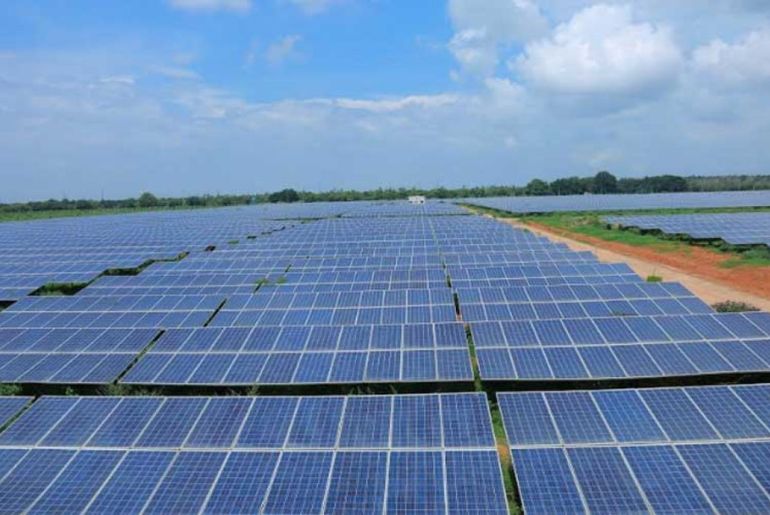
The Central Electricity Regulatory Commission (CERC) has approved the final usage charges for a 510 MW solar power project being developed by NLC India Limited under the Central Power Sector Undertaking (CPSU) Scheme Phase-II. The government-backed scheme aims to set up 12,000 MW of solar capacity through public sector entities while encouraging the use of domestically manufactured solar cells and modules.
The project, which is connected to the Inter-State Transmission System (ISTS), was awarded to NLC India through a competitive bidding process conducted by the Indian Renewable Energy Development Agency (IREDA). Under CPSU Phase-II, selected government producers are eligible for Viability Gap Funding (VGF) to offset higher costs associated with domestic solar manufacturing. NLC India emerged as a successful bidder after quoting a VGF of around ₹44.75 lakh per MW, reflecting a transparent and competitive selection process.
Initially, the ceiling usage charge for the project was fixed at ₹3.50 per unit. Following multiple revisions and government notifications, the final usage charge has been determined at ₹2.57 per kilowatt-hour (kWh). These charges are payable by government entities or distribution companies (DISCOMs) procuring the power and do not include additional costs such as transmission charges. The Commission noted that the decision is in line with the Electricity Act, 2003, ensuring fairness and competitiveness in the bidding and tariff framework.
NLC India has already entered into Power Usage Agreements (PUAs) to supply 300 MW to Rajasthan and 200 MW to Telangana, while the remaining 10 MW has been earmarked for captive consumption. The Rajasthan state regulator has approved the agreements, and CERC’s adoption of the usage charges enables the arrangements to move forward.
During the review process, CERC examined compliance with government guidelines and transparency norms. While procedural delays were observed, including instances of non-appearance by IREDA during hearings, the required documentation was subsequently submitted, allowing the Commission to conclude its assessment.
With the approval of usage charges, the project is set to progress toward commissioning, with the deadline extended to March 31, 2025, to address implementation challenges. The project is expected to contribute meaningfully to India’s solar deployment targets and supports the government’s broader objective of achieving 100 GW of solar capacity, while reinforcing the push for a self-reliant domestic solar manufacturing ecosystem.
 Electrify your feed! Click here to join our Whatsapp group and to get the latest updates, expert insights, and innovations driving India’s energy storage revolution.