In the electrified future, batteries aren’t just power sources — they’re circular assets that carry within them the very materials that fueled our innovation. As India surges ahead in EV adoption and energy storage deployment, an inevitable question arises: what happens to every battery that reaches its end of life? The answer lies in transforming waste into wealth — establishing a robust battery recycling ecosystem that restores critical minerals for re-use, strengthens supply chains, and closes the loop in the energy transition narrative.
This cover story journeys through how pioneering Indian recyclers are turning this vision into reality. From pioneering extraction technologies and modular plant designs to OEM collaborations, regulatory frameworks, and second-life strategies, the voices of industry leaders illuminate the path forward. Collectively, they underscore a foundational belief: recycling is not an add-on, but the backbone of a resilient, self-reliant, and circular battery economy.
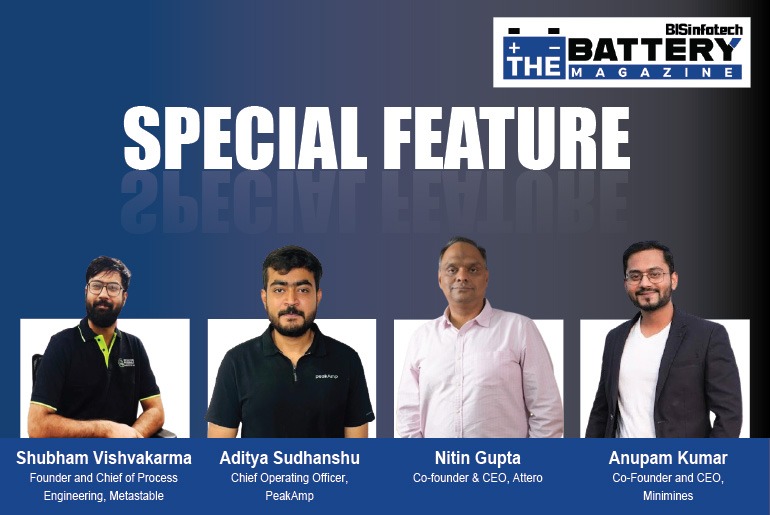
Below, we present responses to a shared questionnaire from thought leaders at Metastable Materials, PeakAmp, Attero, and MiniMines. Their insights offer a panoramic view of India’s battery recycling trajectory — and the innovations yet to come.
Battery Recycling: The Cornerstone of India’s Circular Energy Economy
Shubham Vishvakarma, Founder and Chief of Process Engineering at Metastable Materials, said, “Battery recycling sits at the intersection of circularity and raw material security. It has the responsibility of determining the industrial competitiveness of the drive for electrification as a whole. India is aiming for large-scale EV adoption and grid storage and the question does not end at whether end-of-life batteries will pile up. Battery recycling should answer whether EoL batteries can be a strategic, dependable domestic resource.
For us, recycling is critical material refining. Our goal is to produce refined cobalt, nickel and other metals to industry-grade specifications, not just break down batteries for blackmass. Refined cobalt, nickel, copper, lithium, etc are strategic resources that can be used for manufacturing purposes of different industries including batteries. Availability of refined critical materials domestically can substitute a significant share of imports, given that these materials are nearly 100% imported. India’s raw material resilience will depend on how well we engineer the recycling supply chain, from collection logistics to pre-processing and refining of blackmass and capturing industrial value at home.”
Aditya Sudhanshu, Chief Operating Officer, PeakAmp, said,“Battery recycling will be the cornerstone of India’s clean energy transition; more than waste management, it is a strategic tool for raw material security and circularity. At Peakamp, we view recycling as the enabler of resilience: converting end-of-life batteries into critical resources, reducing import dependency, and integrating long-term sustainability into India’s EV and energy storage ecosystem.”
Nitin Gupta, Co-founder & CEO, Attero, said “With EV adoption and energy storage accelerating in India, battery recycling is key to building a circular economy and securing critical raw materials required for making EV batteries. About 100% of battery materials are currently imported, and recycling will assist in catering to the domestic portion. Attero is addressing this by scaling lithium-ion and rare earth recycling capacity, recovering over 98% pure materials like lithium, cobalt, nickel and manganese. This not only reduces import dependence but also supports the government’s National Critical Mineral Mission. Over the coming decade, these efforts will enable India to meet a significant share of its EV battery raw material needs domestically while cutting costs and reducing environmental impact.”
Anupam Kumar, Co-Founder and CEO, Minimines, said “India is at a fascinating turning point. Last year alone, EV sales touched a little over two million units, which is close to 7–8% of total auto sales, and the bulk of this was two-wheelers and three-wheelers. At the same time, the grid is gearing up for a new era of storage. This growth means that within a few years we’ll be staring at a huge wave of end-of-life batteries.
The question is, do we treat them as a problem or as an opportunity? India doesn’t have abundant reserves of lithium, cobalt or nickel, and global supply chains for these minerals are fragile. Recycling gives us a way to turn spent batteries into a domestic mine. Players like us (MiniMines) are already showing that with hydrometallurgical and pyrometallurgical processes, you can recover lithium, nickel, cobalt, manganese, and even graphite at scale. Those recovered materials can then flow straight into the 50 GWh of cell manufacturing capacity being set up under the government of India’s ₹18,100 crore ACC-PLI scheme. That makes recycling not just about waste management, but a critical enabler for ensuring long-term raw material security and supply chain resilience.
Policy is actually a step ahead here. The Battery Waste Management Rules of 2022 make Extended Producer Responsibility mandatory. Producers are now legally bound to collect, recycle, and report on the national portal, with penalties for non-compliance. This creates a formal structure for collection, and over time it will draw the informal sector into safer, auditable supply chains. If we get collection and logistics right, we can guarantee a reliable feedstock for domestic recyclers.
On the strategic side, the government has identified 30 critical minerals and is pursuing overseas partnerships in Latin America and Africa. But some auctions have already been cancelled, which shows how uncertain primary supply can be. Circular flows from recycling are the hedge against those uncertainties. By the early 2030s, if we execute properly, India could generate enough secondary material to support tens of gigawatt-hours of new battery production every year.
So, to my mind, recycling will become the bridge between India’s clean mobility ambitions and its resource independence. It will bring down costs, reduce the carbon footprint of locally made cells, and insulate us from geopolitical shocks. In short, I’d sum it up this way: recycle to secure, reuse to scale. That’s how India will build a green, resilient, and truly circular battery economy in the next decade.”
From Mechanics to Metallurgy: The Science Behind Modern Battery Recycling
Shubham Vishvakarma, Founder and Chief of Process Engineering at Metastable Materials, said, “Ours is a pioneering, novel process based on metallurgical practices used in the virgin metal refining. Firstly, we use novel physical separation methods, leveraging physical properties of the metals in the battery, like density, magnetic susceptibility, etc, to extract the valuable fractions with minimal cross-contamination. Pre-processing allows us to extract copper, aluminium and by-products like steel and plastics, depending on the feedstock used.
Our key differentiator is Integrated Carbothermal Reduction™ (ICR), a patented, low-carbon technology, through which we conduct metallurgical extraction, with little to nil chemical effluents. It is able to selectively extract metal content from shredded material at controlled high temperatures, and the lowest possible carbon footprint. It yields cobalt-nickel and lithium carbonate and phosphate. Our method consistently delivers above 95% metal recovery, while using minimal water and creating negligible waste. Our process allows us to treat batteries as though they were dug out from the ground, mirroring the robustness and technicalities of virgin mining, but with a far lower environmental footprint.”
Aditya Sudhanshu, Chief Operating Officer, PeakAmp, said, “Our technology roadmap is phased yet future-ready:
- Mechanical recycling (current): Advanced dismantling and separation processes achieve 98% segregation of copper and aluminum, along with high-quality black mass.
- Hydrometallurgy (upcoming): Our facility, operational from January, will enable battery-grade recovery of lithium, cobalt, nickel, and copper at high yields with minimal environmental impact.”
Nitin Gupta, Co-founder & CEO, Attero, said “Attero uses its indigenously developed mechanical and hydrometallurgical processes, which are far more efficient and sustainable than conventional pyrometallurgy. Our proprietary technology enables over 98% recovery of critical materials with 99.9% purity, including lithium, cobalt, nickel, and manganese from spent batteries, while ensuring zero liquid discharge and minimal carbon footprint. With CAPEX lowered by 30% and OPEX reduced by 40%, this model delivers scalability alongside environmental responsibility. Unlike conventional mechanical processes that leave behind large residues, our closed-loop system consistently produces battery-grade materials ready for reuse in new cells.”
Anupam Kumar, Co-Founder and CEO, Minimines, said “At MiniMines, we’ve always believed that India’s recycling model cannot simply copy-paste what works elsewhere. It needs to be efficient, safe, and built for scale in a market where EV batteries are growing exponentially. That’s why we’ve developed and patented our own process, which we call Hybrid Hydrometallurgy (HHM™).
The approach combines the best of both worlds. We begin with mechanical pre-treatment, where batteries are safely discharged, dismantled, and converted into black mass. From there, our proprietary HHM process takes over. Unlike conventional pyrometallurgy, which is energy-intensive and emissions-heavy, HHM works at low temperatures and uses carefully controlled aqueous chemistry. This allows us to recover critical materials like lithium, cobalt, nickel, and manganese at purity levels above 95–96%.
What makes it unique is the selectivity and sustainability of the process. We’ve designed it to minimize water use, recycle reagents, and ensure near zero liquid discharge. That means high recovery rates without creating new environmental liabilities.
Our vision goes beyond just extracting value from end-of-life batteries. We want to close the loop for India — where the materials that powered one generation of EVs or storage systems can re-enter the next, reducing dependence on imported critical minerals. In other words, we’re not just recycling batteries; we’re building a technology foundation for India’s circular economy.”
EPR & Battery Waste Rules: Reshaping Industry Partnerships and Compliance
Shubham Vishvakarma, Founder and Chief of Process Engineering at Metastable Materials, said, “The framework provided by BWMR has brought discipline and transparency to an informal ecosystem. Batteries officially become regulated feedstock to be channelled responsibly. For us this has meant partnerships with OEMs. Producers require compliant partners who can transport and recycle responsibly. In turn, we are guaranteed regulated feedstock for our facilities. By combining patented technology with high recovery rates, we give our partners confidence that their EPR obligations are met with efficiency and transparency. The framework has managed to align the key players in the battery ecosystem like producers, recyclers and regulators; this clarity accelerates formal partnerships, and supports scaling of recycling operations.”
Aditya Sudhanshu, Chief Operating Officer, PeakAmp, said, “The BWM Rules 2022 and EPR guidelines are catalysts, not constraints. They create structure, accountability, and transparency, exactly what OEMs need. At Peakamp, we view EPR as a strategic partnership opportunity:
- Helping OEMs manage end-of-life batteries through collection, traceability, and certification.
- Building systems aligned with global audit standards, ensuring OEMs meet obligations while strengthening their ESG credentials.
This regulatory shift directly accelerates our collaborations with OEMs.”
Nitin Gupta, Co-founder & CEO, Attero, said “The Battery Waste Management Rules 2022 and EPR guidelines have created a structured framework that makes OEMs directly accountable for the collection and recycling of end-of-life batteries. This has accelerated demand for credible recycling partners who can ensure compliance, traceability, and sustainability. For Attero, it has strengthened collaborations with leading OEMs in electronics, automotive, and energy storage. Our proprietary, patented hydrometallurgical technology enables recovery of lithium, cobalt, nickel, manganese, and rare earths with high efficiency and purity, while significantly lowering environmental impact. These regulations have moved OEMs towards long-term partnerships with us, focused on assured offtake and building closed-loop supply chains. In effect, the rules have not only expanded our business opportunities but also reinforced our role in helping the industry meet both regulatory requirements and sustainability commitments.”
Anupam Kumar, Co-Founder and CEO, Minimines, said “The 2022 Rules did two big things for us. First, they turned recycling volumes from ‘best effort’ into contracted, auditable supply. Second, they pushed everyone—OEMs, collection partners, recyclers—onto a single data rail through digital tracking. That has changed how we operate, price, and even design our plants.
On operations, EPR targets mean we now plan capacity against committed take-back pipelines rather than spot collections. Our MSAs with OEMs carry year-wise ramps, quality specs for incoming material, and clear SLAs on collection, safe discharge, and transit. Because shortfalls carry penalties for producers, reliability matters; we’ve built redundant logistics, packaging, and incident-response SOPs into every lane.
In partnerships, the rules have pulled us much closer to the product. We also share closed-loop recovery data so OEMs can claim recycled content with confidence. That transparency makes offtake bankable, which in turn lowers our cost of capital for new HHM™ lines.”
From Import Reliance to Resource Independence: The Strategic Role of Recycling
Shubham Vishvakarma, Founder and Chief of Process Engineering at Metastable Materials, said, “A healthy recycling ecosystem can change the trajectory of import dependence for critical minerals drastically. Firstly, with innovative recycling and refining technology, black mass can be recycled to produce refined lithium, cobalt, nickel, etc. The refined material can be used in a myriad of different industries e.g., cobalt can be used for superalloy production, along with dyes, pigments and other industries, including the battery industry. With the cell manufacturing industry coming up in India, refined materials will soon be used for battery precursors domestically as well.
The consequence of recycled battery materials being of use in the manufacturing industry is that the recycled materials act as a direct buffer against global supply shocks and price swings.
Availability of these materials domestically and partial substitution of imports with recycled streams enhances supply resilience.
Building end-to-end recycling capabilities domestically allows India to climb the value chain. With in-house metallurgical knowledge and IP, in an industry highly monopolised by a handful of nations, India becomes globally attractive globally by developing this highly specialised skill set. Recycled battery materials are actually India’s most scalable near-term source of critical minerals. Treating it as a strategic capability is how we move towards self-reliance.”
Aditya Sudhanshu, Chief Operating Officer, PeakAmp, said, “India’s import reliance on lithium, cobalt, and nickel is a strategic vulnerability. Recycling is the fastest, most resilient path to self-reliance. By extracting battery-grade lithium hydroxide and other metal salts domestically, Peakamp converts urban waste into a local resource base. This directly supports the Atmanirbhar vision, reduces forex outflow, and positions India as a net contributor to global supply chains.”
Nitin Gupta, Co-founder & CEO, Attero, said “India currently depends heavily on imports for critical minerals such as lithium, cobalt, nickel, and even high-grade graphite. This reliance creates both strategic and supply chain vulnerabilities. A strong domestic recycling ecosystem offers a sustainable pathway to self-reliance by recovering these materials at battery-grade purity levels, making them immediately usable in new cells and advanced components. With recovery efficiencies of over 98%, recycling can meet a large share of India’s growing EV and energy storage demand locally, reducing dependence on volatile global markets. Unlike conventional mining, recycling achieves this with far lower environmental costs; cutting greenhouse gas emissions by up to 99% for certain metals. By embedding recycling into the National Critical Mineral Mission, India can secure its raw material supply, reduce import bills, create green jobs, and emerge as a global hub for circular and sustainable battery materials.”
Anupam Kumar, Co-Founder and CEO, Minimines, said “You’re right. India is heavily import-dependent for lithium, cobalt, nickel, and even high-grade graphite. We don’t have the geological abundance that countries like Australia or Chile enjoy, and many of these minerals are concentrated in geographies with supply chain risks. That makes recycling not just an environmental imperative but a matter of strategic security.
A robust domestic recycling ecosystem allows us to treat end-of-life batteries as a local mine. Every EV, every stationary storage project, every consumer gadget that comes to the end of its life carries within it a stock of critical minerals. By recovering these materials at battery-grade purity, we can feed them straight back into India’s upcoming gigafactories under the ACC-PLI scheme. In effect, yesterday’s battery powers tomorrow’s battery without relying solely on virgin imports.”
Bridging the Gaps: How Innovators Are Solving Recycling’s Biggest Challenges
Shubham Vishvakarma, Founder and Chief of Process Engineering at Metastable Materials, said, “All four dimensions have interlinked challenges. Regarding collection, the market is fragmented, with batteries dispersed across dealerships and informal aggregators. We address this by partnering with OEMs. As for logistics and safety, transporting end-of-life batteries is a dangerous goods (DG) challenge. We use UN-certified packaging, and dismantle to cells, as close to source as possible to move batteries safely. When it comes to economics, our answer is diversification. Our recovered materials already power the secondary metals industry as well as manufacturers. Lastly, when it comes to technology, we are aware of how the chemistries are evolving. The solution is a modular process design and sustained R&D. Pre-processing units and pilot units, adaptive shredding lines, and selective separation and extraction make our plants resilient to feedstock variability. This is how we ensure that we remain technically robust and economically defensible in the face of challenges.”
Aditya Sudhanshu, Chief Operating Officer, PeakAmp, said, “The challenges in scaling battery recycling are as follows: fragmented collection networks, complex reverse logistics, volatile commodity markets, and evolving technology requirements. At PeakAmp, we address these by cultivating integrated partnerships with OEMs, designing modular and economically resilient plant architectures, and embedding strict global standards in safety and compliance. We firmly believe that those who invest in robust infrastructure and foresight today will emerge as the enduring leaders of tomorrow.”
Nitin Gupta, Co-founder & CEO, Attero, said “Scaling battery recycling in India involves challenges across collection, logistics, and cost structures, alongside the need for advanced technology. Informal channels still dominate much of the collection ecosystem, and transporting used batteries across a vast country like India remains inefficient. Attero is addressing these barriers by building nationwide infrastructure, deploying cutting-edge proprietary processes, and creating an integrated collection network. We have established credible partnerships with leading OEMs and consumer brands such as MG Motors, Omega Seiki, and Samsung that help ensure a reliable supply of end-of-life batteries. To strengthen supply chain efficiency further, our digital marketplace MetalMandi connects bulk scrap generators with certified recyclers, using AI-based pricing to ensure transparency, traceability, and faster movement of high-value material across the country. This digital layer complements our physical infrastructure, improving both reach and reliability. Combined with our ability to deliver battery-grade outputs at over 98% recovery efficiency and up to 70% lower GHG emissions, these efforts make recycling not just environmentally responsible but also economically viable, positioning us as a key enabler of India’s long-term raw material security.”
Anupam Kumar, Co-Founder and CEO, Minimines, said “Scaling battery recycling in India is not just a question of technology. The challenges cut across the entire value chain, from how batteries are collected, to how safely they are transported, to whether the economics work out in a young and price-sensitive market.
Collection is the first big hurdle. End-of-life batteries come from scattered sources and is usually everything from two-wheeler EVs to consumer electronics. Without robust aggregation and traceability, volumes tend to leak into the informal sector. We address this by building formal collection partnerships with OEMs under the EPR framework and by investing in traceability systems that give visibility from source to recycling plant.
Logistics is equally tough. Batteries are classified as hazardous goods, so moving them safely requires specialized packaging, trained personnel, and incident-response protocols. At MiniMines, we’ve developed standardized discharge and packaging processes that make transportation both safer and more reliable.
Then comes the economics. Commodity prices fluctuate, and unless you can guarantee high recovery yields, the business model becomes fragile. This is where our patented Hybrid Hydrometallurgy (HHM™) technology gives us an edge. By recovering lithium, cobalt, nickel, and manganese at over 95 percent purity and recycling water and reagents in a closed loop, we keep costs competitive while ensuring sustainability.
Finally, there is the technology itself. While the science of recycling is evolving globally, adapting it to Indian conditions—different chemistries, variable quality of feedstock, and limited infrastructure—requires constant innovation. We have focused on building a process that is modular, scalable, and chemistry-agnostic so that as the market shifts from NMC to LFP and beyond, we are ready.
In short, the challenges are real, but they are also the reason why we see this as a long-term play. By solving for collection, logistics, economics, and technology in an integrated way, MiniMines is creating not just a recycling business, but a reliable circular ecosystem for India.”
Future Forward: Building India into a Global Hub for Battery Recycling
Shubham Vishvakarma, Founder and Chief of Process Engineering at Metastable Materials, said, “Our top priority at the moment is the ramp-up our scale to sustainably produce critical raw materials. In the near future, we aim to scale with modularity and expand processing capacity through modular plants, fed by strategically placed aggregators and pre-processing hubs located close to sourcing hubs. We will also finesse our ability in making refined concentrates. Impurity control would be a primary goal while refining. Sustained R&D is what will be a key focus throughout, to deepen our patent portfolio and process know-how in metallurgical sciences, optimisations in ICR and adaptation to future chemistries. In short, the top priorities are to ramp up responsibly, refine strategically and innovate relentlessly and believe that our efforts will make India a global reference point for critical materials refining.”
Aditya Sudhanshu, Chief Operating Officer, PeakAmp, said, “Our top priorities are:
- Hydrometallurgical Facility Commissioning (2025): Establishing large-scale recovery of battery-grade materials (lithium, cobalt, nickel, copper) with world-class recovery yields.
- Second-life Applications: Scaling repurposing of 2W/3W/4W EV batteries and stationary storage to extend lifecycle value.
- R&D Investments: Advancing cathode-to-cathode recycling and adapting to evolving chemistries.
- A tech-enabled platform for sourcing, reverse logistics, and battery traceability”
Nitin Gupta, Co-founder & CEO, Attero, said “Over the next two to three years, Attero’s top priority is to rapidly expand recycling infrastructure and collection networks to match India’s growing demand for critical raw materials. In addition, we aim to process over 300,000 tons of lithium-ion battery waste globally by 2027, supported by new facilities being set up in the US and Europe. Our deep-tech hydrometallurgical processes, protected by 46 granted global patents with nearly 200 further applications, ensure world-class recovery efficiency and purity. To strengthen collection, we are also leveraging digital platforms like Selsmart (consumer collection with doorstep pickup) and MetalMandi (industrial scrap marketplace) to create a seamless, traceable ecosystem. Together, these innovations will reduce import dependence on China, align with India’s Critical Mineral Mission, and firmly position the country as a global hub for sustainable battery recycling and reuse.”
Anupam Kumar, Co-Founder and CEO, Minimines, said “We are currently operating on an industrial scale. In the next 2-3 years, we plan on expanding our processing capacity. With the recent grant support we received, we are setting up facilities that can process thousands of tonnes of spent lithium-ion batteries every year using our patented Hybrid Hydrometallurgy technology. That means not just handling larger volumes but also delivering consistent, battery-grade output that OEMs can directly reuse in new cells.
At the same time, we are deepening our partnerships with manufacturers. The Battery Waste Management Rules and EPR framework have given OEMs both responsibility and incentive to think long-term about recycling. We are working with them to design integrated take-back programs, improve traceability, and ensure that recycled materials re-enter their supply chains seamlessly.
Innovation remains at the heart of this journey. We are focused on pushing recovery rates higher, cutting water and energy use further, and aligning our processes with international standards so that India is not only meeting its domestic needs but also competing globally in recycled materials. For us, the next two to three years are about building trust and scale, creating a recycling ecosystem that can stand shoulder to shoulder with the best in the world.”
 Electrify your feed! Click here to join our Whatsapp group and to get the latest updates, expert insights, and innovations driving India’s energy storage revolution.