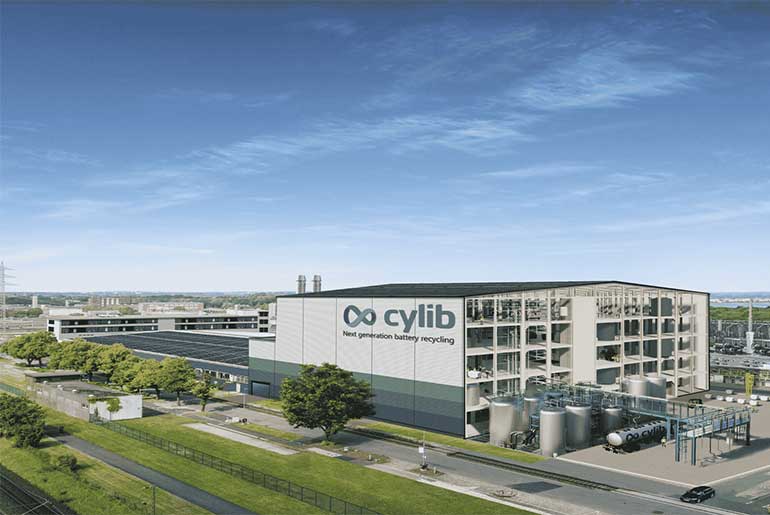
European battery recycling company cylib has acquired a battery processing facility in Wernberg-Köblitz, Bavaria, strengthening its end-to-end electric vehicle (EV) battery recycling capabilities. The facility will have an annual processing capacity of up to 10,000 metric tons of end-of-life EV batteries and is expected to begin operations in the fourth quarter of 2026, subject to regulatory approvals.
The acquisition, completed through insolvency proceedings, includes the processing line, building, and land. cylib will restart the previously decommissioned facility under its own operational, environmental, and safety standards in coordination with Bavarian authorities. The project remains subject to approval under Germany’s Federal Immission Control Act (BImSchG).
The Bavarian facility will process end-of-life EV batteries into black mass, an intermediate material containing valuable metals. The black mass will then be supplied to cylib’s hydrometallurgical recycling plant under construction in Dormagen, North Rhine-Westphalia, where it will be refined into critical battery materials such as lithium, graphite, nickel, cobalt, and manganese.
According to Dr. Lilian Schwich, Co-CEO and Co-Founder of cylib, the acquisition marks a major milestone in the company’s vision of establishing a fully integrated battery recycling value chain.
“Battery recycling has to be end-to-end, from the end-of-life battery to the recovery of high-quality critical raw materials. With this acquisition, we are adding large-scale end-of-life battery processing to complement our material recovery operations in Dormagen,” she said.
Located in the heart of Germany’s automotive manufacturing region, the facility provides cylib with direct access to major automotive OEMs, battery manufacturers, and suppliers across southern Germany and Central Europe. The company said the site will serve as the first hub in its battery collection and pre-processing network, ensuring a stable supply of battery materials for its recycling operations.
Dr. Gideon Schwich, Co-CEO and Co-Founder of cylib, said the expansion would allow the company to provide more comprehensive recycling solutions to automotive manufacturers, Tier-1 suppliers, and battery producers.
“Building large-scale processing capacity enables us to deliver greater value to our customers while advancing our long-term strategy. Reviving this industrial site is an important step toward scaling responsible battery recycling in Europe,” he said.
The company noted that repurposing an existing industrial facility supports a circular economy approach by reducing the environmental impact associated with new construction while accelerating project implementation.
The expansion comes as Europe prepares for a sharp increase in end-of-life EV battery volumes. According to the International Energy Agency’s (IEA) Global EV Outlook 2026, the region’s end-of-life EV battery volumes are expected to more than triple between 2030 and 2035, increasing the need for large-scale battery recycling infrastructure.
cylib expects to begin industrial-scale battery recycling at the Bavarian facility in Q4 2026, with full operational capacity targeted by the end of 2027. The project will be implemented in collaboration with regulatory authorities, equipment suppliers, and industry partners.
 Electrify your feed! Click here to join our Whatsapp group and to get the latest updates, expert insights, and innovations driving India’s energy storage revolution.