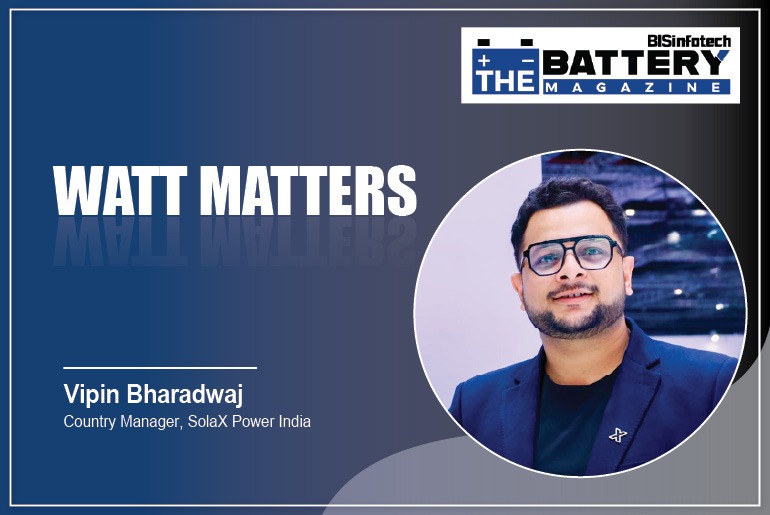
At the Renewable Energy India Expo (REI) 2025, The Battery Magazine engaged in an insightful conversation with Vipin Bharadwaj, Country Manager – SolaX Power India. Manas Nandi, Editor-in-Chief of The Battery Magazine, sat down with Mr. Bharadwaj to discuss SolaX Power’s growing presence in India and its role in shaping the country’s evolving energy-storage landscape.
During the interaction, Mr. Bharadwaj highlighted SolaX Power’s comprehensive portfolio ranging from 3 kW residential solutions to 5 MWh utility-scale systems, emphasizing the company’s strong focus on both AC- and DC-coupled technologies. He elaborated on how SolaX is supporting grid stability through large-scale battery energy storage systems (BESS) and how its upcoming local manufacturing plans will align with the Make in India vision.
Safety, reliability, and scalability emerged as central themes throughout the discussion, with Mr. Bharadwaj reaffirming SolaX Power’s commitment to maintaining its global quality standards while building a robust local presence.
Let us delve deeper into this exclusive conversation to learn more about SolaX Power’s innovations, localisation strategy, and its vision for India’s renewable-energy future.
SolaX Power has established itself as a global name in smart energy solutions. How has the company’s participation been at Renewable Energy India 2025?
REI 2025 has been a highly encouraging experience for us. We have witnessed an excellent response from customers and industry professionals. The footfall and engagement levels this year reflect the growing interest in renewable energy technologies, particularly in storage and hybrid solutions. The platform has allowed us to showcase our full potential and interact with key stakeholders across the energy ecosystem.
Could you elaborate on what SolaX Power is highlighting at the exhibition, particularly in the area of energy storage?
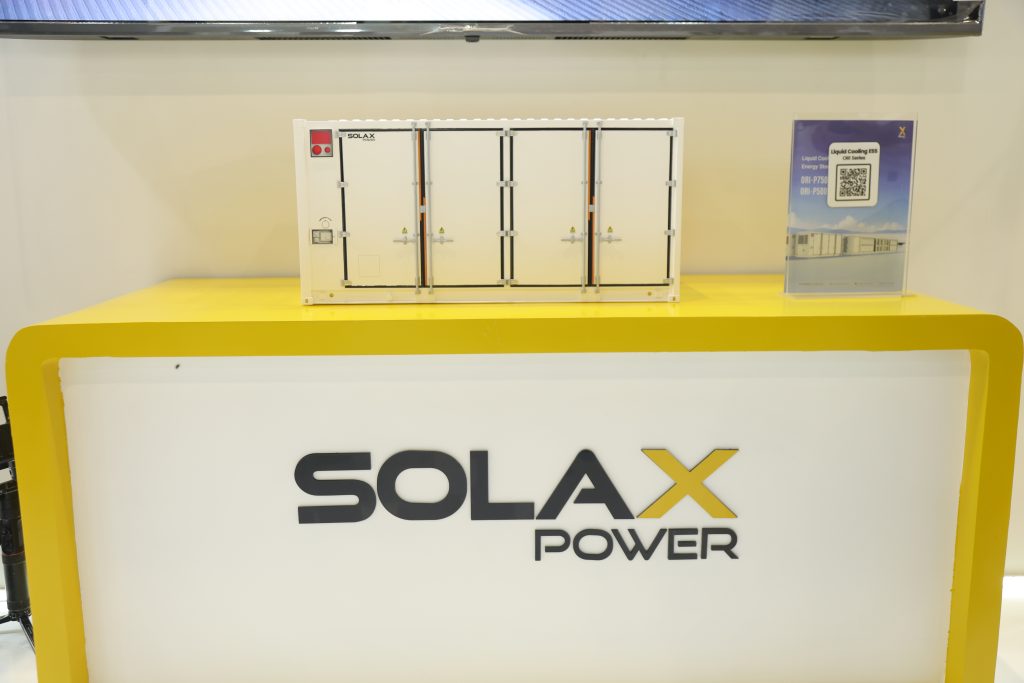
Certainly. When we talk about energy storage, SolaX Power offers a complete portfolio that caters to every market segment. Our product range begins with residential solutions of 3 kW capacity and extends up to large-scale systems of 5 MWh capacity, which we are displaying here at the exhibition.
We provide comprehensive solutions for the residential, low-voltage (LV), and commercial and industrial (C&I) markets, as well as for utility-scale projects. Our portfolio includes both AC-coupled and DC-coupled configurations, ensuring compatibility and flexibility across varied applications. In short, we are well positioned to serve every segment—from individual homeowners to large-scale developers—through reliable, efficient and scalable solutions.
SolaX recently received the SMM Award for its Global Energy Storage System. How is your battery energy-storage system (BESS) scaling internationally, and how are these solutions being aligned with the requirements of the Indian market?
India’s renewable-energy sector, particularly solar, is progressing at an impressive pace. However, as the share of solar generation increases, the issue of grid imbalance becomes more evident. To address this, SolaX Power is introducing advanced energy-storage systems that enhance grid stability and ensure round-the-clock energy availability.
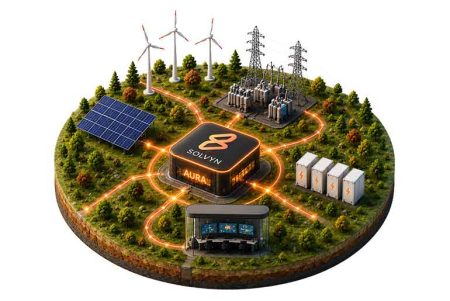
Our utility-scale DC-coupled storage systems can be seamlessly integrated with large solar or wind projects to provide continuous, balanced power output. This reduces dependence on daytime generation and strengthens grid reliability. By leveraging our global R&D expertise, we are supporting Indian developers in creating hybrid, stable, and sustainable energy infrastructures.
What are SolaX Power’s plans with regard to localisation and manufacturing in India?
This is indeed an opportune time for global players to invest in India, and SolaX Power is fully committed to contributing to the “Make in India” initiative. We are in the process of establishing a subsidiary and setting up a manufacturing facility within the country.
In the initial phase, we plan to begin with the production of string inverters, considering the strong market presence we already have in this segment. In the subsequent phase, we will extend our localisation efforts to energy-storage systems.
While building operations in India, we are aligning with national policy frameworks and collaborating with local vendors and suppliers. Our focus will remain on maintaining the same high standards of quality, performance and reliability that define SolaX globally. Customers can be assured that localisation will enhance access without compromising the company’s global manufacturing benchmarks.
Battery safety is a critical factor in the adoption of energy-storage solutions. How does SolaX Power ensure the safety and reliability of its systems?
Safety is one of the most fundamental design principles at SolaX Power. Each of our storage systems incorporates multi-level protection mechanisms. Across our AC- and DC-coupled solutions, we implement four layers of safety, including integrated fire-suppression systems, advanced coolant technologies, electrical isolation safeguards, and intelligent monitoring frameworks that continuously assess operational parameters.
Our systems undergo extensive testing and are certified to meet global standards such as IEC and UL. Through these measures, we ensure that our energy-storage products remain safe, reliable, and durable across diverse environmental conditions.
With energy storage becoming central to the renewable ecosystem, what message would you like to convey to potential customers and project developers?
This is the right time for customers and developers to embrace hybrid systems. Hybrid inverters and storage solutions are not just supporting technologies—they are enabling sustainable energy independence.
By investing in hybrid solutions, users can secure stable, reliable power for their operations while simultaneously supporting the overall grid. SolaX Power’s hybrid portfolio is built on global innovation and is now being adapted to meet India’s energy conditions and market needs. Our goal is to deliver value through efficiency, safety, and dependability. The future of renewable energy will be shaped by smart, hybrid systems—and we are committed to leading that transformation.
 Electrify your feed! Click here to join our Whatsapp group and to get the latest updates, expert insights, and innovations driving India’s energy storage revolution.