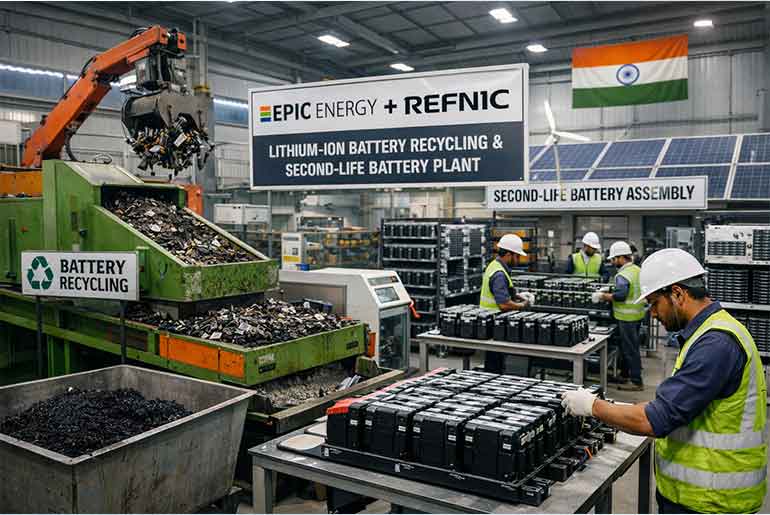
Epic Energy Limited has teamed up with REFNIC, a brand owned by Zetrance Technology, to set up a facility for both recycling lithium-ion batteries and creating second-life batteries in India. This facility will support the sustainable management of batteries as the use of EVs and energy storage devices is expected to increase dramatically throughout India.
The project will be implemented through Swachchha Urja Nirman LLP, a special purpose vehicle of Epic Energy.
Recycling and Second-Life Facilities
An end-of-life battery recycling facility is to be constructed as part of the initiative, with an expected output of 500 kilograms/hour of “black” masses. This will allow the firm to reclaim valuable metals and produce new ones from discarded batteries.
In addition, a second-life battery assembly facility will be built with approximately 10 MWh of processing capacity each month. The facility will take used batteries that can still be utilized and convert them into energy storage alternatives for stationary uses.
REFNIC’s Role as Technical Partner
REFNIC will serve as the technical partner for the project. Its scope of work includes the design, engineering, system integration, installation, and commissioning of both the recycling plant and the second-life battery facility.
Focus on Circular Energy Solutions
This project aims to facilitate responsible recycling, repurposing, and recovery of value from lithium-ion batteries used in electric vehicles, renewable energy storage systems, and electronics. The initiative is in line with Epic Energy’s plan for developing sustainable/circular energy solutions.
Epic Energy has also indicated plans to expand these recycling and second-life capabilities across India and explore opportunities beyond the domestic market as demand for battery lifecycle solutions increases.
Built on Existing Recycling Experience
Epic Energy has earlier entered into a technology licensing agreement with the Centre for Materials for Electronics Technology (C-MET) to recycle end-of-life lithium-ion batteries using hydrometallurgical processes. This experience provides a technical foundation for the company’s current plans in battery recycling and reuse.
With the rapid growth of electric mobility and battery-based energy storage in India, organised recycling and second-life use of batteries is becoming increasingly important. Projects such as this are expected to play a key role in reducing environmental impact, improving material recovery, and supporting India’s long-term clean energy transition.
 Electrify your feed! Click here to join our Whatsapp group and to get the latest updates, expert insights, and innovations driving India’s energy storage revolution.