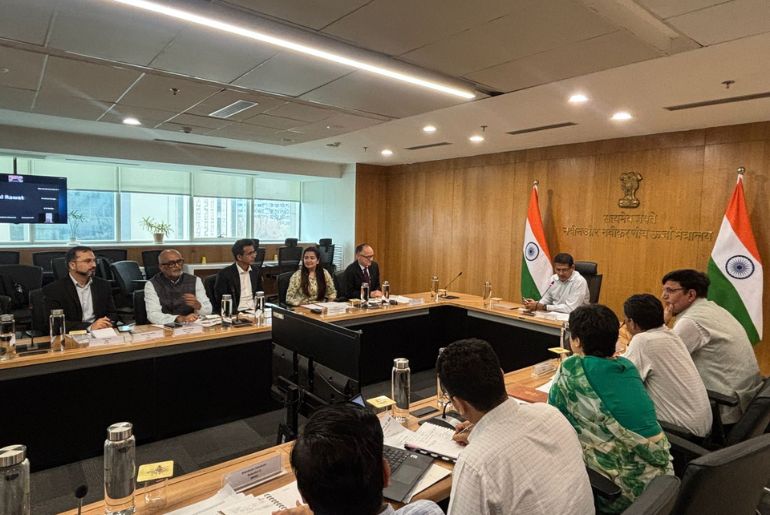
The Indian Wind Turbine Manufacturers Association (IWTMA) underscored the importance of market-based mechanisms, advanced forecasting, and global collaboration in enabling efficient grid integration of wind energy in India at the Indo-German Workshop on “Addressing Challenges in Grid Integration of Wind Energy.” The workshop brought together key stakeholders, including MNRE, German Embassy, NITI Aayog, CEA, ISRO, NCMRWF, and State Departments from Gujarat, Rajasthan, and Tamil Nadu, and industry leaders from India and Germany, to deliberate on practical approaches to managing renewable energy variability and strengthening grid resilience.
Drawing experience, particularly from Germany, industry experts noted that structured balancing systems and commercially driven approaches could serve as scalable models for India’s evolving power sector, supporting a transition towards more efficient grid operations. At the same time, accurate short-term forecasting powered by data and AI emerged as a critical lever to reduce grid imbalances, optimise scheduling, and lower associated costs.
The discussions further highlighted the importance of developing robust ancillary service markets to support higher renewable energy penetration, ensuring system flexibility, availability of reserves, and overall grid stability. In parallel, virtual power plants (VPPs) were identified as a key enabler in aggregating distributed renewable energy resources and enabling coordinated dispatch in high-renewable scenarios.
Shri Santosh Sarangi, Secretary, MNRE, said, “Most countries are now trying to tackle the grid integration challenges. We must pivot away from a purely quantitative expansion to adding qualitative elements into our power system. And in this context, addressing the issues of grid resilience and flexibility by strengthening our transmission system, by upgrading our distribution network will be essential. In addition, using modern digital tools, AI tools to have advanced forecasting and digital monitoring will also be key.”
Shri Rajesh Kulhari, Joint Secretary, MNRE, said “The Indo-German partnership offers valuable, valuable opportunities for technical exchange. Germany’s experience in managing high shares of variable renewable energy provides important insights for India’s evolving power sector. Germany’s balancing group architecture, supported by transparent market signals and clear allocation of responsibility for forecasting and balancing, offers a useful reference point. Virtual power plants represent another promising frontier. We have a unified national grid with well-functioning power exchanges and a strong regulatory foundation built over decades. Further, we are already advancing the next generation of reforms, including hybrid and storage-linked PPAs, green energy open access and emerging instruments such as virtual power purchase agreements. As India scales up distributed solar, wind and battery storage, virtual power plants can play a transformative role in enhancing step- system flexibility and enabling market participation by smaller assets. Accordingly, India is well-positioned to build on the German experience.”
Aditya Pyasi, CEO, IWTMA, said, “Flexible grid integration, supported by smarter forecasting and scheduling mechanisms, is one of the most effective incentives we can provide to the wind manufacturing industry. It significantly de-risks the high and long-term investments required across the value chain.
As India moves toward higher renewable energy penetration, improving forecasting timelines will be critical. The closer forecasting gets to the actual power-injection window, the more efficient and reliable the system becomes. Currently, the 90-minute scheduling window presents certain operational constraints. If regulatory frameworks can progressively shorten this timeframe, it would meaningfully reduce risk not only for wind power but for the entire renewable energy sector. We would therefore encourage the Central Electricity Authority to explore regulatory provisions or grid codes that enable shorter forecasting windows while maintaining system stability. Greater reliance on spot markets and ancillary services will also be essential, as grid operators and market participants collectively take the next step toward integrating higher levels of renewable energy into the system”
The workshop concluded with a shared emphasis on strengthening Indo-German collaboration, aligning policy and regulatory frameworks, and accelerating the adoption of policy levers and short-term forecasting solutions to support grid stability.
 Electrify your feed! Click here to join our Whatsapp group and to get the latest updates, expert insights, and innovations driving India’s energy storage revolution.