In the battery manufacturing realm, the simple act of slurry mixing holds profound significance. Often overshadowed by more visible stages like cell assembly or formation cycling, slurry mixing is, in fact, the bedrock of battery performance. The very foundational step for homogeneity and good electrode coating quality, which results in good battery performance, longer life, and safety of the produced battery. As India is ambitiously racing towards becoming a battery manufacturing leader, mastering the science and art of the slurry mixing technologies is not only an option but a fundamental necessity. By learning from global experiences and strategically integrating the cutting-edge mixing innovations, India can elevate its manufacturing capabilities and pave the way for the production of standard-quality, efficient, and sustainable batteries that can power India’s electric future.
Let’s Decode the Significance of Slurry Mixing in Battery Manufacturing
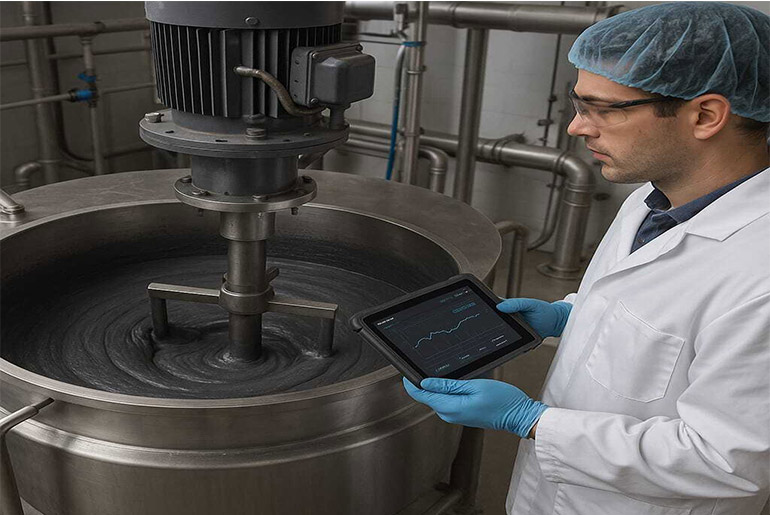
The making of slurry mixing or electrode slurry is the foundational stage of battery manufacturing, which involves the precise blending of active materials (like lithium compounds), conductive additives (like carbon black), binders (like PVDF or CMC), and solvents (NMP or water) to form a homogeneous mixture. According to industry experts, even minor faults in the mixing process can have cascading negative effects. These can turn into uneven coating thickness, poor electrical conductivity within the electrode, reduced energy densities, shorter life cycles, and higher risk of internal shorts, ultimately resulting into bad battery performance.
Global Advancements in the Slurry Mixing Technologies
In recent years, the battery manufacturing landscape has witnessed significant innovations in the slurry mixing technologies, designed to meet the needs of the next-generation batteries:
- Continuous Mixing Systems: Unlike the traditional batch mixing, the continuous mixing systems offer real-time control over the slurry properties, such as temperature, homogeneity, and viscosity. The continuous flow ensures greater uniformity and reduces batch-to-batch variations, resulting in consistent quality of electrodes and reduced processing time.
- Vacuum Mixing (Elimination of air): Vacuum mixing has emerged as a crucial technique for the production of high-performance batteries as it eliminates the air during the process. In the traditional methods, the trapped air bubbles in the slurry can hinder ion transport within the electrode and cause the coating to adhere poorly to the current collector. However, vacuum mixing efficiently degasses the slurry, creating thick electrode coatings that have better electrochemical performance and electrical contact.
- High-Shear and Planetary Mixers: These mixers offer intense mixing action, which helps achieve thorough dispersion of materials in high-density batteries.
Case Studies by Industry
- Wirtz Manufacturing (USA)
Wirtz created a continuous flow and vacuum degassing slurry mixing and delivery system. Many gigafactories in the US and Europe are currently using their systems, which significantly lower coating failures and slurry defects. - Xerion Advanced Battery Corporation
A high-vacuum planetary mixer that can process LFP and NMC slurries with a 40% higher solid content was introduced by this Ohio-based company. The outcome? enhanced mechanical integrity, increased electrode density, and extended battery life. - Amara Raja Energy & Mobility (India)
Amara Raja, an Indian company, is investing in cutting-edge mixing systems from global technology partners in order to get ready for next-generation chemistries at its upcoming 16 GWh facility. Inline viscosity is already being incorporated into the company’s pilot lines.
India’s Vision for Battery Manufacturing and the role slurry mixing plays in it
India’s commitment to a sustainable future, driven by the growing adoption of electric vehicles and the integration of renewable energy sources, has led to substantial investment in battery manufacturing.
Projected Capacity Targets: Currently India is making a good progress in its Battery Manufacturing capacity with estimating capacity of around 110-150 GWh by 2027-28 and it aims to achieve 500 GWh of annual battery manufacturing capacity by 2035.
To achieve this, India must invest in core process technologies like slurry mixing to:
- Ensure consistency across gigafactories
- Reduce import dependency on foreign electrode materials
- Minimize process defects and waste
- Train engineers in electrode formulation science
Investment and Generating Employment: This massive expansion is expected to attract potential investments of $35 billion and create 2.6 million jobs across the value chain.
Key Players: Several leading Indian Companies are leading the way forward in the energy revolution. Agratas Energy Storage Solutions, owned by the Tata Group, is making a big impact with a 20 GWh capacity. Aiming for a 16 GWh capacity by 2030, Amara Raja Energy & Mobility is also rapidly growing its manufacturing capabilities. Plans for a 20 GWh battery manufacturing facility have also been revealed by Ola Electric, a major player in the electric two-wheeler market.
Conclusion: Mixing the Future
Slurry mixing is no longer a behind-the-scenes operation — it is a strategic lever that defines the quality and competitiveness of battery manufacturers. For India to become a global battery hub, mastering slurry mixing technology is not optional; it is imperative. With strong industry partnerships, indigenous innovation, and attention to foundational processes, India can truly lead the global energy storage revolution — one well-mixed slurry at a time.
 Electrify your feed! Click here to join our Whatsapp group and to get the latest updates, expert insights, and innovations driving India’s energy storage revolution.