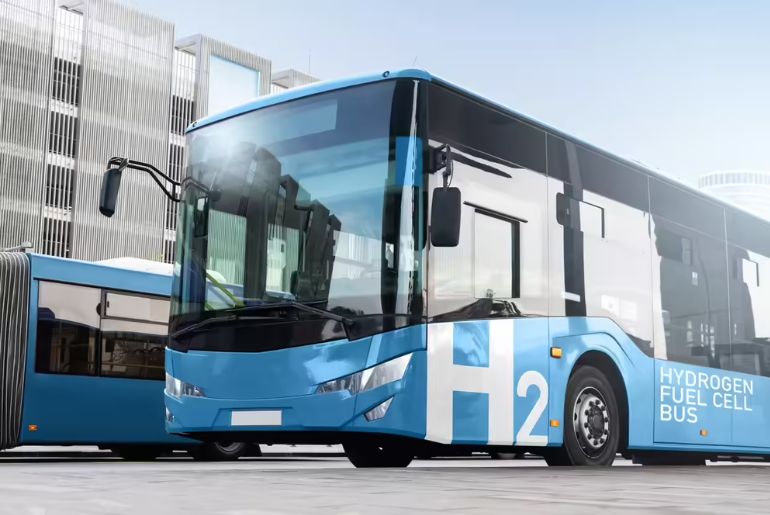
The government will approve an additional 30 hydrogen-powered buses and trucks under the National Green Hydrogen Mission to expand pilot deployments in the transport sector, said Abhay Bakre, Mission Director of the initiative.
These vehicles will complement the 37 hydrogen vehicles already sanctioned under five pilot projects, which include 10 hydrogen fuelling stations. The pilots are focused on heavy commercial vehicles, such as buses and large trucks, where hydrogen is being explored as a clean, long-term alternative to conventional fuels.
Focus on Heavy-Duty Transport
Medium and heavy commercial vehicles mainly work in the mid-mile and long-haul segments, which are responsible for a large part of transportation emissions. These vehicles need to carry a lot of weight and volume, which makes battery-electric solutions less practical because batteries are heavy and take up a lot of space.
The pilot includes both hydrogen internal combustion engine (ICE) technology and fuel cell systems. Of the 37 vehicles previously sanctioned, 15 are fuel cell vehicles while 22 are hydrogen ICE vehicles. The additional 30 vehicles will help expand real-world testing and operational data collection.
Government Support and Industry Participation
The government has allocated approximately ₹208 crore in financial support for the pilot projects. Companies participating in the program include Tata Motors, Reliance Industries, NTPC, ANERT, Ashok Leyland, HPCL, BPCL, and IOCL.
Hydrogen generated from renewable sources acts as a zero-emission fuel, making it ideal for decarbonising long-haul trucks, buses, and heavy-duty transport applications.
National Green Hydrogen Mission Goals
The National Green Hydrogen Mission, which was approved in 2023 with a budget of ₹19,744 crore, aims to increase the production of green hydrogen in India and boost demand in sectors such as refining, fertilizers, steel, and transportation. The mission’s goal is to produce 5 million metric tonnes of green hydrogen every year by 2030. It also wants to build up the capacity to make electrolyzers and the infrastructure to support them.
Within transport, hydrogen is positioned for heavy-duty and long-distance applications, where refuelling time and driving range are critical. Battery-electric vehicles continue to dominate smaller segments, such as two- and three-wheelers.
Abhay Bakre, Mission Director noted, “Mobility is one area where all these green fuels can be experimented with and then scaled up in a much more effective and equitable manner than most other sectors.”
Industry Progress
In 2024, Ashok Leyland and Reliance worked together to make India’s first hydrogen ICE-powered heavy-duty truck. At the same time, Tata Motors gave Indian Oil hydrogen fuel cell-powered buses. The new 30 vehicles will expand testing, provide operational insights, and support future scaling decisions under the mission.
 Electrify your feed! Click here to join our Whatsapp group and to get the latest updates, expert insights, and innovations driving India’s energy storage revolution.