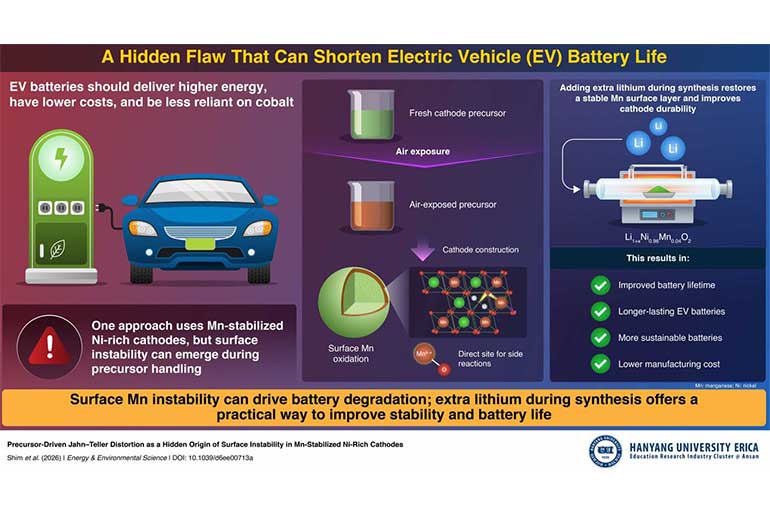
Researchers at Hanyang University ERICA in South Korea have identified a previously overlooked manufacturing-related flaw that could accelerate degradation in high-nickel batteries designed for electric vehicles (EVs). The study found that exposing battery precursor materials to air can trigger chemical changes in manganese, creating reactive surface defects that accelerate electrolyte breakdown and reduce battery life.
High-nickel, cobalt-free cathodes with manganese-rich protective shells are being developed as a promising alternative for next-generation EV batteries. The technology can help increase driving range while reducing reliance on expensive and critical minerals such as cobalt. However, the new findings suggest that the manufacturing and storage conditions of these materials could play a crucial role in determining their long-term performance.
The research team, led by Professor Jin Ho Bang and PhD scholar JinHa Shim of Hanyang University, found that simply storing precursor materials in air-exposed environments can cause subtle changes to the manganese chemistry on the surface of the particles. These changes can lead to the formation of defective regions containing manganese species affected by “Jahn-Teller distortion.”
According to the researchers, these distorted surface regions are highly reactive and can accelerate electrolyte decomposition, transition-metal dissolution and harmful reactions with the graphite anode. In nickel-rich battery systems, the resulting degradation mechanism was found to nearly double the rate of capacity fading during extended cycling tests.
“We found that a manganese-rich shell, which is normally introduced to protect high-nickel cathodes, can instead become a catalyst for degradation if the precursor chemistry is not carefully controlled,” said Prof. Bang. “Even small variations in precursor storage history can substantially affect battery stability.”
The researchers also identified a potential solution to the issue. By increasing the amount of excess lithium used during the synthesis process, they were able to suppress the formation of the defective surface phase and restore more stable manganese-oxygen bonding.
The modified cathode materials demonstrated improved durability, retaining more than 90% of their capacity during long-term cycling tests.
The findings could have implications for the development and commercial manufacturing of high-energy-density batteries for EVs. As battery manufacturers increasingly explore ultra-high-nickel and manganese-rich cathodes to lower costs and reduce dependence on cobalt, the study highlights the importance of closely controlling precursor storage and synthesis conditions.
The research findings were made available online on May 13, 2026, and were subsequently published in Volume 19, Issue 12 of Energy & Environmental Science on June 23, 2026.
The study suggests that reducing or eliminating cobalt from battery chemistries may not be enough to ensure long-term performance. Understanding how manganese chemistry changes during material handling and manufacturing could be equally important in developing safer, more durable and longer-lasting EV batteries
“Our results show that even minor variations in precursor history can have major consequences for battery performance, making precursor management an important consideration for large-scale manufacturing,” adds Prof. Bang. Instead of requiring expensive coatings or major redesigns of production lines, careful control of precursor handling and lithium stoichiometry could provide a comparatively upfront route towards more durable batteries. These improvements could eventually translate into electric vehicles with longer battery lifetimes and also benefit large-scale energy storage systems that would require stable, high-energy batteries for renewable energy applications in future.
Hanyang University ERICA (Education Research Industry Cluster at Ansan) is a prominent research-focused campus established in 1979 in Ansan, South Korea. ERICA offers undergraduate and graduate programs. ERICA is renowned for its active industry-university cooperation, offering students hands-on experience through partnerships with various industries. This ensures that graduates are well-prepared to meet societal needs and excel in their respective fields. With state-of-the-art facilities and a supportive learning environment, Hanyang University ERICA empowers students to pursue their passions and contribute meaningfully to society, staying true to the university’s founding philosophy of “Love in Deed and Truth.”
 Electrify your feed! Click here to join our Whatsapp group and to get the latest updates, expert insights, and innovations driving India’s energy storage revolution.