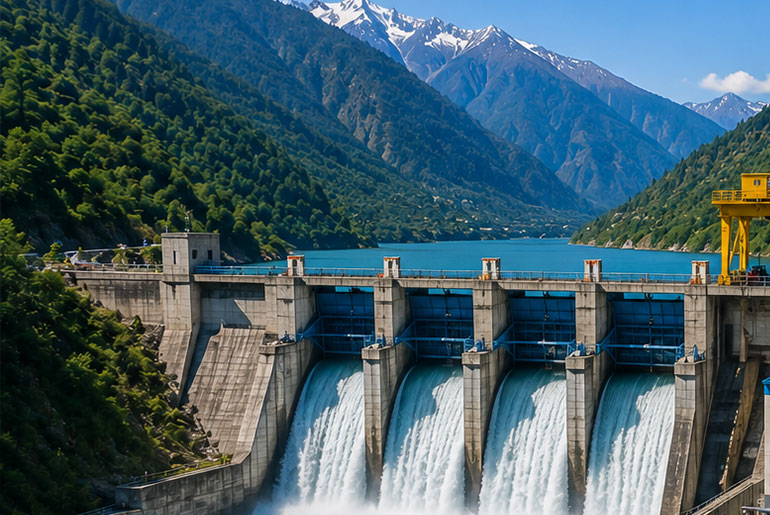
In a significant push to revive the state’s hydropower sector, the Himachal Pradesh government has signed implementation agreements for 19 hydro power projects with a combined capacity of 278 MW. The projects are expected to attract investments worth around ₹3,336 crore and are being seen as a major step towards accelerating clean energy development in the hill state.
The move forms part of the state government’s broader strategy to harness Himachal Pradesh’s vast hydropower potential, boost revenue generation and position the state as a key contributor to India’s clean energy transition.
New Investments to Drive Hydro Expansion
The newly signed agreements cover a mix of small and medium-sized run-of-the-river projects spread across various districts of the state. Among the key projects are Soyal Dashal (9 MW), Khauli-II (6 MW), Gramang (9 MW), Umli (10 MW), Bharmour Stage-I (24 MW), Bharmour Stage-II (21 MW), Harsar Stage-II (22.5 MW), Harsar Stage-III (19 MW), Tundah Stage-II (24 MW), Janglik (18 MW), Rupin Stage-II (15 MW), Dunali-I and II (17 MW), Jari (12 MW), Toral Kundli (18 MW), Tundan (15 MW), Kot Dogri (10 MW), Upper Kurmi (8 MW), Kalal Khol (11 MW), and the 9.6 MW Melan Hydroelectric Project.
Once commissioned, these projects are expected to strengthen the state’s renewable energy portfolio while generating long-term revenue through royalties, water cess and free power provisions available to the state government.
Chief Minister of Himachal Sukhvinder Singh Sukhu has repeatedly stressed the need for timely execution of hydro power projects to ensure that the state’s natural resources are utilised efficiently and contribute meaningfully to economic growth.
Alongside attracting fresh investments, the state government has also cancelled the allotments of 15 hydropower projects that had remained stalled for several years.
Officials said these projects had failed to demonstrate meaningful physical or financial progress despite repeated opportunities provided to developers. By cancelling the delayed allotments, the government intends to release valuable hydro sites and make them available for fresh, time-bound investments.
The decision is expected to send a strong signal to investors that the state is committed to ensuring accountability and timely project implementation.
Himachal Pradesh possesses an estimated hydropower potential of nearly 25,000 MW, making it one of India’s most resource-rich states. However, a considerable share of this potential remains untapped.
The latest initiative comes at a time when hydropower is gaining renewed importance in India’s power sector. With solar and wind capacity expanding rapidly, flexible hydro generation is increasingly being viewed as a critical balancing resource capable of stabilising the grid and supporting renewable energy integration.
By combining fresh investments with policy reforms and stricter project monitoring, Himachal Pradesh is seeking to revive investor confidence and strengthen its position as one of the country’s leading green energy states.
 Electrify your feed! Click here to join our Whatsapp group and to get the latest updates, expert insights, and innovations driving India’s energy storage revolution.