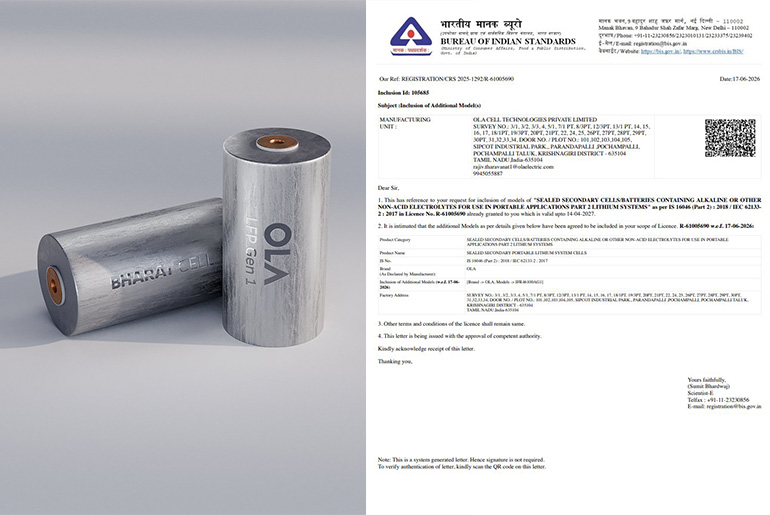
Ola Electric has become the first Indian company to receive Bureau of Indian Standards (BIS) certification for an indigenously developed 46100 Lithium Iron Phosphate (LFP) battery cell, marking a significant milestone for India’s advanced battery manufacturing ecosystem and strengthening the country’s ambitions of building a self-reliant battery supply chain. The certification, along with qualification under IS 16893 and UN 38.3 standards, validates the safety, reliability and performance of the company’s latest cell technology across global and domestic benchmarks.
This development comes as the latest in the company’s efforts to localise battery manufacturing in India, with the Ola Electric’s Bharat Cell platform at the heart of its efforts. Its current 4680 Bharat Cells have already accumulated millions of kilometres of real-world usage on Indian roads across Ola’s electric scooters, providing valuable validation across a range of climatic and operating conditions.
The newly certified 46100 LFP cell represents a significant technological change for the company. The new LFP chemistry is expected to offer better safety, longer cycle life and lower prices, compared to the current Nickel Manganese Cobalt (NMC)-based 4680 Bharat Cell. It measures 46 mm in diameter and 100 mm in height, making it larger than Ola’s current 4680 format, and is designed to enhance manufacturing scale, cost efficiency and versatility across multiple applications.
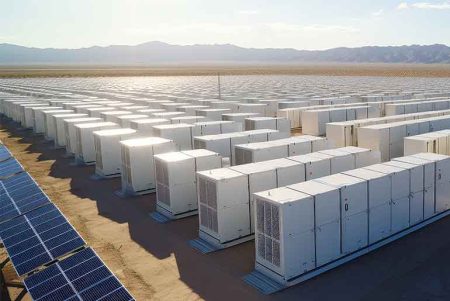
Earlier this year, Ola Electric had announced that it has developed, in-house, the 46100 LFP cell, which was ready and the technology will be used in products once the regulatory approvals are in place. The company said the new chemistry is expected to be key to lowering battery costs and faster adoption of electric vehicles in India. In addition to electric mobility the company is also targeting stationary energy storage applications, pointing to a broader strategy to serve both the transportation and energy storage markets with a common cell architecture.
The certification also underscores the increasing importance of domestic cell manufacturing as India looks to cut its dependence on imported battery components. Ola Electric has been ramping up activities at its Gigafactory and Battery Innovation Centre, which are seen to be supporting the commercial production of next-gen battery technologies. The indigenous cell manufacturing, the company has said, would lead to more localisation, support Production Linked Incentive (PLI) benefits and make India stronger in the global battery value chain.
Industry observers believe the successful BIS certification of an indigenous 46100 LFP cell by OLA could encourage broader adoption of locally manufactured batteries across electric vehicles and energy storage systems. As India ramps up investments in EVs, grid-scale storage and distributed energy solutions, advancements in domestic cell technology are expected to play a critical role in building a resilient and competitive battery ecosystem.
 Electrify your feed! Click here to join our Whatsapp group and to get the latest updates, expert insights, and innovations driving India’s energy storage revolution.