Beyond the quiet hum of an electric scooter weaving through city traffic, beyond the batteries silently storing solar power in the deserts of Rajasthan or the plains of Gujarat, and beyond the smartphone charging beside you at this very moment, a larger story is unfolding across India under the mandatory Battery waste management rules in India.
Every battery has a journey. It starts in a factory, runs a vehicle, a home, a business or a device, and eventually reaches the end of its useful life. This last chapter has often been ignored for decades: batteries are used, discarded and forgotten.
But as India sprints towards electric mobility, renewable energy and advanced manufacturing, that linear approach is not sustainable anymore. These particular rules are not just a regulatory framework, but a complete national roadmap. They make sure that used cells are not sent to landfills, informal scrap yards or unsafe disposal paths, completely transforming how we think of, track and recover energy storage technology throughout the country.
The timing is nothing short of perfect. India’s electric vehicle market is booming with EV penetration tracking around 8.5%. Battery Energy Storage Systems (BESS) are increasingly important in the country’s energy transition, and the spread of consumer electronics continues in both urban and rural India. These sectors combined are driving an unprecedented demand for batteries and consequently an equally significant volume of battery waste.
Waste management is not just environmentally responsible, it is becoming economically necessary. In each discarded battery there are valuable materials such as lithium, nickel, cobalt, copper and manganese. These are not just ordinary materials, but essential minerals that are used in today’s industries. Every battery successfully recycled is an opportunity to recover these resources and cut down on expensive imports.
This upward trend of resource recovery has also increased the importance of Battery Recycling Companies in India. These companies are becoming an important part of the country’s circular economy, helping facilitate the collection, processing and recovery of valuable materials from batteries at the end of their useful lives, while helping companies meet their regulatory obligations.
But how do these rules work in reality? Who collects the waste batteries? What’s the role of the recycler? And what is the future of the battery ecosystem in India with the Battery waste management rules in India? To answer these questions, we first need to understand why battery waste has become one of the most important sustainability challenges of our time.
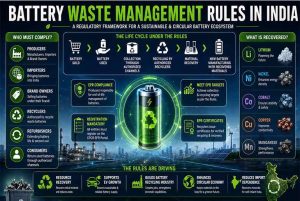
The Old Approach: [ LINEAR LIFECYCLE: THE PAST ]
Step 1: Raw Minerals — Earth’s finite resources are mined and extracted.
Step 2: Cell Manufacturing — Minerals are processed into new cells and battery packs.
Step 3: Product Usage — The battery powers a consumer device, industrial setup, or electric vehicle.
Step 4: Landfill / Informal Dump — At the end of its life, the battery is discarded, leading to environmental contamination and a total loss of critical raw materials.
The Modern Approach: [ CIRCULAR LIFECYCLE: THE PRESENT ]
Step 1: Raw Minerals — Initial manufacturing still relies on mined ores, but dependence decreases over time.
Step 2: Cell Manufacturing — Sustainable design practices are used to assemble new battery tech.
Step 3: Product Usage — Operational lifespan is maximized through efficient energy management.
Step 4: Authorized Collection — Spent batteries are intercepted by formal compliance channels instead of being thrown away.
Step 5: Advanced Material Recovery — Recyclers extract battery-grade metals (Lithium, Cobalt, Nickel) back out of the scrap.
Step 6: Domestic Remanufacturing — The recovered high-purity minerals are fed straight back into the local production loop to create brand-new batteries.
Why Battery Waste Has Become a National Concern
A few years ago, battery waste was not a topic that appeared frequently in public discussions. Today, the situation is very different. Electric vehicles are becoming increasingly common on Indian roads. Homes and businesses are installing solar energy systems with battery storage. Batteries are essential for the dependable operation of data centers, telecom towers, industrial facilities and consumer electronics.
This is good for the energy transition and electrification but also presents a new challenge. Where do these batteries go when they reach the end of their life?
Improperly handled waste batteries can pose significant environmental and safety hazards:
- Contamination: Certain battery chemistries include heavy metals and toxic chemicals that need to be handled with care. If abandoned in open scrap yards they can leach into the soil and ground water.
- Fire Risks: Damaged, swollen or punctured lithium-ion batteries pose serious thermal runaway risks, resulting in unpredictable industrial or landfill fires.
- Resource loss: Landfilling batteries means permanent loss of finite, high-value technical resources which could otherwise be recovered and reused.
This is one of the main reasons why battery waste management rules are becoming important in India. The rules encourage industries to see used batteries not as waste, but as a ‘mined’ source of valuable materials that can be fed back into manufacturing supply chains. The future of battery sustainability will ultimately depend not only on how batteries are made, but how well used batteries are collected, recycled and reintroduced into the economy.
What Are the Battery Waste Management Rules in India?
Battery waste management rules in India were issued by the Ministry of Environment, Forest and Climate Change (MoEFCC) in 2022. They replaced the earlier Batteries (Management and Handling) Rules, 2001 which were largely focused on the traditional lead acid battery technology.
The battery scene in India was very different then when those older rules were introduced. Electric vehicles were rare, grid-scale energy storage was limited, and lithium-ion chemistry had not yet become a core component of modern energy systems. The 2022 framework corresponds to an entirely new industrial reality.
The battery waste management rules in India cover a broad spectrum of battery categories and technologies, not just one type of battery. The rules cover batteries used in consumer electronics, cars, industrial applications and electric vehicles. More importantly, the framework changes the focus from primary disposal to holistic resource recovery. The goal is not just to collect batteries, but to recover valuable elements and put them back to productive use.
This philosophy sits at the heart of India’s emerging circular economy strategy. Under this framework, batteries are no longer viewed as the end of a product’s lifecycle. They are viewed as the beginning of a new resource cycle.
Why India Replaced the 2001 Battery Rules
To understand the significance of the current framework, it helps to look at what changed. The 2001 rules were effective in addressing many challenges associated with conventional lead-acid battery waste, but they were not designed for the complexities of today’s battery ecosystem.
The rise of lithium-ion batteries transformed the industry. Electric vehicles, portable electronics, and energy storage systems introduced new battery chemistries, new supply chains, and new recycling requirements. At the same time, India began focusing more aggressively on domestic manufacturing, critical mineral security, and localized circular economy principles. The older framework simply could not address these emerging realities. The updated rules were therefore introduced to create a more comprehensive, technology-neutral, and future-ready system capable of supporting the country’s evolving battery landscape.
Which Batteries Are Covered Under the Rules?
One of the important aspects of the Battery waste management rules in India is their huge scope. The rules apply to four main categories of batteries:
- Portable Batteries: Batteries used in smart phones, laptops, tablets, cameras, power banks and other everyday portable electronic devices.
- Automotive Batteries: These are batteries made for starting, lighting and ignition (SLI) applications in conventional internal combustion engine vehicles.
- Electric Vehicle Batteries: Batteries used in electric two-wheelers, three-wheelers, passenger vehicles, commercial fleets and electric buses.
- Industrial Batteries: Batteries for telecom infrastructure, data centers, UPS systems, renewable energy projects and large scale energy storage installations (BESS).
The rules cover almost all categories of batteries in terms of chemistry, shape, volume and material composition creating a common framework that can support the growing battery ecosystem in India.
Understanding Extended Producer Responsibility (EPR)
If there is one concept that defines the entire framework, it is Extended Producer Responsibility, commonly known as EPR. At first glance, the idea sounds simple: if a company places batteries in the market, that company must also take responsibility for those batteries when they become waste.
But the operational implications are significant. Traditionally, manufacturers focused on producing and selling products. Once a product reached the customer, responsibility largely ended there. The Battery waste management rules in India change that equation completely.
- PRODUCER: Places the battery pack onto the Indian market.
- CONSUMER: Uses the product to the end of its mechanical life.
- COLLECTION: Channelized through authorized collection points.
- RECYCLER: Extracts high-purity battery materials from the waste.
- CREDITS: Generates verified EPR certificates on the CPCB portal.
- SETTLEMENT: Producer purchases credits to offset their annual legal targets.
Under the EPR framework, producers maintain responsibility for batteries throughout their whole lifecycle, encompassing collection, recycling, and end-of-life management. This means that the responsibility does not stop at the point of sale. But it also goes beyond that, to what happens after a battery is thrown away years later.
The framework covers a wide range of entities including domestic manufacturers, importers and brand owners bringing in batteries into the Indian market. Under EPR, battery waste management rules in India encourage companies to actively participate in the development of collection systems, contribute to the recycling infrastructure and ensure appropriate treatment of battery waste. This also opens up new opportunities for Battery Recycling Companies in India who are key in helping manufacturers meet their compliance requirements. As battery volumes continue to increase across the country, EPR is expected to remain one of the most important drivers of investment in battery collection and recycling infrastructure.
How the CPCB EPR Portal Works
A framework of this scale requires transparency, accountability, and real-time traceability. For this, Central Pollution Control Board (CPCB) has a dedicated digital platform for compliance of battery waste. The portal is the digital backbone of the Battery waste management rules in India.
The system requires registration of producers, recyclers and refurbishers and the submission of relevant information on sales of batteries, collection weights, recycling volumes and material recovery activities. The portal will also be connected with the national GST networks and Customs data (ICEGATE) to ensure complete honesty in data, automatically cross-checking the volume of batteries imported or sold against the compliance targets declared by the company.
Think of the portal as a digital ledger for the battery ecosystem. It enables the tracking of the delivery of obligations and the movement of waste batteries through approved channels by regulators.
Management of EPR certificates is an important function of the platform. The system generates verified EPR certificates for authorised Battery Recycling Companies in India which recycle waste batteries and recover materials based on the exact weight of recovered metals. Producers can buy these certificates to prove they are fulfilling their annual EPR obligations. This mechanism creates a direct financial link between recycling activity and regulatory compliance.
Responsibility of Producers, Recyclers and Consumers
A regulation is only as good as the people and organisations charged with enforcement. That is why the Battery waste management rules in India clearly define the responsibilities of various stakeholders in the battery value chain.
- For Producers: The responsibility starts long before the battery is waste. – Manufacturers, importers and brand owners are required to establish physical take-back systems or enter into Memorandums of Understanding (MoUs) with recyclers to ensure proper channelisation of batteries. They need to achieve their targets and submit their Annual Return (Form 3) through the portal.
- For Recyclers: Batteries in the formal recycling chain can only be safely processed and valuable materials recovered without harm to the environment by licensed recyclers. They also have to file a Form 4 each quarter reporting their activity.
- For Consumers: Consumers, including households, disposing of a used laptop battery, or fleet operators disposing of end-of-life EV batteries, are required to bring spent units back to authorised collection channels instead of dumping them on informal scrap routes.
The Increasing Importance of Battery Recycling Companies in India
Recyclers are the engine that keeps the system moving, if producers are the starting point of compliance. The role of Battery Recycling Companies in India is growing rapidly with the increasing use of batteries in various sectors. These companies do far more than provide basic waste management. They help with recovery of valuable materials, EPR compliance, reduction of environmental risks, and strengthening of India’s domestic supply chains for critical minerals.
Now consider what happens when a Li-ion battery reaches the end of its useful life. Without recycling, valuable materials like lithium, cobalt, nickel, copper and manganese are trapped inside the battery or lost forever through improper disposal. However, these materials can be recovered at high purity and re-used in manufacturing with proper recycling.
“This is where you can see the connection between regulation and industry.” The Battery waste management rules in India create the mandatory regulatory demand. The Battery Recycling Companies in India provide the technical, industrial capability needed to make that framework work. As recycling capacity grows, the companies are likely to become an increasingly important part of India’s battery manufacturing ecosystem.
From Collection to Recovery: How Recycling Supports Compliance
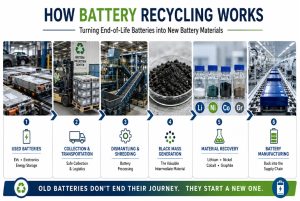
When most people think about recycling, they imagine waste simply being collected and sorted. But recycling a battery is much more complicated. Following collection, batteries are subjected to a series of specialised processes such as deep discharging, automated disassembly, shredding and advanced separation of materials.
The industry is heading towards high yield resource recovery and away from basic waste management. In order to make this shift explicit, the Battery waste management rules in India have prescribed stringent and escalating material recovery targets that recyclers need to meet:
- FY 2024-25: 70% Minimum Recovery on Dry Weight
- FY 2025-26: 80% Minimum Recovery (dry weight)
- FY 26-27. Onwards: 90% Minimum Recovery by Dry Weight
Note: For the automotive and industrial lead acid batteries, the rules set a fixed target of 60% material recovery by FY 2026–27.
Many of the materials recovered from batteries can be reused directly in new cells. As a result, recycling is becoming an important part of national resource security. The rules are designed to accelerate this transition. By linking EPR obligations directly with actual material recovery weights, the framework creates a massive market incentive for higher recovery rates. This is also where specialized sectors like the
lithium battery recycling process and black mass recovery companies become vital. Black mass—the highly valuable powder-like material recovered after shredding batteries—contains the concentrated blend of lithium, cobalt, and nickel. Refinement of this black mass allows India to harvest battery-grade minerals locally.
Environmental Compensation and Penalties for Non-Compliance
Every regulatory framework requires accountability. The Battery waste management rules in India have strong provisions for Environmental Compensation (EC) and enforcement mechanisms to ensure compliance. Strict financial penalties are triggered in case of non-compliance by producers with their collection obligations, failure to meet mandatory labelling requirements (physical barcodes or QR codes), or failure of stakeholders to use the authorized platform. The regime of carry-forward of Environmental Compensation operates in a systematic manner:
- Three year period: The financial penalty and non-fulfilment of EPR obligations can be carried forward for a period of maximum three years.
- Partial Refunds: If a producer misses their targets late, they can get a partial refund of the compensation they have paid: 75% if they are caught up within a year, 60% within two years and 40% within three years.
- Forfeiture: Any compensation remaining after three years is permanently forfeited to the state. These provisions are not meant to merely impose penalties. Rather they are designed to promote full participation in the formal recycling ecosystem and to ensure that battery waste is managed responsibly. The message from the regulators is clear: battery waste management is no longer a choice. This is a core legal business obligation.
Challenges in Implementing Framework
The framework is ambitious, but there are real challenges to implementation on the ground:
- Collection Logistics: India is a large country with millions of decentralized batteries reaching end-of-life each year. But the design of efficient reverse logistics networks in urban and rural districts is still a complex challenge.
- Public Awareness: Consumers are unaware of the proper disposal practices of batteries. Used electronics and spent batteries often enter informal waste streams rather than authorized collection points.
- Technical Evolution: Recycling infrastructure investments are on the rise, but more advanced automated sorting and zero-liquid-discharge (ZLD) refining facilities are still in the development stage relative to more developed global markets.
- Traceability Gaps: Illegal, informal recycling processing makes it difficult to track small portable cells through their multi-year lifecycle, which requires strong digital enforcement and clear reporting to stop.
Many of these challenges are addressed through the Battery waste management rules in India, with automated digital compliance mechanisms and stringent EPR mandates. However, long-term success will require sustained industry participation and public awareness.
How the Rules Are Reshaping India’s Battery Industry
Every major industry transformation begins with a strong policy framework. In many ways, the Battery waste management rules in India are doing for battery recycling what earlier national policies did for solar energy and electric mobility.
The rules are creating consistent commercial demand for collection infrastructure. They are encouraging significant venture capital and industrial investment into advanced recycling technologies. They are supporting the creation of domestic material recovery facilities, and they are helping establish a premium, formalized market for recycled battery materials.
This shift is already creating massive opportunities across the energy storage ecosystem. Battery Recycling Companies in India are rapidly expanding their factory capacities. Clean-tech startups are creating new hydrometallurgical processing methods with low emissions. Specialists in critical minerals are looking at local lithium and nickel extraction, and institutional investors see recycling as a strategic and profitable part of India’s green transition.
Meanwhile, with the increasing adoption of electric vehicles, the budding EV battery recycling market in India is attracting global attention. The result is a fast moving industry that sits in the sweet spot between sustainability and manufacturing and national resource security.
The Road Ahead: Creating a Circular Battery Economy
Imagine a future where every battery sold in India contributes back to the economy as a predictable stream of valuable materials. A future in which lithium, nickel, cobalt and copper are recovered at maximum efficiency and reused directly in domestic gigafactories. A future where battery waste is not an environmental hazard but an opportunity for strategic resources.
And that’s the long-term vision for the Battery waste management rules in India. The framework is not only about waste management. It is about a circular battery economy. It’s about cutting reliance on imported stuff, building up manufacturing at home and ensuring India’s clean energy transition is truly sustainable end to end.
FY 2027-28 onwards: All new batteries to contain a minimum percentage of domestically recovered, recycled minerals, by cell manufacturers in India.
That will take time.
Collection systems need to be improved, recycling capacity increased, and consumers more aware of their shared responsibilities. But the direction is clear: India is moving away from a linear model of “manufacture, use, and discard” towards a circular model of “manufacture, use, recover, and reuse.”
Conclusion
The story of India’s battery sector does not end when a cell stops working. In many ways, that is precisely where the next chapter begins. The Battery waste management rules in India have created a framework that recognises the value hidden inside end-of-life batteries and seeks to bring those resources back into the economy through collection, recycling and recovery.
The rules are setting the stage for a sustainable battery ecosystem by bringing in Extended Producer Responsibility, bolstering digital compliance mechanisms through the CPCB portal and promoting high-yield material recovery. Battery Recycling Companies in India will play an increasingly important role in supporting compliance, recovering critical minerals, and advancing circular economy goals as battery adoption accelerates across electric vehicles, renewable energy, and consumer electronics.
The challenge ahead is big but so is the opportunity. Because in the age of electrification, the future of batteries will depend not only on how they are made, but also on how well they are brought back to life.
 Electrify your feed! Click here to join our Whatsapp group and to get the latest updates, expert insights, and innovations driving India’s energy storage revolution.